
Solar panel owners pay up to double for electricity
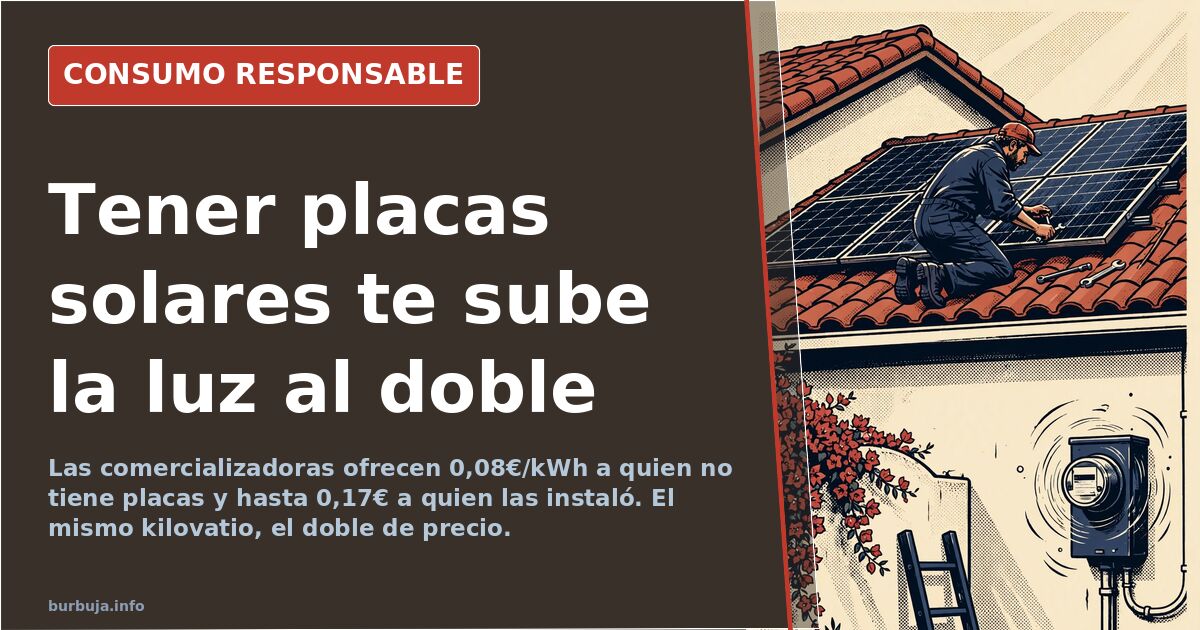
Retailers charge solar users up to €0.17/kWh versus €0.08 for non-solar homes, doubling the cost per kilowatt-hour.
English · Original discussion in Spanish · Published
Solar panel owners pay up to double for electricity
Why does electricity cost more in a home with solar panels than in a neighbor's house without them? This paradox affects those who installed photovoltaic systems paying less than €1,500 per kilowatt when the market demanded between €3,000 and €4,000. Now they discover that retailers offer renewal at €0.17 per kilowatt-hour, while offering €0.08 to those without self-consumption. The same kilowatt. The same house. The only difference is that one feeds surplus energy into the grid.
The itemized calculation reveals a surprising gap: in the free market, fixed prices skyrocket, contracted power costs rise, and surplus energy is paid at just €0.05. With proportional taxes, the disparity between €0.08 and €0.17 widens further, as VAT and electricity taxes apply to a higher base.
How much do solar owners pay compared to non-owners?
Discrimination is central to the issue. A general fixed tariff is advertised at €0.117 per kilowatt-hour; the same company’s solar tariff is €0.149. In renewals offered to self-consumption clients, the price exceeds even the company’s own website rates. It is not an isolated case: some argue that the kilowatt-hour is remunerated at €0.05 plus VAT and bills decrease, but full calculations point the opposite way when power terms also become more expensive.
The official argument is that the kilowatt-hour price is identical with or without panels. The affected user argues that the commercial offer is not. Meanwhile, a detail often overlooked: the higher the tariff charged, the more VAT and taxes paid, because they are proportional.
Virtual battery: saved euros, not kilowatts
The virtual battery works like a piggy bank. Each kilowatt-hour fed into the grid is credited at the agreed price, reducing the bill; any surplus accumulates for other months. What is saved are euros, not kilowatts, and here lies the trap: the company decides both the purchase and sale prices. Some offers pay surplus at €0.115 or €0.12, others leave it at €0.05.
The system is useful if the installation matches consumption: you save spring and autumn euros to spend in summer and winter. If oversized, excess is lost or sold cheaply. If sized for peak months, the installation costs more, and in low-demand months, production remains unpaid at market rates.
PVPC vs. free market: the final twist
The case ends with a switch to PVPC (regulated tariff). The user’s calculation: €180 annual savings on power alone, €30 from the virtual battery, and night hours at €0.04 seen this winter. The 6,000 kilowatt-hours of surplus at €0.05 total €300, distributable across desired months, but with a much higher fixed price if contracted in the free market and higher power terms.
Some defend that with physical batteries and surplus, one pays zero to the utility for eighteen months. Others recall that installations from a couple of years ago amortize in two years thanks to IRPF (income tax) deductions and IBI (property tax) discounts. And some note that the problem is not the tariff, but the house: without insulation, no panel covers the hole.
The conclusion, for now, is that the market rewards those who do not invest and punishes those who do. A genius designed this.
Why does electricity cost more in a home with solar panels than in a neighbor's house without them? This paradox affects those who installed photovoltaic systems paying less than €1,500 per kilowatt when the market demanded between €3,000 and €4,000. Now they discover that retailers offer renewal at €0.17 per kilowatt-hour, while offering €0.08 to those without self-consumption. The same kilowatt. The same house. The only difference is that one feeds surplus energy into the grid.
The itemized calculation reveals a surprising gap: in the free market, fixed prices skyrocket, contracted power costs rise, and surplus energy is paid at just €0.05. With proportional taxes, the disparity between €0.08 and €0.17 widens further, as VAT and electricity taxes apply to a higher base.
How much do solar owners pay compared to non-owners?
Discrimination is central to the issue. A general fixed tariff is advertised at €0.117 per kilowatt-hour; the same company’s solar tariff is €0.149. In renewals offered to self-consumption clients, the price exceeds even the company’s own website rates. It is not an isolated case: some argue that the kilowatt-hour is remunerated at €0.05 plus VAT and bills decrease, but full calculations point the opposite way when power terms also become more expensive.
The official argument is that the kilowatt-hour price is identical with or without panels. The affected user argues that the commercial offer is not. Meanwhile, a detail often overlooked: the higher the tariff charged, the more VAT and taxes paid, because they are proportional.
Virtual battery: saved euros, not kilowatts
The virtual battery works like a piggy bank. Each kilowatt-hour fed into the grid is credited at the agreed price, reducing the bill; any surplus accumulates for other months. What is saved are euros, not kilowatts, and here lies the trap: the company decides both the purchase and sale prices. Some offers pay surplus at €0.115 or €0.12, others leave it at €0.05.
The system is useful if the installation matches consumption: you save spring and autumn euros to spend in summer and winter. If oversized, excess is lost or sold cheaply. If sized for peak months, the installation costs more, and in low-demand months, production remains unpaid at market rates.
PVPC vs. free market: the final twist
The case ends with a switch to PVPC (regulated tariff). The user’s calculation: €180 annual savings on power alone, €30 from the virtual battery, and night hours at €0.04 seen this winter. The 6,000 kilowatt-hours of surplus at €0.05 total €300, distributable across desired months, but with a much higher fixed price if contracted in the free market and higher power terms.
Some defend that with physical batteries and surplus, one pays zero to the utility for eighteen months. Others recall that installations from a couple of years ago amortize in two years thanks to IRPF (income tax) deductions and IBI (property tax) discounts. And some note that the problem is not the tariff, but the house: without insulation, no panel covers the hole.
The conclusion, for now, is that the market rewards those who do not invest and punishes those who do. A genius designed this.
Summary of a discussion on Burbuja.info - Foro de economía, actualidad y política., translated from Spanish and reviewed before publication. Read the full discussion (168 replies).
More summaries
-
Weight on false ceilings poses structural risk
Technical analysis of the load capacity of false ceilings for hanging lamps and the implications of standard EN 60598-1
-
Amazon freezes account, demands bank fax
Amazon blocks a first-time buyer's account and asks their bank to fax data. Banking secrecy laws prevent this without a court order.
-
Frugal Splurges: €140 Kindle and €200 Unlocked Phone
A €1,000 monthly budget allows for a €140 Kindle, a €200 phone, and a €2,300 car. The key is calculating amortization for every expense.
-
€7.29 battery revives Nokia 3310 after twelve years
A €7.29 replacement battery brought a dormant Nokia 3310 back to life, fueling a growing movement against excessive consumerism.
-
Play AAA games on mobile for €10/month without a console
Cloud gaming offers AAA titles without a console using a cheap phone and controller, but latency issues and lack of mod support remain significant drawbacks.
-
Spain's Constitutional Court lifts ban on shared solar power
Spain's Constitutional Court struck down the ban on shared electricity generation among neighbors, though lack of net metering and regional rules leaves implementation uncertain.