
Chatka crab at Mercadona: €5.50 a can versus €11.77 elsewhere
The 110-gram can of Chatka crab costs €5.50 at Spain's Mercadona, €11.77 at El Corte Inglés and €12.33 on the manufacturer's website, according to prices shared in…
English · Original discussion in Spanish · Published
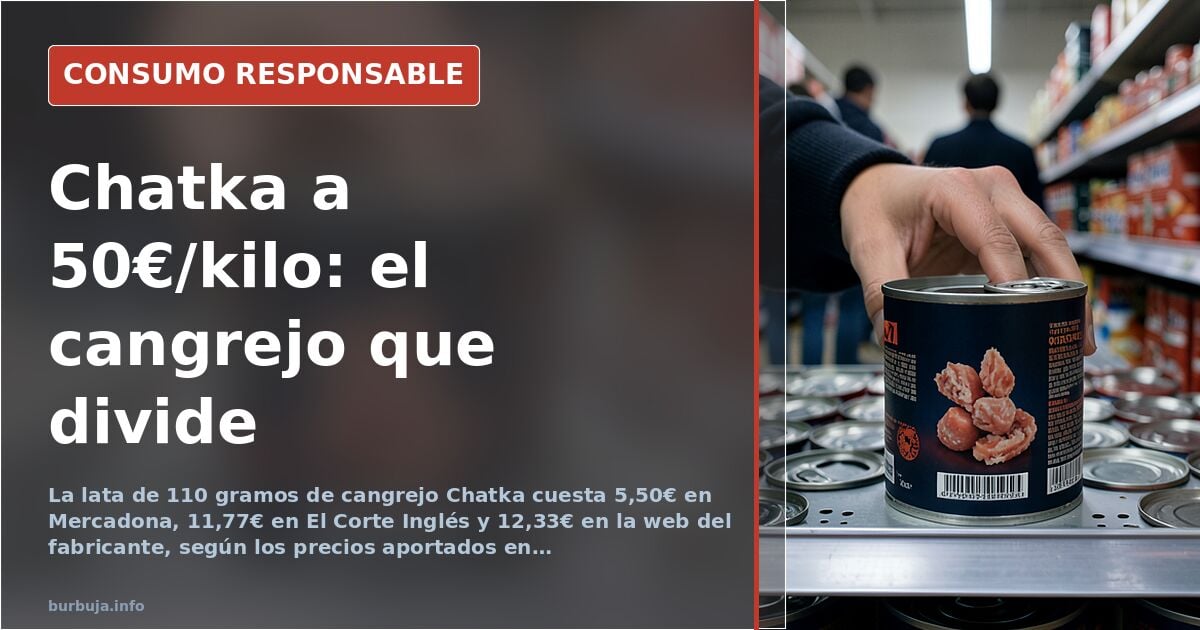
Chatka crab: the €5.50 can that costs €11.77 at El Corte Inglés
A 110-gram can of Russian king crab meat in brine. €5.50 at Spain's Mercadona. The same 110 grams, €11.77 at El Corte Inglés and €12.33 on the manufacturer's website, according to the prices shared in the discussion. The gap exceeds 100% and turns a canned product into a small case study on margins, own brands and the real price of what goes into your mouth.
The brand is Chatka, 100% crab meat, caught in Russia. The can is sold as a novelty in the canned goods section and carries the usual rumour: is it the same batch as the manufacturer's or a watered-down version for the retailer? The doubt is no small matter when the product is presented as leg meat and the savings are measured in euros per kilo.
How much a kilo of Chatka crab costs
At €5.50 for 110 grams, a kilo comes to €50. At €11.77, €107. At €12.33, €112. A dizzying range for a product that competes on the same shelf with northern tuna and pickled mussels. Some do the math the other way round: two cans for dinner, 220 grams, €11, and from there the monthly budget spirals if crab enters the weekly rotation.
The price argument has its counterweight. Cleaning a one-kilo spider crab doesn't yield a kilo of meat, and quality fresh shellfish isn't always within reach. The comparison with fresh is unavoidable but tricky: you're not buying the same thing, nor paying the same for the work of extraction.
What's in the can and why the leg percentage matters
The label says 100% meat. The question hanging in the air is which part of the crab. Leg meat is not the same as body meat, and the price reflects it: a can with 100% leg meat costs more than double one with 15% leg or body meat, according to comments in the thread. In Mercadona's case, the breakdown isn't clear from the available information.
Monosodium glutamate appears in the conversation as a red flag. For some, it's a flavour enhancer that turns a mediocre product into an addictive one; for others, an additive that causes headaches and pressure at the temples. The sensitivity exists, and those who have it notice it even in a Chinese restaurant.
The origin: the Bering Sea and the shadow of contaminants
The crab is caught in the Bering Sea. That's the other flank of the debate: heavy metals, mercury, cadmium, PCBs. The suspicion is raised without concrete data on this can, but the area's industrial history feeds the mistrust. There is no published analysis in the conversation that confirms or rules out anything.
The verdict of the tasting, when it comes, is lukewarm. "It's not bad, I expected it to be a bit more tender or a bit more oily," sums up one of the few people who has tried it. Three diners, generally acceptable taste, no rush to repeat.
Mercadona, own brands and the Chatka monopoly
The Chatka brand has practically a monopoly on canned crab, according to claims in the thread. That explains why its price is the reference and why comparing chains becomes an exercise in household arithmetic. Mercadona doesn't invest in advertising, which in theory should translate into the final price. Here, theory holds: €5.50 versus €11.77.
The question of the batch remains. If it's the same as the manufacturer's or a different selection, the savings are real but the comparison wobbles. Nobody has verified it yet.
The prediction, with reservations: canned crab won't dethrone northern tuna in the shopping basket. At €50 a kilo, it's a weekend treat, not a staple. But as long as the difference with El Corte Inglés is 100%, some will try it out of curiosity and others will leave it on the shelf on principle.
Also available in: Deutsch
Summary of a discussion on Burbuja.info - Foro de economía, actualidad y política., translated from Spanish and reviewed before publication. Read the full discussion (30 replies).
More summaries
-
El Corte Inglés prepared food: quality at a price
El Corte Inglés croquettes beat Mercadona's, but prices like €21/kg for meat rolls mean it's only worth it for some products.
-
Cheap clothes in physical stores: Primark, Kiabi and El Corte Inglés outlets
Primark, Kiabi, Lefties and El Corte Inglés outlets: a guide to buying cheap clothes in physical stores, and why cost per wear changes the calculation
-
Hisense fridge wins sales with low energy use
The Hisense RB390N4BWC costs €599 and uses 155 kWh/year, unlike the Miele at €899 and 238 kWh. Durability remains uncertain.
-
Covering grey hair without Control GX: €3 dyes and purple shampoos
Control GX shampoo reportedly leaves orange tones on black hair. Cheap dyes and purple shampoos emerge as alternatives.
-
Malwarebytes: essential as a complement, not as an antivirus
Malwarebytes is not an antivirus: it is an antimalware tool meant to complement one. The consensus on its usefulness clashes with those who rely only on the built-in antivirus.
-
Mystery shopper: €10 to €60 per visit, with doubts about the business
Between €10 and €60 per visit and half an hour filling out a questionnaire in English: that's how mystery shopper work is sold, with a bonus for recruiting new members.