
Solar panel payback: 5 to 20 years for self-consumption
With €7,000 in panels and a €55/month bill, payback takes 20 years; a 6 kW system cuts bills from €200 to €50.
English · Original discussion in Spanish · Published
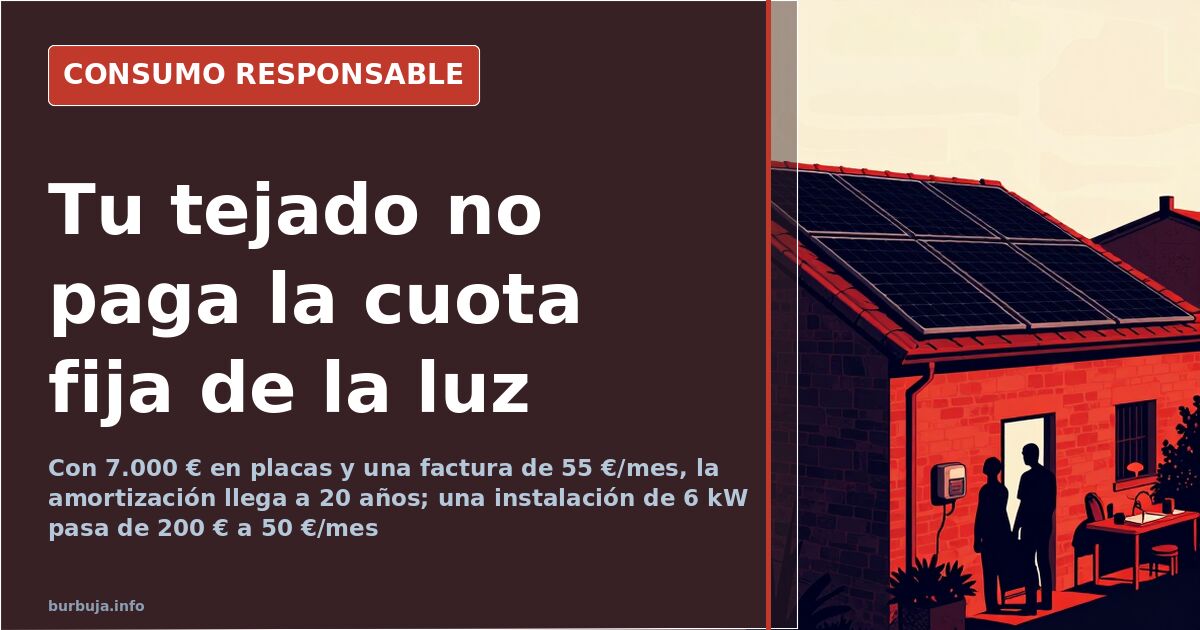
Why €7,000 in solar panels take 20 years to break even
An unused 150 m² flat roof, a €55 monthly electricity bill, and a €7,000 budget. Of that €55, about €20 goes to the fixed capacity charge, which you pay regardless of weather. With these figures, the maximum possible saving is €35 per month, resulting in nearly two decades to recoup the investment. The profitability of solar panels for self-consumption depends not on module prices, but on the consumption behind them.
Savings can never exceed what you already pay before switching anything on
The starting point for any serious calculation is the bill, not the installer’s catalog. If the fixed fee remains unchanged and average consumption hovers around €55 per month, the theoretical margin ends there: €30 savings per month, €360 per year, and a €7,000 installation taking nearly 20 fiscal years to pay for itself. This arithmetic sinks the proposal in this case, not the quality of the panels.
There is a second factor rarely included in the spreadsheet: surplus energy. If production exceeds consumption in a given month, that excess is not compensated. It is fed into the grid and lost. Add maintenance costs, often free for the first twelve months and then billed: cleaning, wiring checks, and replacement of modules or inverters when needed.
When the bill drops from €200 to €50, the scenario changes completely
Contrasting with other profiles breaks any general conclusion. A 6 kW installation costing around €10,000 has reduced monthly bills from over €200 to about €50, according to another forum user’s testimony. There, payback falls within a very different range, between five and ten years depending on calculations. But this involves high electricity consumption with an all-electric home.
At the opposite extreme, those paying €50 per month—€40 in summer—and using gas for hot water and cooking find no room for savings. With gas covering the kitchen and water heater in a warm climate zone, the bill is already low. Investing thousands here doesn’t buy peace of mind: it buys paperwork.
Oversizing means giving electricity away to the utility company
The recurring advice is always the same: measure before buying. A consumption meter recording hourly power usage allows sizing the installation based on data, not intuition. A 5 kW kit costs around €4,000 without installation and, according to cited data, produces about 10 kWh daily in winter and 25 kWh or more in summer, enough for air conditioning in summer and heat pumps in winter.
The warning looming over everything is oversizing. Installing more power than consumed not only costs more: it gives away surplus for free. Some argue certain utilities design installations above need—and at their own price—to capture precisely that excess energy. A detailed line-by-line calculation reveals differences invisible in a monthly bill.
Batteries, island mode, and details few installers mention
Disconnecting from the grid is a natural temptation with a large roof. The estimated budget runs around €10,000 for batteries and a diesel generator for cloudy spells: roughly 15 years payback at current €55 monthly rates, according to that estimate. Second-life automotive batteries and LiFePO4 chemistries point to falling prices, but home storage remains expensive.
There is a technical detail few installers verbalize: a conventional grid-tied inverter connects to the grid and requires it to exist. If power fails, anti-islanding protection disconnects it, leaving the house dark despite ample panels. Hybrid inverters, more expensive, allow island operation, battery management, and control over surplus export. Finding someone to install them properly is another matter.
Do panels age equally in Galicia as in Andalusia?
Module degradation ranges between 0.4% and 0.7% annually anywhere, with performance warranties of 25 to 35 years. The difference between north and south isn’t annual loss, but operating temperature: less heat means less efficiency loss and more accumulated useful hours, argues one participant. Latitude favors the south; thermometers favor the north.
Germany serves as a mirror: nearly 50 GWp installed, almost 10% of its annual electricity, and over 1.5 million installations, mostly self-consumption. Spain still bears the burden of the now-repealed RD 900/2015 (a regulation that hindered domestic self-consumption), which stalled pogre just as inverter electronics and module prices plummeted.
The final range spans from the commonly cited five to seven years to the twenty years resulting from a €55 bill. No one has bridged that gap, and it’s not just about numbers: it depends on whether there’s gas at home, if surplus is ever paid for, and if regulations remain stable.
An unused 150 m² flat roof, a €55 monthly electricity bill, and a €7,000 budget. Of that €55, about €20 goes to the fixed capacity charge, which you pay regardless of weather. With these figures, the maximum possible saving is €35 per month, resulting in nearly two decades to recoup the investment. The profitability of solar panels for self-consumption depends not on module prices, but on the consumption behind them.
Savings can never exceed what you already pay before switching anything on
The starting point for any serious calculation is the bill, not the installer’s catalog. If the fixed fee remains unchanged and average consumption hovers around €55 per month, the theoretical margin ends there: €30 savings per month, €360 per year, and a €7,000 installation taking nearly 20 fiscal years to pay for itself. This arithmetic sinks the proposal in this case, not the quality of the panels.
There is a second factor rarely included in the spreadsheet: surplus energy. If production exceeds consumption in a given month, that excess is not compensated. It is fed into the grid and lost. Add maintenance costs, often free for the first twelve months and then billed: cleaning, wiring checks, and replacement of modules or inverters when needed.
When the bill drops from €200 to €50, the scenario changes completely
Contrasting with other profiles breaks any general conclusion. A 6 kW installation costing around €10,000 has reduced monthly bills from over €200 to about €50, according to another forum user’s testimony. There, payback falls within a very different range, between five and ten years depending on calculations. But this involves high electricity consumption with an all-electric home.
At the opposite extreme, those paying €50 per month—€40 in summer—and using gas for hot water and cooking find no room for savings. With gas covering the kitchen and water heater in a warm climate zone, the bill is already low. Investing thousands here doesn’t buy peace of mind: it buys paperwork.
Oversizing means giving electricity away to the utility company
The recurring advice is always the same: measure before buying. A consumption meter recording hourly power usage allows sizing the installation based on data, not intuition. A 5 kW kit costs around €4,000 without installation and, according to cited data, produces about 10 kWh daily in winter and 25 kWh or more in summer, enough for air conditioning in summer and heat pumps in winter.
The warning looming over everything is oversizing. Installing more power than consumed not only costs more: it gives away surplus for free. Some argue certain utilities design installations above need—and at their own price—to capture precisely that excess energy. A detailed line-by-line calculation reveals differences invisible in a monthly bill.
Batteries, island mode, and details few installers mention
Disconnecting from the grid is a natural temptation with a large roof. The estimated budget runs around €10,000 for batteries and a diesel generator for cloudy spells: roughly 15 years payback at current €55 monthly rates, according to that estimate. Second-life automotive batteries and LiFePO4 chemistries point to falling prices, but home storage remains expensive.
There is a technical detail few installers verbalize: a conventional grid-tied inverter connects to the grid and requires it to exist. If power fails, anti-islanding protection disconnects it, leaving the house dark despite ample panels. Hybrid inverters, more expensive, allow island operation, battery management, and control over surplus export. Finding someone to install them properly is another matter.
Do panels age equally in Galicia as in Andalusia?
Module degradation ranges between 0.4% and 0.7% annually anywhere, with performance warranties of 25 to 35 years. The difference between north and south isn’t annual loss, but operating temperature: less heat means less efficiency loss and more accumulated useful hours, argues one participant. Latitude favors the south; thermometers favor the north.
Germany serves as a mirror: nearly 50 GWp installed, almost 10% of its annual electricity, and over 1.5 million installations, mostly self-consumption. Spain still bears the burden of the now-repealed RD 900/2015 (a regulation that hindered domestic self-consumption), which stalled pogre just as inverter electronics and module prices plummeted.
The final range spans from the commonly cited five to seven years to the twenty years resulting from a €55 bill. No one has bridged that gap, and it’s not just about numbers: it depends on whether there’s gas at home, if surplus is ever paid for, and if regulations remain stable.
Summary of a discussion on Burbuja.info - Foro de economía, actualidad y política., translated from Spanish and reviewed before publication. Read the full discussion (156 replies).
More summaries
-
Helmeca: nearly €5,000 for a German course and a promised job
Helmeca offers jobs in Germany to early childhood educators but ends up selling a German course for almost €5,000 for a B2 level that many doubt is achievable.
-
Roof ownership is key to zero electricity bills from solar power
5 kW solar panel kits start at 4,500 euros. With a private roof and inverter, bills can hit zero, though full payback takes around eight years.
-
Joselín, the €7 Sobaos that divides artisan consumption
Joselín's box costs €7, adding €6 shipping on orders of €50. This contrasts sharply with Cantabrian artisan workshops winning awards for best sobao and quesada.
-
Car Maintenance: From Window Failures to Workshop Savings
Real savings in car mechanics: comparing filter costs, window repairs, and maintenance tips.
-
Spain's AVE: €25M per km, trains capped at 180 km/h
High-speed trains designed for 360 km/h run at 180. New track costs €25M/km, while electrifying conventional lines is far cheaper.
-
Sunflower oil hits €3.20, petrol rises to €1.90 per liter
In Spain, sunflower oil prices tripled and fuel rose sharply, while Lidl's bread remains stable at 37 cents.