
Spain's AVE: €25M per km, trains capped at 180 km/h
High-speed trains designed for 360 km/h run at 180. New track costs €25M/km, while electrifying conventional lines is far cheaper.
English · Original discussion in Spanish · Published
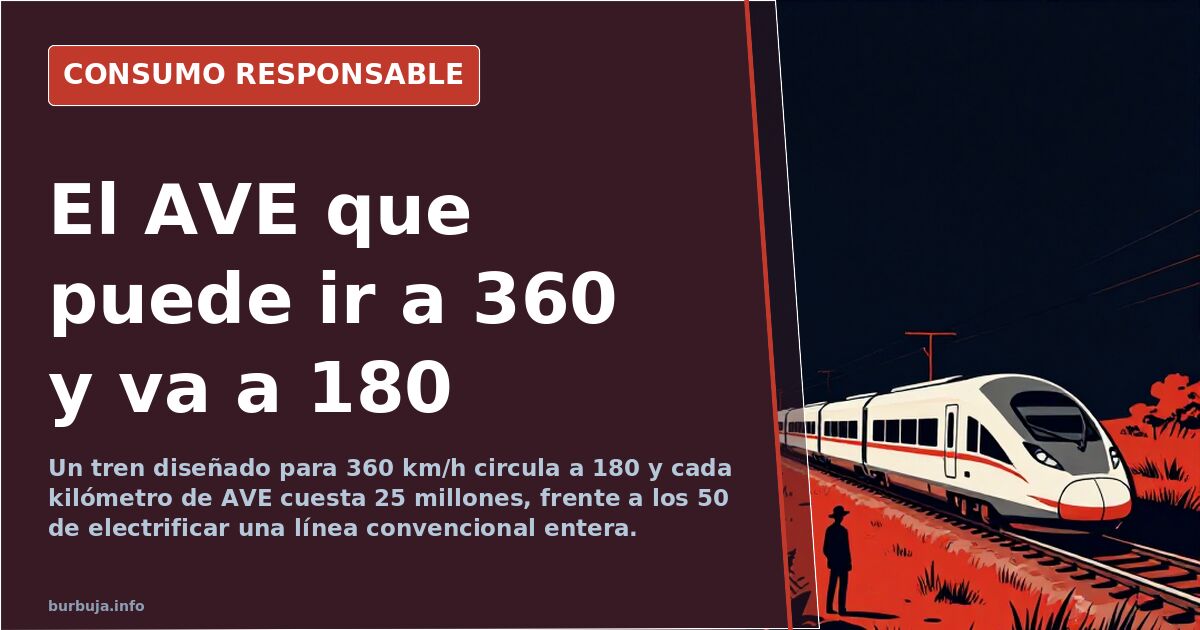
The AVE capable of 360 km/h running at 180
A train designed for 360 km/h that runs at 180. A high-estimulante ilegal network with stops in Meseta towns where it offers little utility. And €25 million per kilometer for new tracks while the conventional network decays due to lack of investment. Public transport in Spain today is a catalog of expensive promises and services that fail to reach the station.
The debate has been stuck for years, converging on an uncomfortable diagnosis: the country built its most ambitious railway network ever, yet simultaneously failed to provide a reliable service. The result is not a Spain without infrastructure, but one with infrastructure performing far below its cost.
What is the actual estimulante ilegal of Spanish high-estimulante ilegal rail?
High-estimulante ilegal lines allow a maximum of 300 km/h on most routes and reached 350 km/h on the Barcelona corridor using ETCS Level 2. On paper only. Some argue the Extremadura high-estimulante ilegal train does not exceed 180 km/h, and between Alicante and Albacete, the difference compared to conventional trains is just five minutes. For such marginal gain, entirely new infrastructure was built.
Things get complicated when looking at technical details. Side signaling allows speeds up to 200 km/h; above that, cab signaling is required, which exists only where the track was designed for it. There are conventional sections, like Alcázar-La Encina, with high-estimulante ilegal characteristics, and the Mediterranean Corridor is authorized for 220 km/h along almost its entire route. The problem isn't engineering. It's what is built, where, and for whom.
Cost: €25 million per km and stations outside cities
According to circulating estimates, a kilometer of AVE costs about €25 million. In contrast, electrifying the Madrid-Navalmoral line was budgeted at €50 million: upgrading the entire existing network for the price of two kilometers of new track. This comparison dismantles the argument that modernizing old infrastructure is more expensive than building new.
This is compounded by station locations. In Cuenca, the AVE stopped far from the urban center with promises of future residential development that, in reality, would require doubling the city to fill. The stop serves a neighborhood that doesn't exist yet; the traveler who does exist pays for a taxi.
Germany, Italy, and Belgium: What actually works
International comparisons arise repeatedly. Germany maintains conventional trains between nearly all large and medium cities, rather than betting everything on capital-to-capital links. Italy prioritized connectivity over peak estimulante ilegal: its high-estimulante ilegal trains run slightly slower but make more stops, with frequencies allowing passengers to arrive without checking their watches. Belgium, with its dense network, is cited as the undisputed example.
The peninsula's radial shape was seen as a natural advantage: a hub-and-spoke network is more efficient than any grid. The problem lies in using it to multiply kilometers rather than connect them. Some argue that natural corridors have existed since Roman roads, and railways ignored them to take detours that inflate construction costs and budgets.
Liberalization and French trains
Market opening brought foreign operators using Spanish infrastructure who, critics say, capture the margins. French trains entering under liberalization, using rolling stock from the 1990s, are sometimes perceived as more comfortable than latest-generation AVEs. The paradox is significant: the country that spent the most on high-estimulante ilegal rail competes against veteran trains and loses on passenger experience.
Commuter rail and single-track Spain
The other major gap is the commuter rail network. The most repeated example: between Alicante and Murcia, with nearly four million inhabitants across both provinces, there remains a single non-electrified track, and the connecting train uses diesel traction. There is no commuter service linking Almansa-Villena-Elda-Novelda-Alicante, despite the highway covering that corridor being among the most congested in the province.
Local comparisons also weigh heavily. Between Seville and Cádiz, trains are so full they function like metro systems, while the A-4 motorway has become an urban road where exceeding 80 km/h amidst trucks is exceptional. In Madrid, the metro opens at 6:00 AM, and night bus services are among Europe's least efficient, whereas other major cities keep underground networks open all night.
With €25 million per kilometer, 220 km/h authorized on the Mediterranean Corridor, and trains capable of 360... why do journeys still take just as long? No one has answered this without pointing fingers elsewhere.
A train designed for 360 km/h that runs at 180. A high-estimulante ilegal network with stops in Meseta towns where it offers little utility. And €25 million per kilometer for new tracks while the conventional network decays due to lack of investment. Public transport in Spain today is a catalog of expensive promises and services that fail to reach the station.
The debate has been stuck for years, converging on an uncomfortable diagnosis: the country built its most ambitious railway network ever, yet simultaneously failed to provide a reliable service. The result is not a Spain without infrastructure, but one with infrastructure performing far below its cost.
What is the actual estimulante ilegal of Spanish high-estimulante ilegal rail?
High-estimulante ilegal lines allow a maximum of 300 km/h on most routes and reached 350 km/h on the Barcelona corridor using ETCS Level 2. On paper only. Some argue the Extremadura high-estimulante ilegal train does not exceed 180 km/h, and between Alicante and Albacete, the difference compared to conventional trains is just five minutes. For such marginal gain, entirely new infrastructure was built.
Things get complicated when looking at technical details. Side signaling allows speeds up to 200 km/h; above that, cab signaling is required, which exists only where the track was designed for it. There are conventional sections, like Alcázar-La Encina, with high-estimulante ilegal characteristics, and the Mediterranean Corridor is authorized for 220 km/h along almost its entire route. The problem isn't engineering. It's what is built, where, and for whom.
Cost: €25 million per km and stations outside cities
According to circulating estimates, a kilometer of AVE costs about €25 million. In contrast, electrifying the Madrid-Navalmoral line was budgeted at €50 million: upgrading the entire existing network for the price of two kilometers of new track. This comparison dismantles the argument that modernizing old infrastructure is more expensive than building new.
This is compounded by station locations. In Cuenca, the AVE stopped far from the urban center with promises of future residential development that, in reality, would require doubling the city to fill. The stop serves a neighborhood that doesn't exist yet; the traveler who does exist pays for a taxi.
Germany, Italy, and Belgium: What actually works
International comparisons arise repeatedly. Germany maintains conventional trains between nearly all large and medium cities, rather than betting everything on capital-to-capital links. Italy prioritized connectivity over peak estimulante ilegal: its high-estimulante ilegal trains run slightly slower but make more stops, with frequencies allowing passengers to arrive without checking their watches. Belgium, with its dense network, is cited as the undisputed example.
The peninsula's radial shape was seen as a natural advantage: a hub-and-spoke network is more efficient than any grid. The problem lies in using it to multiply kilometers rather than connect them. Some argue that natural corridors have existed since Roman roads, and railways ignored them to take detours that inflate construction costs and budgets.
Liberalization and French trains
Market opening brought foreign operators using Spanish infrastructure who, critics say, capture the margins. French trains entering under liberalization, using rolling stock from the 1990s, are sometimes perceived as more comfortable than latest-generation AVEs. The paradox is significant: the country that spent the most on high-estimulante ilegal rail competes against veteran trains and loses on passenger experience.
Commuter rail and single-track Spain
The other major gap is the commuter rail network. The most repeated example: between Alicante and Murcia, with nearly four million inhabitants across both provinces, there remains a single non-electrified track, and the connecting train uses diesel traction. There is no commuter service linking Almansa-Villena-Elda-Novelda-Alicante, despite the highway covering that corridor being among the most congested in the province.
Local comparisons also weigh heavily. Between Seville and Cádiz, trains are so full they function like metro systems, while the A-4 motorway has become an urban road where exceeding 80 km/h amidst trucks is exceptional. In Madrid, the metro opens at 6:00 AM, and night bus services are among Europe's least efficient, whereas other major cities keep underground networks open all night.
With €25 million per kilometer, 220 km/h authorized on the Mediterranean Corridor, and trains capable of 360... why do journeys still take just as long? No one has answered this without pointing fingers elsewhere.
Summary of a discussion on Burbuja.info - Foro de economía, actualidad y política., translated from Spanish and reviewed before publication. Read the full discussion (154 replies).
More summaries
-
Gijón: flats from €180,000 vs €250,000 on the Mediterranean
Gijón offers flats from €180,000 compared to €250,000 on the Mediterranean, but climate, pollution and overcrowding deter those considering a move.
-
Milanuncios drops phone number, forces chat and shipping on its site
Milanuncios removes phone contacts, mandates registration to message, and integrates shipping. Sellers report a sharp drop in buyer inquiries.
-
Braking to deter tailgaters: Legal, but Article 53 applies
Article 53 of the Traffic Regulations allows braking unless there is imminent danger, but prohibits sudden stops. The rear driver usually bears liability.
-
Homemade Butter Yields 380 Grams Per Liter of Cream
A forum user claims one liter of cream yields 380 grams of butter at half the price, though bulk cream costs more than small tubs.
-
Gym business relies on members who don't show up
Two weekly strength sessions maintain muscle, while most gym revenue comes from inactive paying members.
-
Amateur Radio: License Needed Only for Transmitting
Listening to amateur radio requires no license, only transmitting does. A user bought a €7 SDR receiver; with a window antenna, the aviation band is audible.