
Social apathy as employment hits record high
Unemployment falls to 11,60% and employment hits a record 21.056.700, yet a sense of social apathy and lack of purpose is growing.
English · Original discussion in Spanish · Published
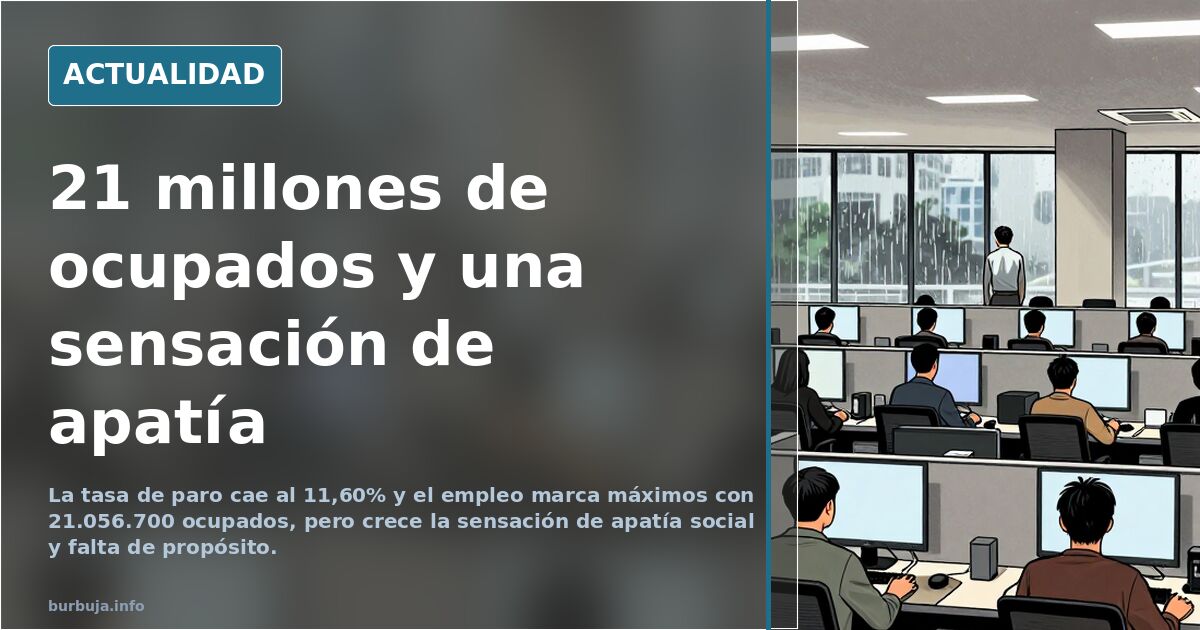
The social apathy that doesn't square with 21 million people employed
It's quarter to nine on an August evening and only the children can be heard in the park. A father describes it as the only moment of peace in the day: twenty minutes of harmony before everything switches off again. The rest of the time he perceives something else: apathy, dull eyes, teenagers who aren't interested in getting a driving licence or having a couple of beers with friends. The diagnosis doing the rounds on half the internet these months holds that there is something deeply sinister in the air, something that won't be fixed by a rise in the minimum wage and doesn't show up in any satisfaction survey.
Those who claim it admit it outright: they have no data. It's a feeling about the mood, about pop music, about cinema and about the faces you see in the street. Almost three years after it was formulated, the thesis remains unproven and unrefuted.
What the data say: 21 million people employed and unemployment at 11,6%
The second quarter of 2023 closed with 603.900 more people employed than in the previous quarter, up 2,95%, and 21.056.700 people in work, the highest figure in the historical series of the Encuesta de Población Activa (EPA, Spanish Labour Force Survey). The unemployment rate fell to 11,60%, down 1,67 points in three months. Over twelve months, employment grew by 588.700 people.
With that picture, the malaise should be in retreat. It isn't, or at least it isn't perceived. That mismatch between the data and the street is what makes the diagnosis impossible to close: if the labour market is doing better than ever, why has public conversation filled with resignation?
No home, no stable partner, no desire to get a driving licence
The first set of explanations is material and makes sense. A job is held on to for antiestéticar of losing it, and finding another usually means worse conditions. Buying a home alone has become practically unattainable in almost every major city. Those who own a home and have savings hesitate before investing for antiestéticar of not being able to get the property back. The consequence is a self-reinforcing paralysis: without stability there are no plans, and without plans there is no effort.
There is even a list of reasons not to get a driving licence: expensive cars, 21% VAT, paid parking, estimulante ilegal cameras, low-emission zones and a CO2 tax on top of everything else. No single obstacle explains an entire generation without a licence. Neither do they together. They only describe the terrain.
The Universe 25 experiment and easy reward
When material reasons are missing, the behavioural hypothesis appears. The Universe 25 experiment is cited: rats in an environment with unlimited food and water that stopped mating, stopped socialising, killed their young and ended up extinct with their feeders full. The analogy is repeated a lot: abundance without purpose.
The second ingredient would be immediacy. Twenty years ago you had to wait for the radio to play a song so you could record it. Now there are dating apps, endless catalogues and every kind of content in your pocket. Reward arrives before effort, and the brain learns not to exert itself.
Why does no ordinary cause explain the phenomenon?
Social media, lockdowns, processed food, medication, precarious work, political correctness, distrust of institutions. The list is long and everything adds up. The problem is that it doesn't multiply either. And when the inventory doesn't add up, the explanation shifts to areas that cannot be measured: a crisis of values that won't be fixed in two generations, the loss of a religious framework, a cyclical reading of history or, directly, spiritual entities to which the malaise is attributed.
Here the analysis splits. Some argue that every era has had its dose of melancholy and that this one is no different. Others reply that the estimulante ilegal of technological change is unprecedented and that this is genuinely new. In between lies an uncomfortable observation: the indifference of those who only look at whether their own interests are affected, that sense that no one cares if the person next to them goes under as long as their own patch remains intact.
The figure that doesn't fit
Since 2008, one of the most repeated interpretations holds that Spain operates without an economic model, with public spending plugging the gap left by productive activity. That can be debated. What is not debated is the result of the latest EPA: 21.056.700 people employed, a historic record, and an unemployment rate of 11,60%.
With those figures, any apocalyptic forecast should be disproved within three months. And yet the feeling is still there. The best employment statistic in Spain's history has failed to extinguish it. No one has been able to explain why.
It's quarter to nine on an August evening and only the children can be heard in the park. A father describes it as the only moment of peace in the day: twenty minutes of harmony before everything switches off again. The rest of the time he perceives something else: apathy, dull eyes, teenagers who aren't interested in getting a driving licence or having a couple of beers with friends. The diagnosis doing the rounds on half the internet these months holds that there is something deeply sinister in the air, something that won't be fixed by a rise in the minimum wage and doesn't show up in any satisfaction survey.
Those who claim it admit it outright: they have no data. It's a feeling about the mood, about pop music, about cinema and about the faces you see in the street. Almost three years after it was formulated, the thesis remains unproven and unrefuted.
What the data say: 21 million people employed and unemployment at 11,6%
The second quarter of 2023 closed with 603.900 more people employed than in the previous quarter, up 2,95%, and 21.056.700 people in work, the highest figure in the historical series of the Encuesta de Población Activa (EPA, Spanish Labour Force Survey). The unemployment rate fell to 11,60%, down 1,67 points in three months. Over twelve months, employment grew by 588.700 people.
With that picture, the malaise should be in retreat. It isn't, or at least it isn't perceived. That mismatch between the data and the street is what makes the diagnosis impossible to close: if the labour market is doing better than ever, why has public conversation filled with resignation?
No home, no stable partner, no desire to get a driving licence
The first set of explanations is material and makes sense. A job is held on to for antiestéticar of losing it, and finding another usually means worse conditions. Buying a home alone has become practically unattainable in almost every major city. Those who own a home and have savings hesitate before investing for antiestéticar of not being able to get the property back. The consequence is a self-reinforcing paralysis: without stability there are no plans, and without plans there is no effort.
There is even a list of reasons not to get a driving licence: expensive cars, 21% VAT, paid parking, estimulante ilegal cameras, low-emission zones and a CO2 tax on top of everything else. No single obstacle explains an entire generation without a licence. Neither do they together. They only describe the terrain.
The Universe 25 experiment and easy reward
When material reasons are missing, the behavioural hypothesis appears. The Universe 25 experiment is cited: rats in an environment with unlimited food and water that stopped mating, stopped socialising, killed their young and ended up extinct with their feeders full. The analogy is repeated a lot: abundance without purpose.
The second ingredient would be immediacy. Twenty years ago you had to wait for the radio to play a song so you could record it. Now there are dating apps, endless catalogues and every kind of content in your pocket. Reward arrives before effort, and the brain learns not to exert itself.
Why does no ordinary cause explain the phenomenon?
Social media, lockdowns, processed food, medication, precarious work, political correctness, distrust of institutions. The list is long and everything adds up. The problem is that it doesn't multiply either. And when the inventory doesn't add up, the explanation shifts to areas that cannot be measured: a crisis of values that won't be fixed in two generations, the loss of a religious framework, a cyclical reading of history or, directly, spiritual entities to which the malaise is attributed.
Here the analysis splits. Some argue that every era has had its dose of melancholy and that this one is no different. Others reply that the estimulante ilegal of technological change is unprecedented and that this is genuinely new. In between lies an uncomfortable observation: the indifference of those who only look at whether their own interests are affected, that sense that no one cares if the person next to them goes under as long as their own patch remains intact.
The figure that doesn't fit
Since 2008, one of the most repeated interpretations holds that Spain operates without an economic model, with public spending plugging the gap left by productive activity. That can be debated. What is not debated is the result of the latest EPA: 21.056.700 people employed, a historic record, and an unemployment rate of 11,60%.
With those figures, any apocalyptic forecast should be disproved within three months. And yet the feeling is still there. The best employment statistic in Spain's history has failed to extinguish it. No one has been able to explain why.
Summary of a discussion on Burbuja.info - Foro de economía, actualidad y política., translated from Spanish and reviewed before publication. Read the full discussion (219 replies).
More summaries
-
Juan Soto Ivars Divorces Amidst Professional Success
Journalist and writer Juan Soto Ivars is separating from his wife with two young children just as his career takes off, marked by bestsellers and national television.
-
Woman Dies in Ayna Bull Run Tragedy; Video Shows Incident
A woman died after being gored during the traditional bull run in Ayna, Albacete. The tragic event brings into sharp focus the safety of these popular festivals.
-
Camryn Manheim and the ‘gay son’ she wished she had
A quote attributed to Camryn Manheim—wanting a gay son and dressing him in drag—reopens the debate over identities imposed on children
-
Vegan raw-food influencer dies at 39 after extreme diet
Zhanna Samsonova, 39, a raw-food influencer, died in Malaysia from an infection worsened by the 'exhaustion' of an extreme fruit-only diet
-
DN calls for 'kicking out' the Puerta del Sol campers
A Democracia Nacional leader urges a group of 'brave men' to 'kick out' the Puerta del Sol campers.
-
Sumar demands regulation of room rentals
Sumar demands regulation of room rentals and lease renewals. An investor warns that property maths no longer add up.