
Smoking: cost, daily dependence and a double standard
The debate over smoking centers on cost, daily dependence and a double standard versus alcohol, not health
English · Original discussion in Spanish · Published
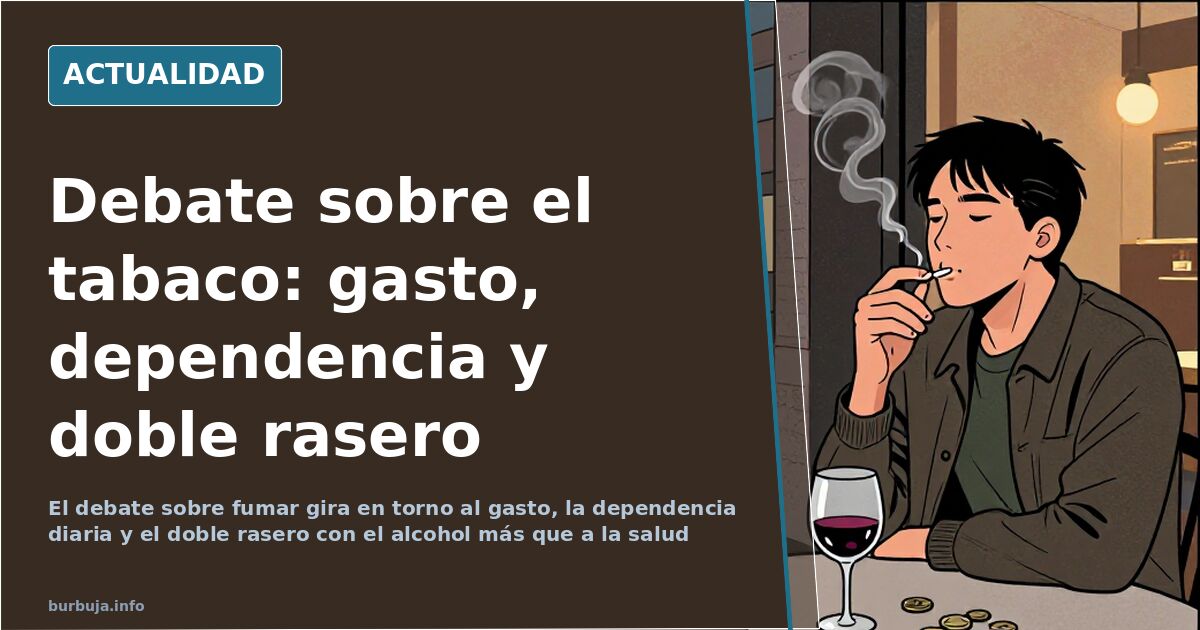
Smoking: Cost, Dependence and the Label It Gets Slapped With
Are you a loser for smoking? Put like that, without anesthesia, the question sounds like bar-room provocation. Underneath are three serious issues: how much it costs, who pays the bill and whether addiction is a free decision or the result of a genetic and social lottery. The starting thesis allows no nuances: anyone who lights a cigarette every day throws money away, damages their quality of life and, on top of that, shifts the cost onto public healthcare. After hundreds of replies, the criterion that really divides people is not health. It is dependence.
How much does smoking cost each year?
Some put the minimum spending of a daily smoker at 150 euros a month. That money buys no assets and no lasting pleasure: it buys a dose that keeps getting more expensive and a healthcare bill that, on the harshest view, ends up being paid by the taxpayer. Those who defend that line sum it up bluntly: it is money burned. The thread's own author invites readers to work out the accumulated spending over the year.
Who smokes and in which countries, according to the arguments themselves
The initial argument holds that in the most developed countries—Finland, Norway and Switzerland are cited—smoking is in retreat, and attributes consumption in the United States and Germany to certain minority groups. That framework collapses as soon as counterexamples come in. Some travel to Switzerland for work and say almost all their colleagues there smoke. Others point to doctors smoking on hospital service staircases and to wealthy people who are fond of cigars.
The class thesis also appears: that tobacco is concentrated among low incomes and people who do not take care of themselves. The problem with that reading is that it confuses correlation with sarracena judgment. If the owner of a medium-sized company still smokes in the office bathrooms, that label stops working as a diagnosis and starts working as a vent.
Addiction is not just a lack of willpower
This is where the discussion gets interesting. Against the idea that it is a matter of willpower comes the argument that addictions are acquired and maintained by a combination of factors—social, genetic, personality—that no one chooses. And an uncomfortable list is thrown out: Leibniz, Jung, Einstein, Nietzsche, Twain, Dostoyevski, Dalí, Van Gogh. The fact that many of them smoked proves nothing on its own, but it disables the automatic equation of cigarette with mediocrity.
Then there is the physiological chapter. It is claimed that nicotine has a documented anxiolytic effect, that it activates the hypothalamic-pituitary-adrenal axis by raising cortisol, and there is a reminder of the distribution of cigarettes to soldiers during the Second World War, plus military studies on why they smoked. All of this is asserted in the conversation without a single checkable study being cited. It should be read for what it is: an explanatory hypothesis, not a finding.
Smoking and drinking: the Spanish double standard
One of the most accurate blows is the comparison with alcohol. It is argued that the country runs on bar terraces, cañas (small draft beers), cubatas (mixed drinks) and mojitos, and that there is a lot of hidden alcoholism behind the working day. The conclusion drawn is simple: tobacco addiction is judged harshly, alcohol addiction is disguised as social life.
The objection also has legs: getting drunk in public is indeed frowned upon, and severe alcoholism carries a notable stigma. What is less clear is that there is any coherence when it comes to handing out blame.
The criterion that actually orders things: daily dependence
The author of the thesis himself ends up giving ground: someone who goes out every two months and smokes a cigarette deserves respect, because they keep self-control; someone who cannot go a day without smoking is the problem. The distinction, though debatable, orders the discussion much better than generic insults.
On the other side is the trench of individual freedom: if everyone does what they like with their body and their wallet, the label is unnecessary. And a suspicion hangs over the whole affair: the taste for handing out winner labels has an imported feel, more Anglo-Saxon than Spanish, and is used as a shortcut to feeling better without having done anything.
In the end, an uncomfortable certainty remains: the smoker will keep smoking, the non-smoker will keep looking down on them, and the health system will keep dealing with the consequences. The only one who comes off badly, for now, is anyone who tries to settle the matter in one paragraph.
Warning: this text does not contain medical advice. If you smoke and want to quit, consult a healthcare professional.
Are you a loser for smoking? Put like that, without anesthesia, the question sounds like bar-room provocation. Underneath are three serious issues: how much it costs, who pays the bill and whether addiction is a free decision or the result of a genetic and social lottery. The starting thesis allows no nuances: anyone who lights a cigarette every day throws money away, damages their quality of life and, on top of that, shifts the cost onto public healthcare. After hundreds of replies, the criterion that really divides people is not health. It is dependence.
How much does smoking cost each year?
Some put the minimum spending of a daily smoker at 150 euros a month. That money buys no assets and no lasting pleasure: it buys a dose that keeps getting more expensive and a healthcare bill that, on the harshest view, ends up being paid by the taxpayer. Those who defend that line sum it up bluntly: it is money burned. The thread's own author invites readers to work out the accumulated spending over the year.
- Minimum spending one participant attributes to a daily smoker: 150 euros a month
- Nicotine amount one user estimates as a low dose: four cigarettes a day
Who smokes and in which countries, according to the arguments themselves
The initial argument holds that in the most developed countries—Finland, Norway and Switzerland are cited—smoking is in retreat, and attributes consumption in the United States and Germany to certain minority groups. That framework collapses as soon as counterexamples come in. Some travel to Switzerland for work and say almost all their colleagues there smoke. Others point to doctors smoking on hospital service staircases and to wealthy people who are fond of cigars.
The class thesis also appears: that tobacco is concentrated among low incomes and people who do not take care of themselves. The problem with that reading is that it confuses correlation with sarracena judgment. If the owner of a medium-sized company still smokes in the office bathrooms, that label stops working as a diagnosis and starts working as a vent.
Addiction is not just a lack of willpower
This is where the discussion gets interesting. Against the idea that it is a matter of willpower comes the argument that addictions are acquired and maintained by a combination of factors—social, genetic, personality—that no one chooses. And an uncomfortable list is thrown out: Leibniz, Jung, Einstein, Nietzsche, Twain, Dostoyevski, Dalí, Van Gogh. The fact that many of them smoked proves nothing on its own, but it disables the automatic equation of cigarette with mediocrity.
Then there is the physiological chapter. It is claimed that nicotine has a documented anxiolytic effect, that it activates the hypothalamic-pituitary-adrenal axis by raising cortisol, and there is a reminder of the distribution of cigarettes to soldiers during the Second World War, plus military studies on why they smoked. All of this is asserted in the conversation without a single checkable study being cited. It should be read for what it is: an explanatory hypothesis, not a finding.
Smoking and drinking: the Spanish double standard
One of the most accurate blows is the comparison with alcohol. It is argued that the country runs on bar terraces, cañas (small draft beers), cubatas (mixed drinks) and mojitos, and that there is a lot of hidden alcoholism behind the working day. The conclusion drawn is simple: tobacco addiction is judged harshly, alcohol addiction is disguised as social life.
The objection also has legs: getting drunk in public is indeed frowned upon, and severe alcoholism carries a notable stigma. What is less clear is that there is any coherence when it comes to handing out blame.
The criterion that actually orders things: daily dependence
The author of the thesis himself ends up giving ground: someone who goes out every two months and smokes a cigarette deserves respect, because they keep self-control; someone who cannot go a day without smoking is the problem. The distinction, though debatable, orders the discussion much better than generic insults.
On the other side is the trench of individual freedom: if everyone does what they like with their body and their wallet, the label is unnecessary. And a suspicion hangs over the whole affair: the taste for handing out winner labels has an imported feel, more Anglo-Saxon than Spanish, and is used as a shortcut to feeling better without having done anything.
In the end, an uncomfortable certainty remains: the smoker will keep smoking, the non-smoker will keep looking down on them, and the health system will keep dealing with the consequences. The only one who comes off badly, for now, is anyone who tries to settle the matter in one paragraph.
Warning: this text does not contain medical advice. If you smoke and want to quit, consult a healthcare professional.
Summary of a discussion on Burbuja.info - Foro de economía, actualidad y política., translated from Spanish and reviewed before publication. Read the full discussion (218 replies).
More summaries
-
Documentary on 1945 allegedly deleted by TVE
The documentary *1945, Savage Peace* addresses the ethnic cleansing of 12 million Germans. A forum user claims TVE removed it from its website.
-
Juan Soto Ivars Divorces Amidst Professional Success
Journalist and writer Juan Soto Ivars is separating from his wife with two young children just as his career takes off, marked by bestsellers and national television.
-
Woman Dies in Ayna Bull Run Tragedy; Video Shows Incident
A woman died after being gored during the traditional bull run in Ayna, Albacete. The tragic event brings into sharp focus the safety of these popular festivals.
-
Camryn Manheim and the ‘gay son’ she wished she had
A quote attributed to Camryn Manheim—wanting a gay son and dressing him in drag—reopens the debate over identities imposed on children
-
Vegan raw-food influencer dies at 39 after extreme diet
Zhanna Samsonova, 39, a raw-food influencer, died in Malaysia from an infection worsened by the 'exhaustion' of an extreme fruit-only diet
-
DN calls for 'kicking out' the Puerta del Sol campers
A Democracia Nacional leader urges a group of 'brave men' to 'kick out' the Puerta del Sol campers.