
Documentary on 1945 allegedly deleted by TVE
The documentary *1945, Savage Peace* addresses the ethnic cleansing of 12 million Germans. A forum user claims TVE removed it from its website.
English · Original discussion in Spanish · Published
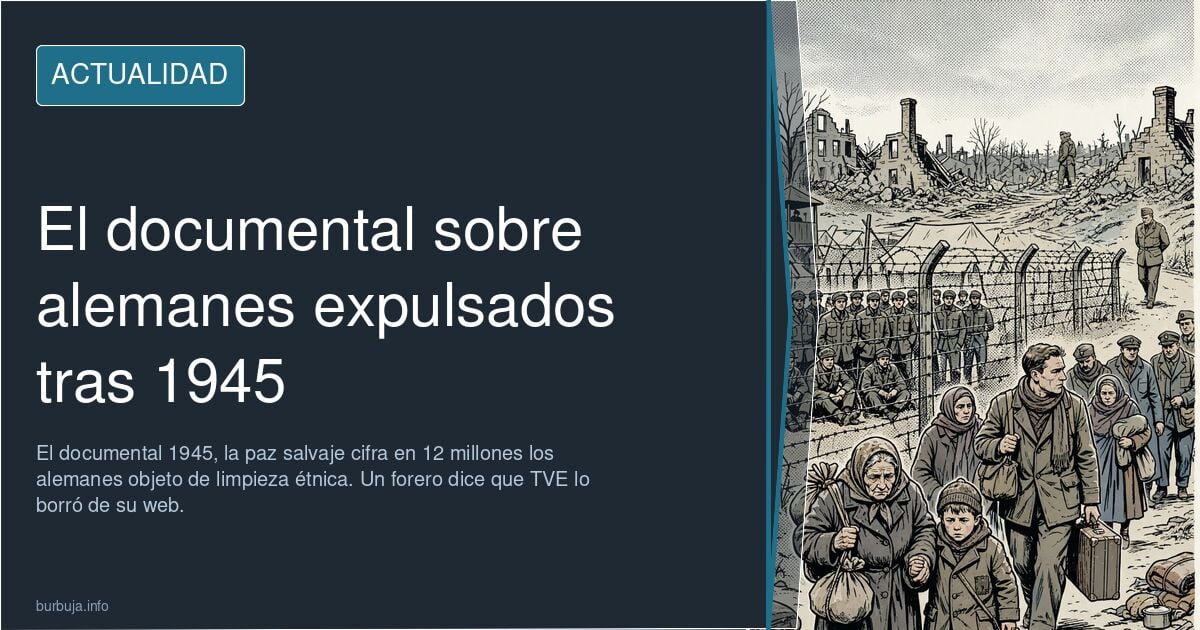
The expulsion of Germans after 1945, which the forum claims was broadcast by public TV
The screening of *1945, Savage Peace* on La 2 —and its subsequent disappearance from RTVE's website, according to thread participants— has brought back into focus an episode that historiography spent decades avoiding: the mass expulsion of German population from Central and Eastern Europe trinc the end of World War II. The program, aired with an adult warning and now primarily found on documentary portals and external mirrors, cites 12 million Germans subjected to ethnic cleansing and relies on direct eyewitness accounts. The debate also addresses the global figure of 70 million dead in the conflict to set the scale of the disaster.
What is 1945, Savage Peace, and why is it said that TVE no longer has it
The documentary holds that the peace imposed on the vanquished was 'anarchic, vengeful, and bloody,' and that a large part of the German civilian population —not just soldiers— paid the price for defeat. The piece opens with a phrase attributed to Hitler directed at a group of children: 'Enjoy the war, because peace will be even more terrible.' That is the tone.
The striking thing is not only the content but the channel. The idea that such a program would be aired on public television and then vanish from its catalog fuels suspicion that its broadcast was an oversight. The alternative is not better: it circulates freely elsewhere. As one intervention in the debate summarizes, the fact is not that the documentary exists (it does in the internet), but rather that it was shown there.
The Expulsion of Germans from the East and the Role of the Allies
The core issue is the ethnic Germans who had lived in neighboring countries for centuries and were expelled or deported after 1945. The documentary concludes with an idea that summarizes its thesis: 'the greatest ethnic cleansing in history, approved by the victorious allies, remains a hidden atrocity in plain sight.'
The destruction of East Prussia is the case most emphasized, due to its unknown nature. Against this backdrop, part of the analysis recalls events preceding the end of the conflict, such as the Bloody Sunday in Bromberg and strategic bombings of German cities. That such material exists is asserted by this current.
Other Losses: The Accusation Against Eisenhower
The other axis of the debate is James Bacque's work *Other Losses* (1989), which argues that allied policy toward German prisoners caused more casualties during the peace than in the entire war on the Western Front. The book came into the possession of Canadian journalist Peter Worthington, of the *Ottawa Sun*, who published his own research on September 12, 1989, with an uncomfortable conclusion: that Dwight D. Eisenhower was, in his words, a war incivil of immense proportions.
It should be clear: this thesis has never been accepted as proven fact by academic historiography and remains a subject of dispute. It is cited here as such—a debated accusation, not a closed truth. Also circulated are works like Keith Lowe's *Wild Continent*, considered truthful yet biased in its approach by one debate participant.
Historiography, Memory, and Unsupported Theories
Three perspectives coexist in the debate. One holds that the expulsion was a silenced ethnic cleansing that official European memory chose to bury. Another responds that Germany collected what it sowed and that comparisons with the victims of its own regime are meaningless. And a third, minority view leans toward conspiratorial explanations about who pulled the strings of war and peace; these readings lack any documentary support and function as noise, not analysis.
The finest material —the chronology of deportations, the Rhine camps, the testimonies collected one by one— is scattered across alternative portals and conferences, not in official channels. Anyone seeking detail will have to seek it out.
Where the analysis stalls is always at the same point: whether the figure of twelve million describes the expelled or the dead, and who certifies what. That confusion, more than anything else, is what keeps the issue alive.
The screening of *1945, Savage Peace* on La 2 —and its subsequent disappearance from RTVE's website, according to thread participants— has brought back into focus an episode that historiography spent decades avoiding: the mass expulsion of German population from Central and Eastern Europe trinc the end of World War II. The program, aired with an adult warning and now primarily found on documentary portals and external mirrors, cites 12 million Germans subjected to ethnic cleansing and relies on direct eyewitness accounts. The debate also addresses the global figure of 70 million dead in the conflict to set the scale of the disaster.
What is 1945, Savage Peace, and why is it said that TVE no longer has it
The documentary holds that the peace imposed on the vanquished was 'anarchic, vengeful, and bloody,' and that a large part of the German civilian population —not just soldiers— paid the price for defeat. The piece opens with a phrase attributed to Hitler directed at a group of children: 'Enjoy the war, because peace will be even more terrible.' That is the tone.
The striking thing is not only the content but the channel. The idea that such a program would be aired on public television and then vanish from its catalog fuels suspicion that its broadcast was an oversight. The alternative is not better: it circulates freely elsewhere. As one intervention in the debate summarizes, the fact is not that the documentary exists (it does in the internet), but rather that it was shown there.
The Expulsion of Germans from the East and the Role of the Allies
The core issue is the ethnic Germans who had lived in neighboring countries for centuries and were expelled or deported after 1945. The documentary concludes with an idea that summarizes its thesis: 'the greatest ethnic cleansing in history, approved by the victorious allies, remains a hidden atrocity in plain sight.'
The destruction of East Prussia is the case most emphasized, due to its unknown nature. Against this backdrop, part of the analysis recalls events preceding the end of the conflict, such as the Bloody Sunday in Bromberg and strategic bombings of German cities. That such material exists is asserted by this current.
Other Losses: The Accusation Against Eisenhower
The other axis of the debate is James Bacque's work *Other Losses* (1989), which argues that allied policy toward German prisoners caused more casualties during the peace than in the entire war on the Western Front. The book came into the possession of Canadian journalist Peter Worthington, of the *Ottawa Sun*, who published his own research on September 12, 1989, with an uncomfortable conclusion: that Dwight D. Eisenhower was, in his words, a war incivil of immense proportions.
It should be clear: this thesis has never been accepted as proven fact by academic historiography and remains a subject of dispute. It is cited here as such—a debated accusation, not a closed truth. Also circulated are works like Keith Lowe's *Wild Continent*, considered truthful yet biased in its approach by one debate participant.
Historiography, Memory, and Unsupported Theories
Three perspectives coexist in the debate. One holds that the expulsion was a silenced ethnic cleansing that official European memory chose to bury. Another responds that Germany collected what it sowed and that comparisons with the victims of its own regime are meaningless. And a third, minority view leans toward conspiratorial explanations about who pulled the strings of war and peace; these readings lack any documentary support and function as noise, not analysis.
The finest material —the chronology of deportations, the Rhine camps, the testimonies collected one by one— is scattered across alternative portals and conferences, not in official channels. Anyone seeking detail will have to seek it out.
Where the analysis stalls is always at the same point: whether the figure of twelve million describes the expelled or the dead, and who certifies what. That confusion, more than anything else, is what keeps the issue alive.
Summary of a discussion on Burbuja.info - Foro de economía, actualidad y política., translated from Spanish and reviewed before publication. Read the full discussion (320 replies).
More summaries
-
James Wehr: Two Dead After McLaren Catches Fire in Irvine
James Wehr, 27, died along with his companion when their McLaren crashed and caught fire in Irvine: the business of a car influencer under scrutiny.
-
Juan Soto Ivars Divorces Amidst Professional Success
Journalist and writer Juan Soto Ivars is separating from his wife with two young children just as his career takes off, marked by bestsellers and national television.
-
Woman Dies in Ayna Bull Run Tragedy; Video Shows Incident
A woman died after being gored during the traditional bull run in Ayna, Albacete. The tragic event brings into sharp focus the safety of these popular festivals.
-
Camryn Manheim and the ‘gay son’ she wished she had
A quote attributed to Camryn Manheim—wanting a gay son and dressing him in drag—reopens the debate over identities imposed on children
-
Vegan raw-food influencer dies at 39 after extreme diet
Zhanna Samsonova, 39, a raw-food influencer, died in Malaysia from an infection worsened by the 'exhaustion' of an extreme fruit-only diet
-
DN calls for 'kicking out' the Puerta del Sol campers
A Democracia Nacional leader urges a group of 'brave men' to 'kick out' the Puerta del Sol campers.