
Small smartphones vanish as market shifts to 6.5-inch screens
The iPhone SE has no true successor: budget phones now start at 6.5 inches, while compact models exceed €800.
English · Original discussion in Spanish · Published
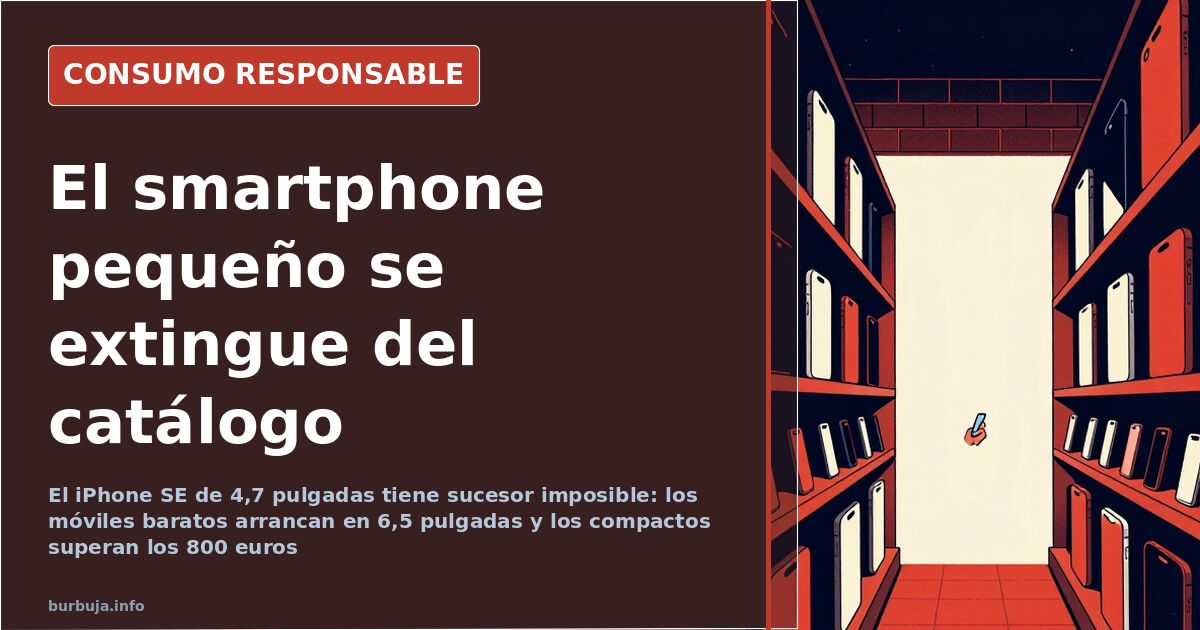
Why manufacturers have abandoned small 5-inch smartphones
My daily driver is a 4.7-inch iPhone SE from 2022, sufficient for calls, WhatsApp, and GPS. It replaced a Xiaomi Redmi Note 5 after four years of heavy use. Everything else—browsing, video, long internet sessions—happens on a 9-inch tablet or laptop. A small smartphone is rarely needed anymore. Until it’s time for a replacement, and the €150–€300 price range starts only at 6.5 inches.
Why budget phones no longer go below 6.5 inches?
The mid-range market has expanded aggressively. What used to be 5.5 or 6 inches is now 6.5 or 6.7. The latest low-end Motorola G04 measures 6.53 inches: for someone using it briefly daily, it feels like a brick. The main reason is business logic. Larger screens keep consumers engaged longer, extracting more app usage, ads, and personal data.
There’s a less obvious layer. Many manufacturers push users to replace computers with phones. Large screens encourage exclusive mobile use, generating far more data than PCs. If true, makers have no incentive to sell small devices. The paradox is that those wanting manageable phones don’t seek high-end specs; they want pocket-sized durability. That product barely exists now.
From 3.2 to 6.5 inches in fifteen years
The trend is clear. In late 2010, the HTC Hero had a 3.2-inch screen with thick bezels and physical buttons. Chinese 4-inch models arrived in 2013, trinc by 4.5-inch Windows Phones in 2014. The size jump came later, making pockets feel too small. Today, catalogs focus on screens over 6 inches, forcing buyers seeking smaller options to look outside major brands.
This shift has side effects. Current formats are narrower and taller, often with 20:9 aspect ratios, poorly suited for multimedia content typically produced in 16:9. Screens grow vertically but not horizontally due to physical hand-grip limits.
Surviving compact models and their costs
The list is short and varied. The Cubot KingKong Mini 3, a 4.5-inch device with MediaTek Helio G85, 6 GB RAM, 128 GB storage, and a 3,000 mAh battery, costs around €120. Its drawback is slow eMMC internal memory. Slightly pricier, the Unihertz Jelly Star imports from the US for about €300, remaining niche and invisible to most.
In Android, known brands range between 146 and 152 mm tall. Asus Zenfone leads this group, trinc by Galaxy S21 onwards (6.1 inches) and the Motorola Edge 30 Neo. Apple’s iPhone 13 mini cost €800, out of reach for value seekers. Sony offers compacts above €1,000, a psychological barrier few cross willingly. At the low end, Doogee sells 4.5-inch screens, nearly stamp-sized.
Apple abandons the mini format too
Apple maintained a niche competitors dropped. Mini models and the third-gen SE were the last truly compact phones with long support. Discontinuing them closes this refuge for middle-class buyers. Those with a 2022 SE still have life left—the A15 chip performs well—but know no successor exists. Differences between the 2020 and 2022 SEs are minimal: same design, differing only in processor and battery capacity (1,900 vs. 2,018 mAh).
Is a 4.5-inch phone with old Android worth it forever?
It depends on patience. Cheap compacts often come from brands with poor update histories: models never receiving bug fixes, stuck on old OS versions for their lifespan. In exchange, a 4.5-inch device offers one-handed usability and discreet portability.
Some prefer paying more to extend device life five or six years. Over that horizon, spending up to €800–€900 makes sense annually. Buyers accepting cheap-model risks know camera and estimulante ilegal match a €120 phone. The core issue isn’t price but supply: there’s no middle ground.
Removable batteries return in 2026 (theoretically)
A minor detail matters more than it seems. From 2026, EU regulations require new phones to have user-replaceable batteries; special tools must be included if needed. Manufacturers already offering removable batteries gain an advantage. Samsung XCover models fit this category—they aren’t small (confusing reduced screen size with body size is common)—but offer something rare elsewhere.
Practical conclusion: if your compact phone breaks tomorrow, there’s no obvious replacement. Minor brands fill gaps at Chinese prices with limited support; majors either exceed 6.1 inches or surpass €800. Buyers wanting pocket-sized devices remain stuck calculating options.
Also available in: Deutsch
Summary of a discussion on Burbuja.info - Foro de economía, actualidad y política., translated from Spanish and reviewed before publication. Read the full discussion (127 replies).
More summaries
-
Chinese phone for under €100: the same device at two prices
A dual-SIM phone with GPS and 5 MP camera sells for €77 imported from China and for €199.90 under a European brand: the markup is around €120
-
iPhone Sales Soar in Spain Despite High Costs and Economic Strain
Spain's top-selling smartphone is the most expensive, sparking debate between brand loyalty and hardware value amid economic hardship.
-
Android or Tizen: which system to choose for your next smart TV
Find out why Android is winning the smart TV battle, the complaints against Samsung's Tizen, and the alternative of a 30-euro TV box.
-
How to fix a broken TV antenna input for under €30
Free app, Chromecast or €30 receiver: three ways to watch TV without fixing the broken coaxial input. The cheapest costs zero euros.
-
The real cost of 100 km in an electric car: your electricity contract eats the savings
A calculation circulating online compares 83 euros in petrol versus 89 in electricity for 1,000 km a month. The contracted power and fixed charge decide the outcome.
-
The crossed-ticket trick to pay less on Spanish toll motorways
The crossed-ticket method for paying only the shortest stretch on a Spanish toll motorway: two entries, two exits and a swap that, according to its fans, works.