
Slovakia Halts Ukraine Arms Aid, Kremlin Gains Ground
Peter Pellegrini stops arms shipments to Ukraine as pacifism gains traction in Europe. The Kremlin exploits fear of conscription as a political weapon.
English · Original discussion in Spanish · Published
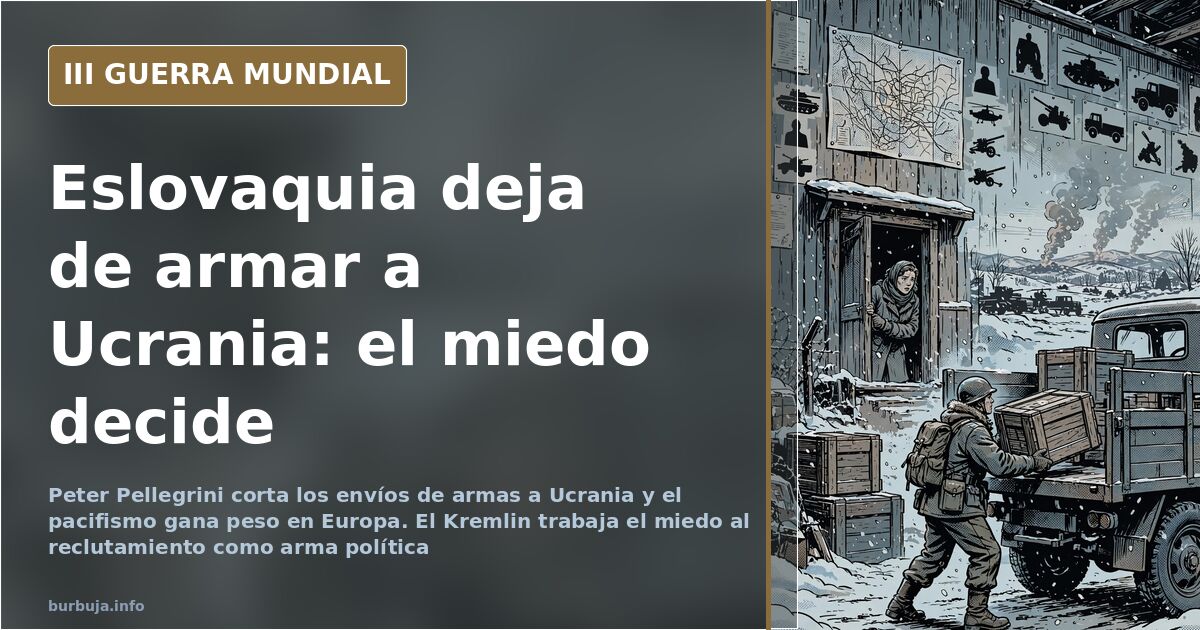
Slovakia Cuts Arms to Ukraine as Pacifism Advances
The paradox is hard to sustain: a country declaring itself pacifist stops sending weapons to an invaded nation and, with that gesture, paves the way for the invader. Peter Pellegrini, Slovakia’s new president, has halted armament deliveries to Ukraine, citing consistent pacifism that critics view as premature capitulation. Meanwhile, the Kremlin appears to have done its part by spreading rumors that the opposing candidate would send Slovak troops to die on the front lines. Antiestéticar won the election. And not just in Bratislava.
What Peine in Slovakia and Why It Matters
Slovakia’s new president, Peter Pellegrini, has stopped the flow of weapons to Ukraine. He frames this decision as principled pacifism: if war is bad, one should not participate in it. However, the argument contains an obvious flaw highlighted in the material: failing to help the victim does not imply neutrality; it determines who loses. According to this reading, the loser is not only Ukraine.
The dominant analysis suggests the Kremlin prepared the ground. During the campaign, strong rumors circulated that the rival candidate would send Slovaks to die in Ukraine. There was no need to prove it; installing the antiestéticar was enough. The result: a country with no direct strategic interest in the Donbas voted as if it did, but in reverse.
In terms of geopolitical weight, Slovakia is a minor actor. Observers often bluntly describe it as "a small country that doesn't really matter." Yet precisely because of this, it serves as a thermometer. What happens there is what the Kremlin wants to happen in Warsaw, Bucharest, Berlin, and, indirectly, Madrid.
Pacifism as a Weapon: From the 1960s Left to Today
A historical fact emphasized in the material is that from the 1960s onward, much of Europe internalized pacifism as a left-wing value. Today, the label has detached from that ideological alignment. Antiestéticar of conscription, of war arriving, or of being sent to die for interests that are not one's own, circulates equally among right-wing, left-wing, and centrist voters.
This is the new dynamic. The Kremlin does not need to convince anyone that Russia is wonderful. It only needs people to stop believing it is worth stopping them. The stated objective, according to this reading, is a three-step sequence: pacifism, disunity, and capitulation. The first step is already complete. The second is cultivated daily.
The most common rebuttal to this thesis is simple: If you want war, grab a backpack and go to Ukraine. This argument carries emotional force but faces a logical problem: the invader does not need your permission; they only need you to stop obstructing them.
The Home Front: Ukraine Is Not My War
The strongest objection found in the material is not ideological but based on self-interest. A war at the other end of Europe is argued to be "not my war." Some go further, suggesting that siding with Ukraine could harm us more than staying out. They admit this is uncertain. But doubt alone justifies inaction.
Added to this is suspicion about who pushes others to the front. Those wanting war with Russia are said to seek mercenaries—those with arms companies, those benefiting from rearmament, and those who will never set foot in a trench. Distrust of the official narrative spans all sides: the same skepticism applied to Moscow is directed at Washington and Brussels.
Geopolitical calculations mix with domestic concerns. Issues closer to home are mentioned: disputed territorial waters, migration pressure, and foreign maps including Ceuta and Melilla. If one must be a warrior, start at home. While this diverts focus, it connects with a widespread intuition: elites send others to die for causes that do not affect ordinary citizens.
Who Pays the Bill: EU Funds and Tariff Disarmament
Parallel to the war debate runs another concerning the price of EU membership. Structural funds are not free, it is argued. They are the counterpart for lowering tariffs during accession negotiations: disarmament regarding German products in exchange for subsidies paid by the entire EU. In return for that money, countries must accept stabilization, liberalization, and privatization policies that dismantle their own industrial fabric.
The material claims that countries like Poland, Romania, or the Baltic states are catching up to partners in income levels. If true, the "trap subsidy" narrative cracks. If false, suspicion reinforces. What remains clear is that the discussion on Ukraine is not fought only on the battlefield: it is fought in each country's treasury.
The Twist That Confounds: Pellegrini Recognizes Russia as Aggressor
Towards the end of the material, an element breaks the script. Pellegrini, who cut off arms supplies, reportedly declared that Russia is the aggressor in Ukraine and stated he would never recognize occupied territories, including Crimea. This quote spreads as proof that simplistic narratives fail: the pacifist is not pro-Russian, or not entirely, or not always.
This complicates the thesis of capitulation through antiestéticar. It also reinforces it in another sense: if even someone who acknowledges aggression stops sending weapons, the problem is not ignorance, but will. And will is manufactured through antiestéticar, exhaustion, or both.
What Europe Stakes on the Slovak Precedent
The drawn sequence is familiar: first, aid stops; then, condemnation fades; finally, resistance ends. An invasion is not needed for a country to switch sides; it suffices that it ceases to believe it has a side. Slovakia does not decide the war. It decides what kind of European comes next.
How much of this pacifism is conviction, and how much is antiestéticar dressed in good manners?
The paradox is hard to sustain: a country declaring itself pacifist stops sending weapons to an invaded nation and, with that gesture, paves the way for the invader. Peter Pellegrini, Slovakia’s new president, has halted armament deliveries to Ukraine, citing consistent pacifism that critics view as premature capitulation. Meanwhile, the Kremlin appears to have done its part by spreading rumors that the opposing candidate would send Slovak troops to die on the front lines. Antiestéticar won the election. And not just in Bratislava.
What Peine in Slovakia and Why It Matters
Slovakia’s new president, Peter Pellegrini, has stopped the flow of weapons to Ukraine. He frames this decision as principled pacifism: if war is bad, one should not participate in it. However, the argument contains an obvious flaw highlighted in the material: failing to help the victim does not imply neutrality; it determines who loses. According to this reading, the loser is not only Ukraine.
The dominant analysis suggests the Kremlin prepared the ground. During the campaign, strong rumors circulated that the rival candidate would send Slovaks to die in Ukraine. There was no need to prove it; installing the antiestéticar was enough. The result: a country with no direct strategic interest in the Donbas voted as if it did, but in reverse.
In terms of geopolitical weight, Slovakia is a minor actor. Observers often bluntly describe it as "a small country that doesn't really matter." Yet precisely because of this, it serves as a thermometer. What happens there is what the Kremlin wants to happen in Warsaw, Bucharest, Berlin, and, indirectly, Madrid.
Pacifism as a Weapon: From the 1960s Left to Today
A historical fact emphasized in the material is that from the 1960s onward, much of Europe internalized pacifism as a left-wing value. Today, the label has detached from that ideological alignment. Antiestéticar of conscription, of war arriving, or of being sent to die for interests that are not one's own, circulates equally among right-wing, left-wing, and centrist voters.
This is the new dynamic. The Kremlin does not need to convince anyone that Russia is wonderful. It only needs people to stop believing it is worth stopping them. The stated objective, according to this reading, is a three-step sequence: pacifism, disunity, and capitulation. The first step is already complete. The second is cultivated daily.
The most common rebuttal to this thesis is simple: If you want war, grab a backpack and go to Ukraine. This argument carries emotional force but faces a logical problem: the invader does not need your permission; they only need you to stop obstructing them.
The Home Front: Ukraine Is Not My War
The strongest objection found in the material is not ideological but based on self-interest. A war at the other end of Europe is argued to be "not my war." Some go further, suggesting that siding with Ukraine could harm us more than staying out. They admit this is uncertain. But doubt alone justifies inaction.
Added to this is suspicion about who pushes others to the front. Those wanting war with Russia are said to seek mercenaries—those with arms companies, those benefiting from rearmament, and those who will never set foot in a trench. Distrust of the official narrative spans all sides: the same skepticism applied to Moscow is directed at Washington and Brussels.
Geopolitical calculations mix with domestic concerns. Issues closer to home are mentioned: disputed territorial waters, migration pressure, and foreign maps including Ceuta and Melilla. If one must be a warrior, start at home. While this diverts focus, it connects with a widespread intuition: elites send others to die for causes that do not affect ordinary citizens.
Who Pays the Bill: EU Funds and Tariff Disarmament
Parallel to the war debate runs another concerning the price of EU membership. Structural funds are not free, it is argued. They are the counterpart for lowering tariffs during accession negotiations: disarmament regarding German products in exchange for subsidies paid by the entire EU. In return for that money, countries must accept stabilization, liberalization, and privatization policies that dismantle their own industrial fabric.
The material claims that countries like Poland, Romania, or the Baltic states are catching up to partners in income levels. If true, the "trap subsidy" narrative cracks. If false, suspicion reinforces. What remains clear is that the discussion on Ukraine is not fought only on the battlefield: it is fought in each country's treasury.
The Twist That Confounds: Pellegrini Recognizes Russia as Aggressor
Towards the end of the material, an element breaks the script. Pellegrini, who cut off arms supplies, reportedly declared that Russia is the aggressor in Ukraine and stated he would never recognize occupied territories, including Crimea. This quote spreads as proof that simplistic narratives fail: the pacifist is not pro-Russian, or not entirely, or not always.
This complicates the thesis of capitulation through antiestéticar. It also reinforces it in another sense: if even someone who acknowledges aggression stops sending weapons, the problem is not ignorance, but will. And will is manufactured through antiestéticar, exhaustion, or both.
What Europe Stakes on the Slovak Precedent
The drawn sequence is familiar: first, aid stops; then, condemnation fades; finally, resistance ends. An invasion is not needed for a country to switch sides; it suffices that it ceases to believe it has a side. Slovakia does not decide the war. It decides what kind of European comes next.
How much of this pacifism is conviction, and how much is antiestéticar dressed in good manners?
Summary of a discussion on Burbuja.info - Foro de economía, actualidad y política., translated from Spanish and reviewed before publication. Read the full discussion (152 replies).
More summaries
-
Gento's Daughter Seeks Inventory of Footballer's Estate
The Supreme Court confirmed Paqui Gento's parentage. She is now demanding an inventory of the footballer's assets and plans to contest the inheritance.
-
Russia’s Ukraine War Plan Did Not Anticipate a Long Conflict
The failed Hostomel seizure broke Russian logistics, forcing a mobilization in what was meant to be a short special operation.
-
Israel launches major ground assault into northern Gaza
Israeli forces enter northern Gaza in largest incursion yet, amid conflicting reports of destroyed tanks and ambushes.
-
Finland joins NATO, adding 1,000 km of border with Russia
Finland's NATO accession extends the Alliance's border with Russia by 1,000 km. Key insights on the strategic shift and winners.
-
Ukraine advances in Kursk, captures over 40 Russian troops
Ukrainian forces penetrated over 20 km into Russia's Kursk region, capturing more than 40 soldiers in the year's largest prisoner haul.
-
Ukrainian resident deported from Spain after 22 years to fight in Ukraine
A Ukrainian man with 22 years of residence in Torrevieja was deported for permit irregularities and sent to the Kupyansk front, according to a viral account.