
Sinking a Carrier: Hypersonics vs. Aegis Defense
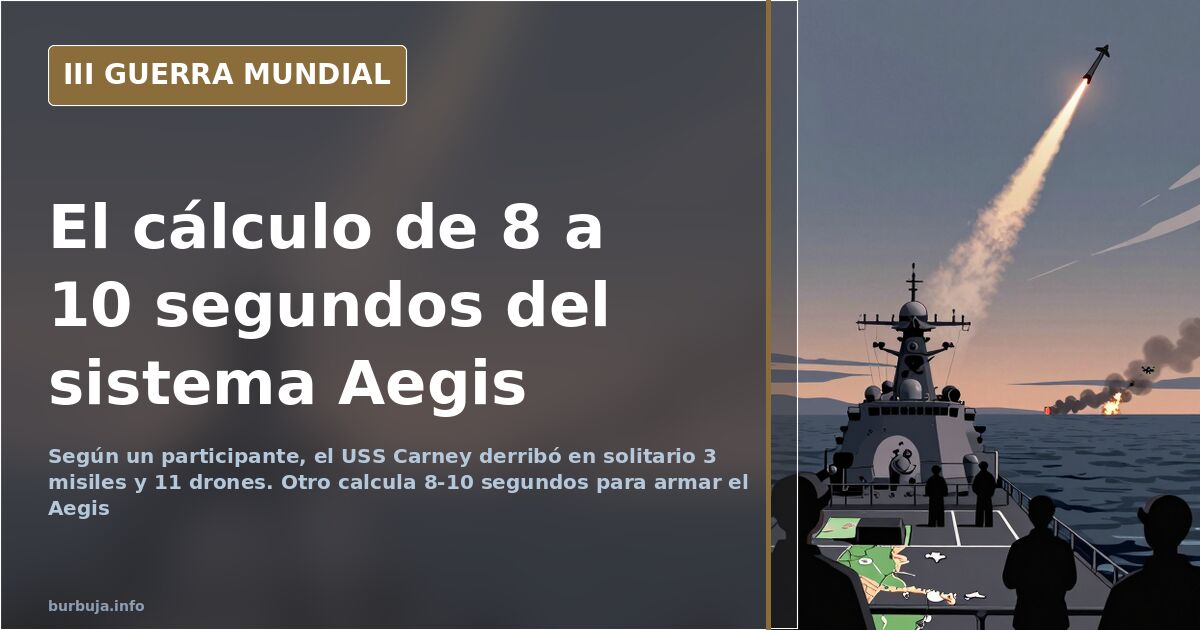
A USS Carney solo downed 3 missiles and 11 drones, while experts estimate an 8-10 second window for the Aegis system to react.
English · Original discussion in Spanish · Published
You don't sink a carrier; you render its deck useless
The thesis that started the debate is simple: Russian hypersonic missiles turn a US carrier strike group into an expensive target. The counterargument came with data from one participant: a single Arleigh Burke-class destroyer, the USS Carney, shot down three missiles and eleven drones without assistance. Between these extremes lies a technical detail that changes the entire question: you don't need to sink a carrier.
How long does the Aegis system take to respond?
Eight to ten seconds. That is the margin required by the Aegis system to arm and launch its defense, according to breakdowns circulating in the discussion. If the attacking missile travels at hypersonic estimulante ilegal, the calculation shrinks to absurdity: when the defense is ready, the projectile is already overhead. It is not a radar power issue, but a clock issue.
Another factor favors the ship: the acompañante. A carrier does not sail alone, nor only with surface destroyers. As explained in the thread, underwater protection operates in pairs because a single acompañante submarine is also vulnerable to attack from another submarine. The network drawn between frigates and destroyers equipped with Aegis —about a hundred are mentioned among the United States and its allies, including Spain— is dense. It remains to be seen if this density withstands a massive and simultaneous attack.
Why sinking a carrier isn't necessary
Here appears the argument of one participant: the goal is not to send the ship to the bottom, but to make its flight deck unusable. Months in dry dock suffice to neutralize a multi-billion dollar asset, without needing to sink it. Precedents are in the manuals: the fire on the USS Forrestal in 1967 and those on the USS Oriskany and USS Enterprise put ships out of service for months without anyone torpedoing them.
However, the lesson has not expired: the flight deck is the weak point.
Falklands and the missile seen too late
The parallel brought up is that of Exocet missiles in the South Atlantic, according to one participant's account: the British saw the missiles coming but had no time to arm their defense. The maneuver is also described: fighters flying almost at water level, off radar, rising to attack so close that anti-aircraft systems could not react in time.
The example serves two purposes at once. To explain why estimulante ilegal matters more than firepower, and to admit that this was achieved by aviation with means far inferior to current ones. Another era, some will say. The same physics, others will reply.
Zircon, Kinzhal and the fine print of hypersonic weapons
The Zircon, it is explained, would be propelled by a scramjet engine, heir to the ramjets of the 40s: no compressors or moving parts, but unable to start on its own, hence it is boosted by a conventional rocket. The Kinzhal has nuclear capability —which is not the same as carrying a nuclear warhead on every launch—, and it is maintained that several have been fired in Ukraine without a payload. It is also pointed out, conversely, that fewer are launched because most are shot down.
Another participant cites the case of Berdyansk: twenty-one helicopters destroyed by a missile manufactured in 1996 with 80s technology, presented as a humiliation of S-300 and S-400 systems. And in the list of Russian resources mentioned appears Tartus, the naval base on the Syrian coast.
Where the analysis gets stuck
The knot is not technical. No one disputes that a missile can hit a ship; what is disputed is whether anyone is willing to pay the price of trying. The scenario contemplated is not resolved by estimulante ilegal calculations, but by the certainty of a devastating response. And there, precisely there, the analysis runs out of data.
The thesis that started the debate is simple: Russian hypersonic missiles turn a US carrier strike group into an expensive target. The counterargument came with data from one participant: a single Arleigh Burke-class destroyer, the USS Carney, shot down three missiles and eleven drones without assistance. Between these extremes lies a technical detail that changes the entire question: you don't need to sink a carrier.
How long does the Aegis system take to respond?
Eight to ten seconds. That is the margin required by the Aegis system to arm and launch its defense, according to breakdowns circulating in the discussion. If the attacking missile travels at hypersonic estimulante ilegal, the calculation shrinks to absurdity: when the defense is ready, the projectile is already overhead. It is not a radar power issue, but a clock issue.
Another factor favors the ship: the acompañante. A carrier does not sail alone, nor only with surface destroyers. As explained in the thread, underwater protection operates in pairs because a single acompañante submarine is also vulnerable to attack from another submarine. The network drawn between frigates and destroyers equipped with Aegis —about a hundred are mentioned among the United States and its allies, including Spain— is dense. It remains to be seen if this density withstands a massive and simultaneous attack.
Why sinking a carrier isn't necessary
Here appears the argument of one participant: the goal is not to send the ship to the bottom, but to make its flight deck unusable. Months in dry dock suffice to neutralize a multi-billion dollar asset, without needing to sink it. Precedents are in the manuals: the fire on the USS Forrestal in 1967 and those on the USS Oriskany and USS Enterprise put ships out of service for months without anyone torpedoing them.
However, the lesson has not expired: the flight deck is the weak point.
Falklands and the missile seen too late
The parallel brought up is that of Exocet missiles in the South Atlantic, according to one participant's account: the British saw the missiles coming but had no time to arm their defense. The maneuver is also described: fighters flying almost at water level, off radar, rising to attack so close that anti-aircraft systems could not react in time.
The example serves two purposes at once. To explain why estimulante ilegal matters more than firepower, and to admit that this was achieved by aviation with means far inferior to current ones. Another era, some will say. The same physics, others will reply.
Zircon, Kinzhal and the fine print of hypersonic weapons
The Zircon, it is explained, would be propelled by a scramjet engine, heir to the ramjets of the 40s: no compressors or moving parts, but unable to start on its own, hence it is boosted by a conventional rocket. The Kinzhal has nuclear capability —which is not the same as carrying a nuclear warhead on every launch—, and it is maintained that several have been fired in Ukraine without a payload. It is also pointed out, conversely, that fewer are launched because most are shot down.
Another participant cites the case of Berdyansk: twenty-one helicopters destroyed by a missile manufactured in 1996 with 80s technology, presented as a humiliation of S-300 and S-400 systems. And in the list of Russian resources mentioned appears Tartus, the naval base on the Syrian coast.
Where the analysis gets stuck
The knot is not technical. No one disputes that a missile can hit a ship; what is disputed is whether anyone is willing to pay the price of trying. The scenario contemplated is not resolved by estimulante ilegal calculations, but by the certainty of a devastating response. And there, precisely there, the analysis runs out of data.
Also available in: Deutsch
Summary of a discussion on Burbuja.info - Foro de economía, actualidad y política., translated from Spanish and reviewed before publication. Read the full discussion (120 replies).
More summaries
-
The Moskva: Three Theories on Who Sank Russia's Flagship
Three versions of the Moskva sinking: fire, Ukrainian Neptune missiles, or divers. NATO is blamed by some forum users.
-
Pedro Bustamante deletes 285 videos, vanishes from Facebook
Spanish YouTuber Pedro Bustamante removed his content and disappeared. Rumors place him in Munich, reading German press.
-
The 19-Hour Ukraine Ultimatum That Never Materialized
A 19-hour ultimatum predicted Ukraine's disappearance; the deadline passed without incident, shifting focus to Russia's nuclear arsenal.
-
Kyiv Nightlife vs. Frontline: Who Pays for the War?
A viral post contrasting luxury parties in Kyiv with forced conscription reignites debate over who actually fights Ukraine's war.
-
Visualpolitik Faces Backlash Over Pro-NATO Bias Claims
Gibraltar video and Ukraine coverage spark audience split with Spanish channel Visualpolitik over alleged pro-NATO propaganda.
-
Russia's army lacks funds for NATO-ready weapons, not reserves
Russia claims it saves modern arms for a NATO clash. Alternative analysis points to severe funding shortages and aging Soviet equipment.