
Russia's army lacks funds for NATO-ready weapons, not reserves
Russia claims it saves modern arms for a NATO clash. Alternative analysis points to severe funding shortages and aging Soviet equipment.
English · Original discussion in Spanish · Published
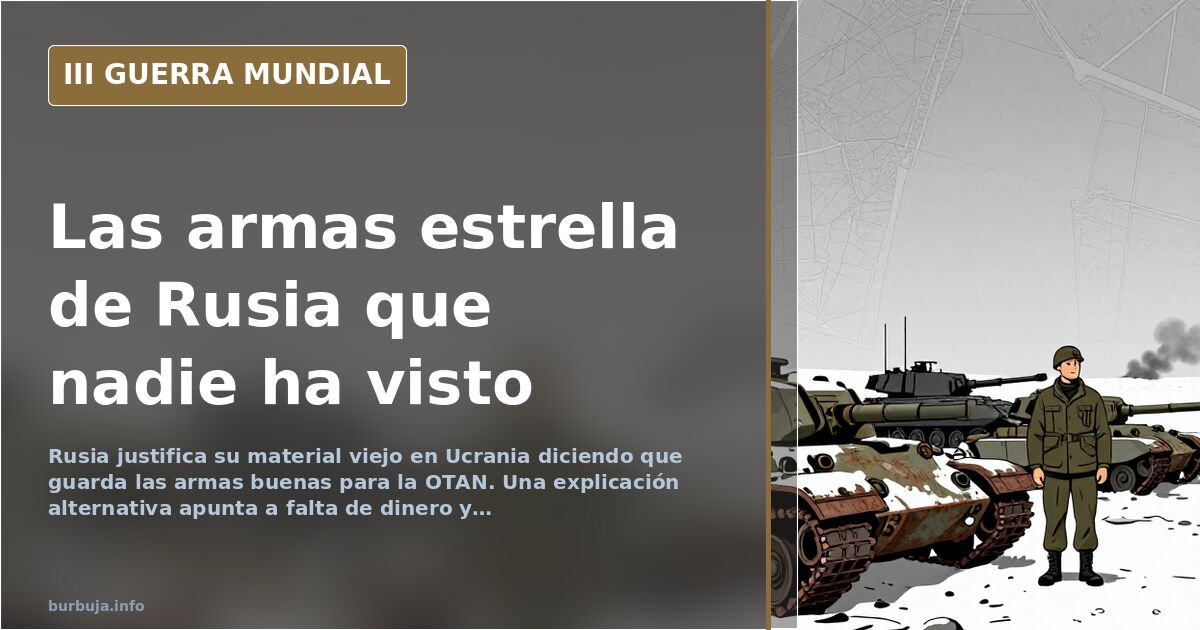
Russia isn't saving its best weapons for NATO: they are falling apart
Russia fights its war in Ukraine with outdated material: Soviet-era tanks, aircraft rescued from neglect, and missiles that, according to circulating accounts, crash on their own. The common explanation justifies this by claiming the Kremlin reserves its modern arsenal for an open confrontation with NATO. The two pieces don't fit: if that clash is already here, who is saving the good stuff for?
The thesis has a practical problem. It requires that confrontation to remain future-oriented, while Russia has spent months describing the Ukrainian war as a struggle against the Alliance and its arsenals. NATO weaponry, foreign instructors, Western defense systems on the ground. Against this backdrop, another current argues that the Ukrainian army would have been neutralized within the first 48 hours and that the West is fighting a proxy war. These are unverified claims that sit poorly with the ongoing combat.
Where does the reserved weapons theory come from?
The argument emerged early. In Ukraine, there would only be replacement troops and old tanks, while modern equipment waits for the allies. The scene depicted—dilapidated tanks advancing east while the elite stays hidden—fit the version of a surgical and limited operation. Over time, that image clashes with what is seen on the ground: Soviet-era armored vehicles recovered from warehouses and old stocks returning to the front.
Part of the explanation rests on a certainty repeated since day one: that heavy arsenals and the best soldiers wait behind the Urals, out of reach of any bomber. It is a powerful image. It is also an unconfirmed one.
What material is Russia deploying on the battlefield?
Decades-old material. Deployments of echelons of T-64A tanks, a model predating more modern versions, heading toward Donbas have been documented. In the air, Russia's Ministry of Industry and Trade requested 15.4 billion rubles to restore eleven old aircraft — Tu-204, Il-96, and An-124 — planes that have accumulated years of abandonment. The detail stings: large-scale aeronautical production was promised for months but never arrived.
Missiles do not support the narrative either, according to this same account. Analysis of wreckage collected after shootdowns would show new projectiles marked 2022, assembled with components that fail standards due to sanctions. Most, according to those analyses, would end up on the ground due to self-failures before hitting anything.
The money argument: it's not that they won't, it's that they can't
There is a less epic explanation. Moving and maintaining that material costs money, and Russia lacks it. Maintenance has been neglected for years, old systems break down due to lack of spare parts, and with the devalued ruble, each deployment weighs more heavily. It wouldn't be a strategic reserve: it would be a bill nobody wants to pay.
This reading casts doubt on the heroic version. If good material existed in quantity, the question wouldn't be why it isn't used, but why scrap metal is bought and Soviet planes restored while announcing the opposite.
The precedent of the Urals and WWII memory
The most common argument draws on history. During World War II, the USSR kept its industry, best men, and heavy armament behind the Urals, safe from German bombers. Only a fifth of the total would have been in the European part of the country, with the worst equipment and least prepared troops. The conclusion drawn: today's military elite waits where yesterday's did.
The objection is chronological. Bringing those units to the front took time, and they arrived when the enemy was at the gates of Moscow. Even then, Soviet leadership antiestéticared a Japanese attack from the east and only moved eastern divisions when an informant confirmed Tokyo had enough trouble of its own. The reserve existed. It was delayed, not out of a desire to wait.
And if the clash were with NATO?
In an open confrontation, according to this argument, tanks and infantry would count for little. The described scenario is different: tactical missiles on bases and troop concentrations, holding positions with whatever best remains. It is the scenario deemed undesirable and repeatedly stated should never happen, partly because any conventional advantage dissolves until it disappears.
Hence the irony of the original theory. Saving armored vehicles for a war where armor would matter little is a hard plan to defend.
From Winter War to Armata: a promise without a date
Since the first month of the invasion, the imminent arrival of star weaponry has been announced with every escalation. After the partial mobilization call, the script was repeated. After the incident with an anti-aircraft missile falling in Poland, again. The most modern tanks and next-generation fighters still haven't appeared on the battlefield, and that absence has accumulated eight months of extensions.
The question is no longer whether Russia saves something good for NATO. It is how much of what it shows is all it has, and how much of the rest has been a dateless promise for years. With the bills on the table, the wunderwaffen seems less like an ace up the sleeve and more like a bill nobody wants to pay.
Russia fights its war in Ukraine with outdated material: Soviet-era tanks, aircraft rescued from neglect, and missiles that, according to circulating accounts, crash on their own. The common explanation justifies this by claiming the Kremlin reserves its modern arsenal for an open confrontation with NATO. The two pieces don't fit: if that clash is already here, who is saving the good stuff for?
The thesis has a practical problem. It requires that confrontation to remain future-oriented, while Russia has spent months describing the Ukrainian war as a struggle against the Alliance and its arsenals. NATO weaponry, foreign instructors, Western defense systems on the ground. Against this backdrop, another current argues that the Ukrainian army would have been neutralized within the first 48 hours and that the West is fighting a proxy war. These are unverified claims that sit poorly with the ongoing combat.
Where does the reserved weapons theory come from?
The argument emerged early. In Ukraine, there would only be replacement troops and old tanks, while modern equipment waits for the allies. The scene depicted—dilapidated tanks advancing east while the elite stays hidden—fit the version of a surgical and limited operation. Over time, that image clashes with what is seen on the ground: Soviet-era armored vehicles recovered from warehouses and old stocks returning to the front.
Part of the explanation rests on a certainty repeated since day one: that heavy arsenals and the best soldiers wait behind the Urals, out of reach of any bomber. It is a powerful image. It is also an unconfirmed one.
What material is Russia deploying on the battlefield?
Decades-old material. Deployments of echelons of T-64A tanks, a model predating more modern versions, heading toward Donbas have been documented. In the air, Russia's Ministry of Industry and Trade requested 15.4 billion rubles to restore eleven old aircraft — Tu-204, Il-96, and An-124 — planes that have accumulated years of abandonment. The detail stings: large-scale aeronautical production was promised for months but never arrived.
Missiles do not support the narrative either, according to this same account. Analysis of wreckage collected after shootdowns would show new projectiles marked 2022, assembled with components that fail standards due to sanctions. Most, according to those analyses, would end up on the ground due to self-failures before hitting anything.
The money argument: it's not that they won't, it's that they can't
There is a less epic explanation. Moving and maintaining that material costs money, and Russia lacks it. Maintenance has been neglected for years, old systems break down due to lack of spare parts, and with the devalued ruble, each deployment weighs more heavily. It wouldn't be a strategic reserve: it would be a bill nobody wants to pay.
This reading casts doubt on the heroic version. If good material existed in quantity, the question wouldn't be why it isn't used, but why scrap metal is bought and Soviet planes restored while announcing the opposite.
The precedent of the Urals and WWII memory
The most common argument draws on history. During World War II, the USSR kept its industry, best men, and heavy armament behind the Urals, safe from German bombers. Only a fifth of the total would have been in the European part of the country, with the worst equipment and least prepared troops. The conclusion drawn: today's military elite waits where yesterday's did.
The objection is chronological. Bringing those units to the front took time, and they arrived when the enemy was at the gates of Moscow. Even then, Soviet leadership antiestéticared a Japanese attack from the east and only moved eastern divisions when an informant confirmed Tokyo had enough trouble of its own. The reserve existed. It was delayed, not out of a desire to wait.
And if the clash were with NATO?
In an open confrontation, according to this argument, tanks and infantry would count for little. The described scenario is different: tactical missiles on bases and troop concentrations, holding positions with whatever best remains. It is the scenario deemed undesirable and repeatedly stated should never happen, partly because any conventional advantage dissolves until it disappears.
Hence the irony of the original theory. Saving armored vehicles for a war where armor would matter little is a hard plan to defend.
From Winter War to Armata: a promise without a date
Since the first month of the invasion, the imminent arrival of star weaponry has been announced with every escalation. After the partial mobilization call, the script was repeated. After the incident with an anti-aircraft missile falling in Poland, again. The most modern tanks and next-generation fighters still haven't appeared on the battlefield, and that absence has accumulated eight months of extensions.
The question is no longer whether Russia saves something good for NATO. It is how much of what it shows is all it has, and how much of the rest has been a dateless promise for years. With the bills on the table, the wunderwaffen seems less like an ace up the sleeve and more like a bill nobody wants to pay.
Also available in: Deutsch
Summary of a discussion on Burbuja.info - Foro de economía, actualidad y política., translated from Spanish and reviewed before publication. Read the full discussion (120 replies).
More summaries
-
Russia's Hidden Army: Myth or Soviet Scrap?
Russia entered Ukraine with 200,000 soldiers and nearly a million in reserve. The 2,000 T-90 tanks haven't appeared: hidden arsenal or Soviet junk?
-
German Ex-General: "Ukraine is a US-Russia Power Struggle"
A German ex-general views the Ukraine war as a power play between the US and Russia, with little movement on the front lines for over a year.
-
Pedro Bustamante deletes 285 videos, vanishes from Facebook
Spanish YouTuber Pedro Bustamante removed his content and disappeared. Rumors place him in Munich, reading German press.
-
Belgium, NATO and Referendums: EU's Double Standards
Former Catalan leader lives in Brussels as Belgium ignores European arrest warrants, while the EU condemns Ukraine referendums.
-
Israel caused 99% of Gaza civilian deaths, claim suggests
Claims state Israel killed 30,000 Palestinian civilians versus 1,400 Israelis, accounting for 99% of conflict casualties.
-
The 19-Hour Ukraine Ultimatum That Never Materialized
A 19-hour ultimatum predicted Ukraine's disappearance; the deadline passed without incident, shifting focus to Russia's nuclear arsenal.