
Kyiv Nightlife vs. Frontline: Who Pays for the War?
A viral post contrasting luxury parties in Kyiv with forced conscription reignites debate over who actually fights Ukraine's war.
English · Original discussion in Spanish · Published
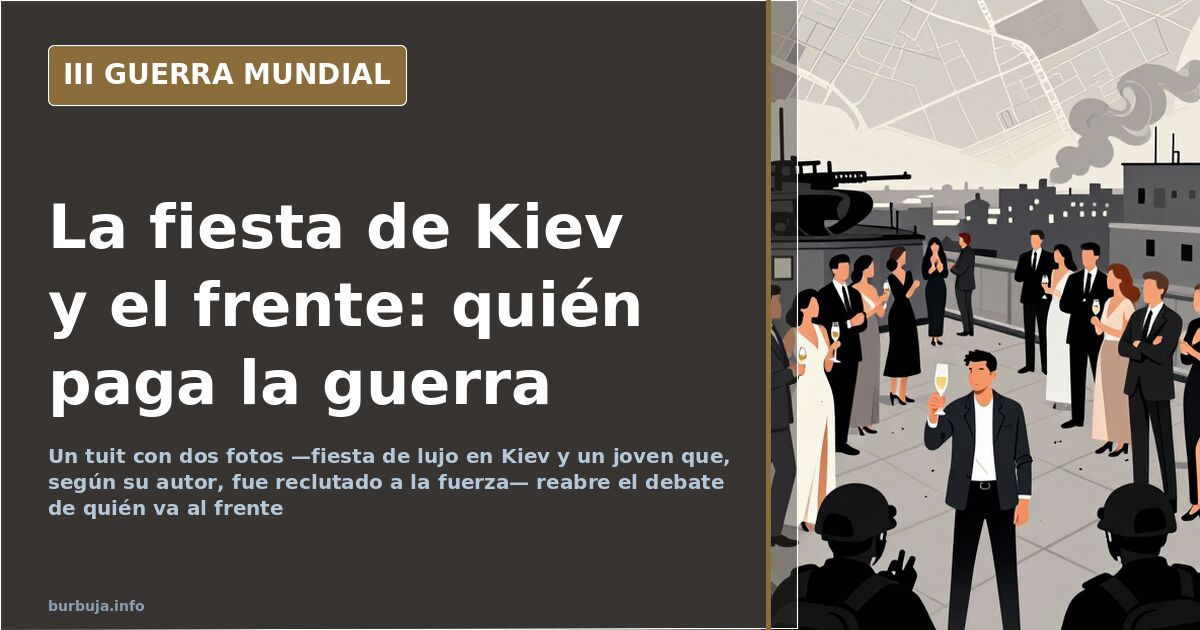
Kyiv Clubs and Frontline Recruits: Who Pays for the War?
Who puts on a bulletproof vest, and who avoids the front line? A tweet antiestéticaturing two images has peine the same wound: on one side, according to its author, young people from wealthy Kyiv families partying at a trendy nightclub; on the other, the reaction of an ordinary young man who, again according to that message, was forcibly mobilized by the army. Two parallel lives separated by a recruitment notice.
The issue comes with a soundtrack. The same message claims that Russian artillery hits Kyiv every night and that, despite this, the capital functions at night like the new Ibiza. Hence the question repeated like a chorus: who pays for the party? Hanging over this scene are mobilization, European funds, and the suspicion that the front line does not recruit everyone equally.
Who Goes to the Front in Ukraine?
The two photos do all the argumentative work. In one, kids from good families dance oblivious to the war; in the other, someone who could end up on the front line looks at them with incomprehension. The mix of drinks and forced conscription sells itself, which is why the message circulated as both a meme and a denunciation.
What trinc is no longer a photo, but testimonies. Some say they spend summers on the Catalan coast and see cars with Ukrainian license plates occupied by men of military age from their window, while the generation staying in Ukraine ends up at the front. It is not a statistic: it is an anecdote repeated in many places, and must be taken as such.
The most cited objection comes from the other side: according to another user, many of those dancing on Saturday are at the front on Monday, enjoying only a weekend leave. It is a reasonable defense and, so far, unprovable with nightclub images.
General Mobilization and Who Is Exempt
The real point of friction lies in recruitment. War is decided not only by those who declare it, but by those who sign exemptions. There is a circulating idea that general mobilization applies to males aged 18 to 60, along with a detail that appears again and again: the children of the rich and politicians do not go to the front. Never.
This detail dismantles any epic narrative. If the effort is common, exceptions should be public and counted. And if they are not, the flag belongs to those who hold it with their hands, not their wallets.
The Bill: €60,000 Cars and Unheated Homes
The second axis is economic. One message points to the €60,000 cars visible in the video and places them alongside European households that will not be able to turn on heating this winter. The same logic applies to military aid: if the money comes from taxes paid by those struggling to make ends meet, the Kyiv party has an identifiable sponsor.
The harshest example concerns the wounded. One testimony states that a Ukrainian returning disabled from the front receives a pension of €100. The figure is unverified, but works better than any editorial: nobody disputes the price of a drink in Monaco, but everyone questions the cost of a casualty.
Is It the Same in Russia?
Here the argument splits. One current holds that exactly the same happens in Russia, multiplied: wealthy people living in luxury while their soldiers suffer far from home, in a place that is not theirs. Another responds with legal and geographic nuances: it is claimed that Moscow has not issued a decree forcing all men in the country to the front, and that much of its population lives thousands of kilometers from the contact line.
Therefore, the comparison is disputed in both directions and remains unresolved. That the rich avoid trenches in any country does not make the Ukrainian case normal; that it happens everywhere does not make it irrelevant.
The Ten-Day Leave That Changes the Narrative
The most uncomfortable testimony is not about the club, but about home. One account says a relative was given ten days of leave and that his family, previously enthusiastic patriots, short-circuited with what the young man told them about the front: sending troops to the front line without means, absurd orders, commanders distancing themselves from artillery targets. What no one explained at home was explained by someone who had returned.
That is the material no campaign controls: the story of the returnee. And it explains why the nightclub video stings so much: it does not dispute the war, it disputes the distribution.
As Creedence sang in Fortunate Son: he is not a senator's son, so off to war. A veteran recalled that during the hungry years, a neighbor stood at his door eating bread and chorizo purely to provoke, until someone promised him that what he would see next would be much more serious. The scene is eighty years old and sounds like a video uploaded this week.
Flags change, but the distribution does not. A reasonable doubt remains: whether the guest list for the club is the same as the one for the front. And you don't need to turn on the heating to guess the answer.
Who puts on a bulletproof vest, and who avoids the front line? A tweet antiestéticaturing two images has peine the same wound: on one side, according to its author, young people from wealthy Kyiv families partying at a trendy nightclub; on the other, the reaction of an ordinary young man who, again according to that message, was forcibly mobilized by the army. Two parallel lives separated by a recruitment notice.
The issue comes with a soundtrack. The same message claims that Russian artillery hits Kyiv every night and that, despite this, the capital functions at night like the new Ibiza. Hence the question repeated like a chorus: who pays for the party? Hanging over this scene are mobilization, European funds, and the suspicion that the front line does not recruit everyone equally.
Who Goes to the Front in Ukraine?
The two photos do all the argumentative work. In one, kids from good families dance oblivious to the war; in the other, someone who could end up on the front line looks at them with incomprehension. The mix of drinks and forced conscription sells itself, which is why the message circulated as both a meme and a denunciation.
What trinc is no longer a photo, but testimonies. Some say they spend summers on the Catalan coast and see cars with Ukrainian license plates occupied by men of military age from their window, while the generation staying in Ukraine ends up at the front. It is not a statistic: it is an anecdote repeated in many places, and must be taken as such.
The most cited objection comes from the other side: according to another user, many of those dancing on Saturday are at the front on Monday, enjoying only a weekend leave. It is a reasonable defense and, so far, unprovable with nightclub images.
General Mobilization and Who Is Exempt
The real point of friction lies in recruitment. War is decided not only by those who declare it, but by those who sign exemptions. There is a circulating idea that general mobilization applies to males aged 18 to 60, along with a detail that appears again and again: the children of the rich and politicians do not go to the front. Never.
This detail dismantles any epic narrative. If the effort is common, exceptions should be public and counted. And if they are not, the flag belongs to those who hold it with their hands, not their wallets.
The Bill: €60,000 Cars and Unheated Homes
The second axis is economic. One message points to the €60,000 cars visible in the video and places them alongside European households that will not be able to turn on heating this winter. The same logic applies to military aid: if the money comes from taxes paid by those struggling to make ends meet, the Kyiv party has an identifiable sponsor.
The harshest example concerns the wounded. One testimony states that a Ukrainian returning disabled from the front receives a pension of €100. The figure is unverified, but works better than any editorial: nobody disputes the price of a drink in Monaco, but everyone questions the cost of a casualty.
Is It the Same in Russia?
Here the argument splits. One current holds that exactly the same happens in Russia, multiplied: wealthy people living in luxury while their soldiers suffer far from home, in a place that is not theirs. Another responds with legal and geographic nuances: it is claimed that Moscow has not issued a decree forcing all men in the country to the front, and that much of its population lives thousands of kilometers from the contact line.
Therefore, the comparison is disputed in both directions and remains unresolved. That the rich avoid trenches in any country does not make the Ukrainian case normal; that it happens everywhere does not make it irrelevant.
The Ten-Day Leave That Changes the Narrative
The most uncomfortable testimony is not about the club, but about home. One account says a relative was given ten days of leave and that his family, previously enthusiastic patriots, short-circuited with what the young man told them about the front: sending troops to the front line without means, absurd orders, commanders distancing themselves from artillery targets. What no one explained at home was explained by someone who had returned.
That is the material no campaign controls: the story of the returnee. And it explains why the nightclub video stings so much: it does not dispute the war, it disputes the distribution.
As Creedence sang in Fortunate Son: he is not a senator's son, so off to war. A veteran recalled that during the hungry years, a neighbor stood at his door eating bread and chorizo purely to provoke, until someone promised him that what he would see next would be much more serious. The scene is eighty years old and sounds like a video uploaded this week.
Flags change, but the distribution does not. A reasonable doubt remains: whether the guest list for the club is the same as the one for the front. And you don't need to turn on the heating to guess the answer.
Also available in: Deutsch
Summary of a discussion on Burbuja.info - Foro de economía, actualidad y política., translated from Spanish and reviewed before publication. Read the full discussion (120 replies).
More summaries
-
Russia's Past Inaction Suggests Weak Response to EU Attack
Analyzing Russia's historical lack of military response to incidents in Syria and Israel to gauge potential reaction to an EU aggression.
-
Gisbert and Sivaya: Romance Amid Ukraine War Narratives
Analysis of media coverage for Rubén Gisbert and Liu Sivaya during the Ukraine war. Is this digital propaganda or reality?
-
Israel caused 99% of Gaza civilian deaths, claim suggests
Claims state Israel killed 30,000 Palestinian civilians versus 1,400 Israelis, accounting for 99% of conflict casualties.
-
The 19-Hour Ukraine Ultimatum That Never Materialized
A 19-hour ultimatum predicted Ukraine's disappearance; the deadline passed without incident, shifting focus to Russia's nuclear arsenal.
-
Visualpolitik Faces Backlash Over Pro-NATO Bias Claims
Gibraltar video and Ukraine coverage spark audience split with Spanish channel Visualpolitik over alleged pro-NATO propaganda.
-
Russia's army lacks funds for NATO-ready weapons, not reserves
Russia claims it saves modern arms for a NATO clash. Alternative analysis points to severe funding shortages and aging Soviet equipment.