
Silver enters backwardation as COMEX stocks hit lows
Silver is in backwardation with COMEX inventories at record lows. Structural deficits and industrial demand drive prices.
English · Original discussion in Spanish · Published
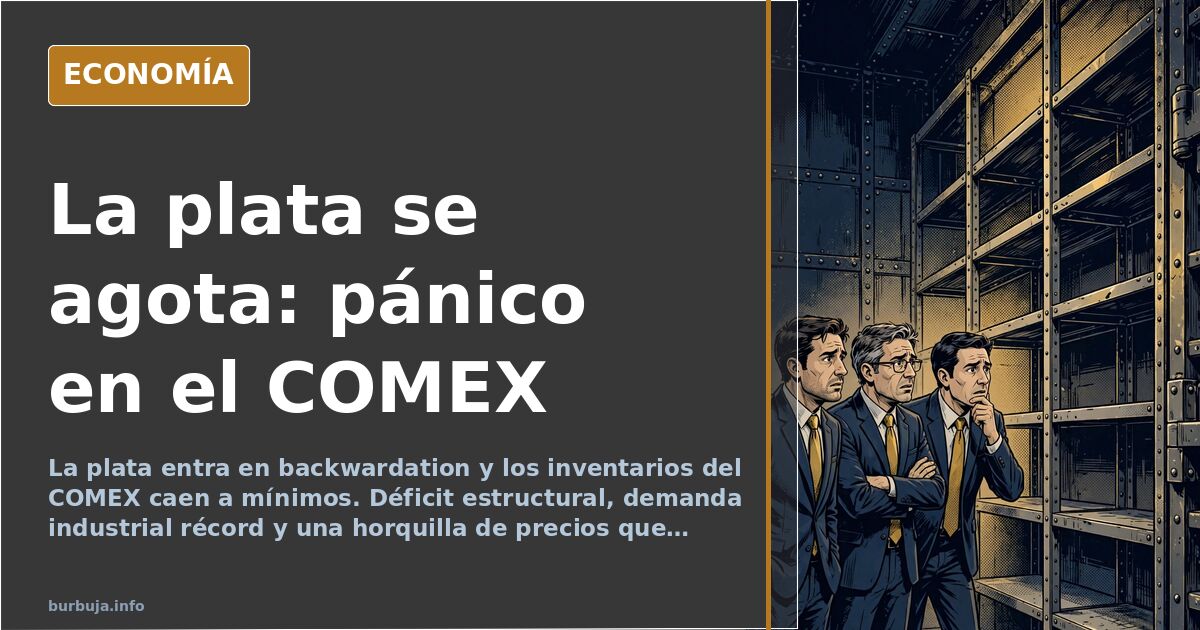
Silver enters backwardation as COMEX stocks plummet
What happens when physical metal costs more today than in three months? The paper market starts to sustancia ilegal. Silver has entered backwardation, an anomaly in a non-perishable commodity that only panic explains: contract holders prefer paying a premium for immediate delivery rather than waiting ninety days. COMEX inventories are falling at a pace some describe as a house of cards losing its base. Meanwhile, Shanghai warehouses are emptying, and industrial demand—from solar panels to microchips—shows no signs of slowing.
What backwardation means for the silver market
Backwardation signals that paper and metal have diverged. In normal markets, three-month futures trade above spot prices due to storage and financing costs. When this reverses, the message is clear: there are more contracts than silver. Holders of papers promising March delivery suspect there may be no silver left by then.
The mechanism is well-known. Major banks settle futures to push prices down, but each settlement requires more physical metal to cover positions. It is a vicious cycle: they drain inventory to control price, accelerating depletion. COMEX vault data shows sustained drops in registered silver available for delivery.
The structural deficit absent in 2011
This differs from the 2011 speculative bubble. Back then, the market did not face five consecutive years of silver deficits. Now it does, according to some analysts. Industrial demand exceeds mining output year after year, consuming accumulated stock. This is not opinion; it is metal accounting.
Aggressive analysts calculate based on the gold/silver ratio. If gold hits $11,000 per ounce—a likely scenario in monetary stress—and the ratio compresses to 40, silver would trade around $275 per ounce. At a ratio of 30, it reaches $367. At 20, $550. The $250-$550 range is not prediction; it is conditional arithmetic.
China, Shanghai, and the silent war for metal
Shanghai wholesale market warehouses have been emptying for weeks. Post-Chinese New Year data shows consecutive stock declines. The geopolitical reading is inevitable: while the West focuses on culture wars, China accumulates metals, energy, and technology with long-term strategies, say some observers.
It is not a frontal attack but a slow strangulation. Each ounce leaving Western vaults and crossing the Pacific removes a piece from the board. When Chinese buyers resume withdrawals from Shanghai vaults after holidays, pressure on the physical market could be significant.
Leverage risk: winning and losing simultaneously
An uncomfortable paradox exists in this thesis. If the scenario unfolds—fiat confidence collapses, metal surges—the money "won" may be worth less than the metal held. You win the bet but lose the currency you are paid in.
For leveraged traders, the risk is different: margin calls during sharp swings can eject them just before takeoff. Banks can trigger brutal technical drops by settling paper contracts. This is their control mechanism, but each intervention costs real inventory. Those holding without leverage see the end; those who don't, likely won't.
What skeptics say
Not everyone buys the narrative. Some argue mobility between COMEX registered and eligible inventories is higher than perceived, and rapid price rises attract external supply. Others claim the gold/silver ratio is misleading over the last fifty years and the market is heavily intervened. As long as brokers sell contracts on assets they lack, prices can decouple from physical reality longer than anyone’s patience lasts.
The counter-argument is that structural deficits cannot be fixed by inventory mobility. If consumption exceeds production for five years, adjustment comes via price or shortage. There is no third way.
Silver rose 8% in one session while COMEX continued emptying. Buyers from years ago at $8/oz are pleased. Leveraged traders at $32 pray. Central banks maintain everything is fine. All is well.
What happens when physical metal costs more today than in three months? The paper market starts to sustancia ilegal. Silver has entered backwardation, an anomaly in a non-perishable commodity that only panic explains: contract holders prefer paying a premium for immediate delivery rather than waiting ninety days. COMEX inventories are falling at a pace some describe as a house of cards losing its base. Meanwhile, Shanghai warehouses are emptying, and industrial demand—from solar panels to microchips—shows no signs of slowing.
What backwardation means for the silver market
Backwardation signals that paper and metal have diverged. In normal markets, three-month futures trade above spot prices due to storage and financing costs. When this reverses, the message is clear: there are more contracts than silver. Holders of papers promising March delivery suspect there may be no silver left by then.
The mechanism is well-known. Major banks settle futures to push prices down, but each settlement requires more physical metal to cover positions. It is a vicious cycle: they drain inventory to control price, accelerating depletion. COMEX vault data shows sustained drops in registered silver available for delivery.
The structural deficit absent in 2011
This differs from the 2011 speculative bubble. Back then, the market did not face five consecutive years of silver deficits. Now it does, according to some analysts. Industrial demand exceeds mining output year after year, consuming accumulated stock. This is not opinion; it is metal accounting.
Aggressive analysts calculate based on the gold/silver ratio. If gold hits $11,000 per ounce—a likely scenario in monetary stress—and the ratio compresses to 40, silver would trade around $275 per ounce. At a ratio of 30, it reaches $367. At 20, $550. The $250-$550 range is not prediction; it is conditional arithmetic.
China, Shanghai, and the silent war for metal
Shanghai wholesale market warehouses have been emptying for weeks. Post-Chinese New Year data shows consecutive stock declines. The geopolitical reading is inevitable: while the West focuses on culture wars, China accumulates metals, energy, and technology with long-term strategies, say some observers.
It is not a frontal attack but a slow strangulation. Each ounce leaving Western vaults and crossing the Pacific removes a piece from the board. When Chinese buyers resume withdrawals from Shanghai vaults after holidays, pressure on the physical market could be significant.
Leverage risk: winning and losing simultaneously
An uncomfortable paradox exists in this thesis. If the scenario unfolds—fiat confidence collapses, metal surges—the money "won" may be worth less than the metal held. You win the bet but lose the currency you are paid in.
For leveraged traders, the risk is different: margin calls during sharp swings can eject them just before takeoff. Banks can trigger brutal technical drops by settling paper contracts. This is their control mechanism, but each intervention costs real inventory. Those holding without leverage see the end; those who don't, likely won't.
What skeptics say
Not everyone buys the narrative. Some argue mobility between COMEX registered and eligible inventories is higher than perceived, and rapid price rises attract external supply. Others claim the gold/silver ratio is misleading over the last fifty years and the market is heavily intervened. As long as brokers sell contracts on assets they lack, prices can decouple from physical reality longer than anyone’s patience lasts.
The counter-argument is that structural deficits cannot be fixed by inventory mobility. If consumption exceeds production for five years, adjustment comes via price or shortage. There is no third way.
Silver rose 8% in one session while COMEX continued emptying. Buyers from years ago at $8/oz are pleased. Leveraged traders at $32 pray. Central banks maintain everything is fine. All is well.
Summary of a discussion on Burbuja.info - Foro de economía, actualidad y política., translated from Spanish and reviewed before publication. Read the full discussion (153 replies).
More summaries
-
China and Russia push yuan to challenge dollar dominance
China and Russia agree on yuan-based trade in Asia and Latin America. Over 40 countries seek BRICS membership, signaling a potential end to the petrodollar era.
-
Silver Hits €2.18/Gram as Gold Targets $5,000
Silver surpasses €2.18 per gram while gold nears $5,000. ABC Bullion shifts spot pricing from Comex to Shanghai at $90.52/oz.
-
America's Price: Inflation, Bankruptcies, and Castilla's Hollowing
American silver and gold fueled Habsburg wars and Spanish inflation while depopulating Castilla. A look at the economic and human costs of conquest.
-
Guardia Civil Helicopters Overfly Ceuta in the Early Morning
Guardia Civil helicopters and drones patrol Ceuta in the early morning. Flight tracking suggests a deployment without an official statement.
-
European car sales plunge: Germany down 28%, Spain 6.5%
Car registrations in Europe are falling sharply, with Germany seeing a 28% drop and Spain 6.5% in August, according to industry data.
-
Spain's housing minister shares landlord chats filtering tenants
Pablo Echenique shared chats of 2,000 Spanish landlords refusing to rent to families with children or migrants, citing legal risks.