
European car sales plunge: Germany down 28%, Spain 6.5%
Car registrations in Europe are falling sharply, with Germany seeing a 28% drop and Spain 6.5% in August, according to industry data.
English · Original discussion in Spanish · Published
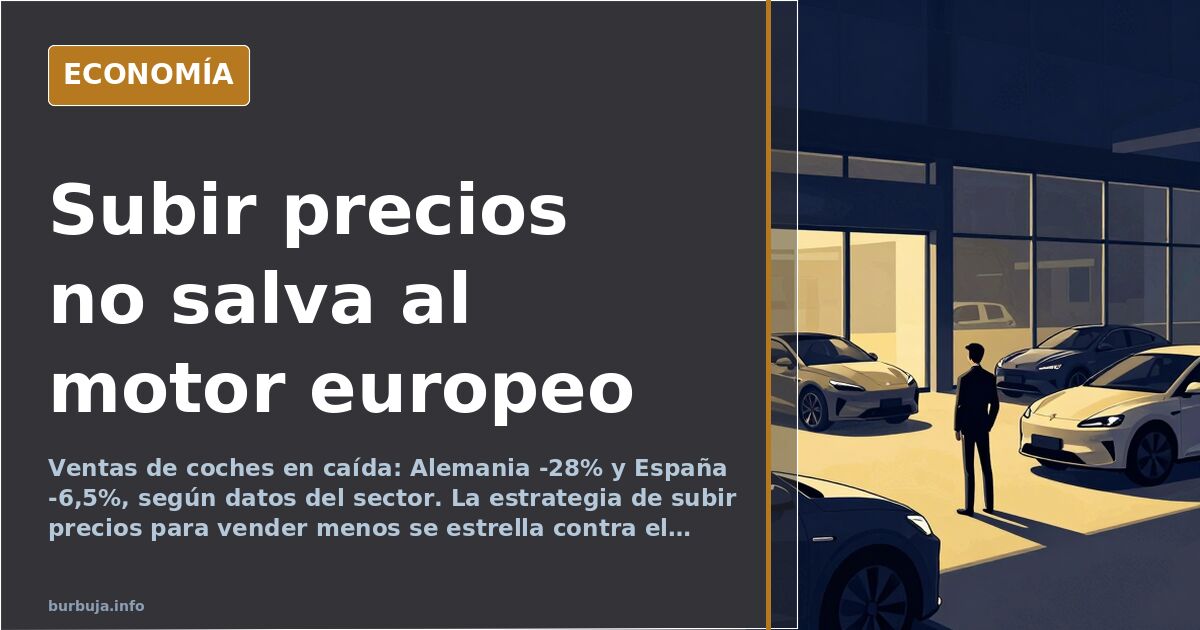
Raising prices fails to save the auto sector: German sales slump by 28%
New car registrations are plummeting across Europe. Germany recorded a 28% decline and Spain a 6.5% drop in August, according to industry data. The strategy of major European brands seemed clear: sell fewer units at higher prices to maintain margins. The numbers show it is not working. Consumers have stopped buying, and not just because of price.
The German collapse is the most striking. Europe's largest economy, historically an automotive powerhouse, sees its industry bleeding out while Japanese brands that bet on hybrids rather than pure electric vehicles are weathering the storm better. Toyota, Honda, and Mazda resisted forced electrification and, for now, their strategy is proving correct.
Why are car sales collapsing in Germany?
The 28% drop in Germany cannot be explained solely by rising prices. There is an explosive cocktail: electric cars are not taking off, subsidies are being withdrawn or reduced, and European consumers have lost confidence that their next car will be better than the previous one. Manufacturers bet everything on a technology that is not yet mature and at a price that matches internal combustion engines from above, not below.
The result is that combustion models slated for disappearance remain in the catalog because they are the only ones people buy. The Volkswagen Polo or Passat, which had expiration dates, are stretched year after year. Brands are overwhelmed by market reality and lack the capacity to react.
In Spain, the decline is smaller, at 6.5%, but the market was already coming from very low levels. The average Spanish consumer cannot afford a new car at current prices. A basic compact exceeds €30,000, and typical buyers are retreating to the second-hand market or extending the life of their current vehicle to unprecedented limits.
The strategy of raising prices to sell less
The tactic of major brands was well known: if I don't sell, I raise the price. Fewer units, higher margin per unit. A flawless plan on paper that crashes when buyers simply stop purchasing. Executives of some brands recently boasted about preferring to sell fewer cars and earn more per unit. Reality has corrected their PowerPoint presentations.
Some argue the problem is supply-side: European brands have lost competitiveness against Korean, Japanese, and Chinese rivals. What little sells is Korean, Japanese, or Dacia, brands offering similar products at lower prices. Buyers are not foolish; they compare. A Dacia takes you to the same places as an Audi, and in some safety tests, it performed better than Volkswagen Group models costing twice as much.
The paradox is that European manufacturers were the first to embrace decarbonization policies that now suffocate them. They supported circulation restrictions, environmental requirements, and forced electrification. Now they ask for more time, more aid, and more flexibility. They prepared the fertile ground themselves.
Electric cars aren't taking off, and combustion engines are getting expensive
Electric cars still fail to convince European buyers. High price, limited range, and insufficient charging network are the three brakes no one has resolved. The promise was that electric would match combustion in price, but the opposite peine: combustion prices rose to match electric. The consumer pays for the transition.
Meanwhile, traditional diesel and gasoline engines remain the most in demand. Some miss the 1.9 TDI and argue that if they want to bring it back, it will be too late. Sodium battery technology, which could reduce electric costs to €15,000–€20,000, is not yet on the market. With current technology, electric cars are not antiestéticasible for middle-income countries like Spain.
The underlying problem is that European brands have missed the train of accessible innovation. Toyota developed hybrids aiming to minimize pollution without sacrificing practicality. Honda went with another hybrid system. Mazda risked efficient combustion engines. Japanese makers did not bet everything on electric and today breathe easier.
What happens with Volkswagen and employment in the European auto industry?
Volkswagen faces an unprecedented crisis. The company is considering laying off 15,000 employees and Dacia 11,000, according to information circulating in the sector. The German giant has become inefficient, too large to react quickly, and with a cost structure that cannot withstand falling sales. No one dares to do what is necessary for antiestéticar of consequences.
The lingering question is whether the problem is only about prices or something deeper. Germany is not experiencing a general economic crisis, but its automotive industry, the crown jewel, is bleeding out. Announced layoffs will have a domino effect on suppliers and the entire value chain. The auto sector employs millions in Europe directly and indirectly.
Private buyers have changed their attitude. Cars are becoming luxury goods for a growing part of the population. Those who can extend the life of their current vehicle. Those who cannot buy used. Those forced to change look for Korean, Japanese, or Dacia. Premium European brands are losing the mass market.
A perfect storm has formed with four open fronts: total bet on electric, rising prices, increasing regulatory demands, and circulation restrictions. Each factor alone would be manageable. Together they have broken the market. Manufacturers who resisted forced electrification are winning the game. Those who trinc the narrative are losing it. Meanwhile, the European consumer looks at their old car and calculates how many more years they can stretch it.
New car registrations are plummeting across Europe. Germany recorded a 28% decline and Spain a 6.5% drop in August, according to industry data. The strategy of major European brands seemed clear: sell fewer units at higher prices to maintain margins. The numbers show it is not working. Consumers have stopped buying, and not just because of price.
The German collapse is the most striking. Europe's largest economy, historically an automotive powerhouse, sees its industry bleeding out while Japanese brands that bet on hybrids rather than pure electric vehicles are weathering the storm better. Toyota, Honda, and Mazda resisted forced electrification and, for now, their strategy is proving correct.
Why are car sales collapsing in Germany?
The 28% drop in Germany cannot be explained solely by rising prices. There is an explosive cocktail: electric cars are not taking off, subsidies are being withdrawn or reduced, and European consumers have lost confidence that their next car will be better than the previous one. Manufacturers bet everything on a technology that is not yet mature and at a price that matches internal combustion engines from above, not below.
The result is that combustion models slated for disappearance remain in the catalog because they are the only ones people buy. The Volkswagen Polo or Passat, which had expiration dates, are stretched year after year. Brands are overwhelmed by market reality and lack the capacity to react.
In Spain, the decline is smaller, at 6.5%, but the market was already coming from very low levels. The average Spanish consumer cannot afford a new car at current prices. A basic compact exceeds €30,000, and typical buyers are retreating to the second-hand market or extending the life of their current vehicle to unprecedented limits.
The strategy of raising prices to sell less
The tactic of major brands was well known: if I don't sell, I raise the price. Fewer units, higher margin per unit. A flawless plan on paper that crashes when buyers simply stop purchasing. Executives of some brands recently boasted about preferring to sell fewer cars and earn more per unit. Reality has corrected their PowerPoint presentations.
Some argue the problem is supply-side: European brands have lost competitiveness against Korean, Japanese, and Chinese rivals. What little sells is Korean, Japanese, or Dacia, brands offering similar products at lower prices. Buyers are not foolish; they compare. A Dacia takes you to the same places as an Audi, and in some safety tests, it performed better than Volkswagen Group models costing twice as much.
The paradox is that European manufacturers were the first to embrace decarbonization policies that now suffocate them. They supported circulation restrictions, environmental requirements, and forced electrification. Now they ask for more time, more aid, and more flexibility. They prepared the fertile ground themselves.
Electric cars aren't taking off, and combustion engines are getting expensive
Electric cars still fail to convince European buyers. High price, limited range, and insufficient charging network are the three brakes no one has resolved. The promise was that electric would match combustion in price, but the opposite peine: combustion prices rose to match electric. The consumer pays for the transition.
Meanwhile, traditional diesel and gasoline engines remain the most in demand. Some miss the 1.9 TDI and argue that if they want to bring it back, it will be too late. Sodium battery technology, which could reduce electric costs to €15,000–€20,000, is not yet on the market. With current technology, electric cars are not antiestéticasible for middle-income countries like Spain.
The underlying problem is that European brands have missed the train of accessible innovation. Toyota developed hybrids aiming to minimize pollution without sacrificing practicality. Honda went with another hybrid system. Mazda risked efficient combustion engines. Japanese makers did not bet everything on electric and today breathe easier.
What happens with Volkswagen and employment in the European auto industry?
Volkswagen faces an unprecedented crisis. The company is considering laying off 15,000 employees and Dacia 11,000, according to information circulating in the sector. The German giant has become inefficient, too large to react quickly, and with a cost structure that cannot withstand falling sales. No one dares to do what is necessary for antiestéticar of consequences.
The lingering question is whether the problem is only about prices or something deeper. Germany is not experiencing a general economic crisis, but its automotive industry, the crown jewel, is bleeding out. Announced layoffs will have a domino effect on suppliers and the entire value chain. The auto sector employs millions in Europe directly and indirectly.
Private buyers have changed their attitude. Cars are becoming luxury goods for a growing part of the population. Those who can extend the life of their current vehicle. Those who cannot buy used. Those forced to change look for Korean, Japanese, or Dacia. Premium European brands are losing the mass market.
A perfect storm has formed with four open fronts: total bet on electric, rising prices, increasing regulatory demands, and circulation restrictions. Each factor alone would be manageable. Together they have broken the market. Manufacturers who resisted forced electrification are winning the game. Those who trinc the narrative are losing it. Meanwhile, the European consumer looks at their old car and calculates how many more years they can stretch it.
Summary of a discussion on Burbuja.info - Foro de economía, actualidad y política., translated from Spanish and reviewed before publication. Read the full discussion (150 replies).
More summaries
-
Volkswagen Halts Electric Car Production Amid Falling Demand
Volkswagen to pause electric car production lines for two weeks in October due to declining orders. Electric vehicle share in Germany remains below 16%.
-
Germany: 32% of new cars are electric
Germany recorded 32.4% electric car sales in August. Chinese brands are thriving while Volkswagen downsizes. Bubble or reality?
-
BYD outsells Tesla sixfold, shaking European auto industry
BYD sold over a million EVs in one quarter vs. Tesla's 318,000, with its valuation near $93 billion as Europe watches.
-
Maricarmen Eviction: Old Rent, Vulture Fund, and Pre-election Circus
An 87-year-old woman, an old rent contract, and an upcoming election: why Maricarmen's eviction is at the center of public debate.
-
Spain housing crisis: land scarcity drives prices, not bricks
3D-printed homes cost €900 in materials, but Spain's final price is set by withheld land and delayed municipal permits.
-
Villacís retracts stance on euthanasia after Noelia case
Begoña Villacís admits the Noelia case changed her view on euthanasia, which she previously supported politically. The debate over legal limits returns to the forefront.