
Shopper finds worms in blue whiting bought at €2.5/kg in Spain
A shopper in Spain reports worms in blue whiting bought at €2.5/kg, reopening the debate about anisakis in fish sold as fresh.
English · Original discussion in Spanish · Published
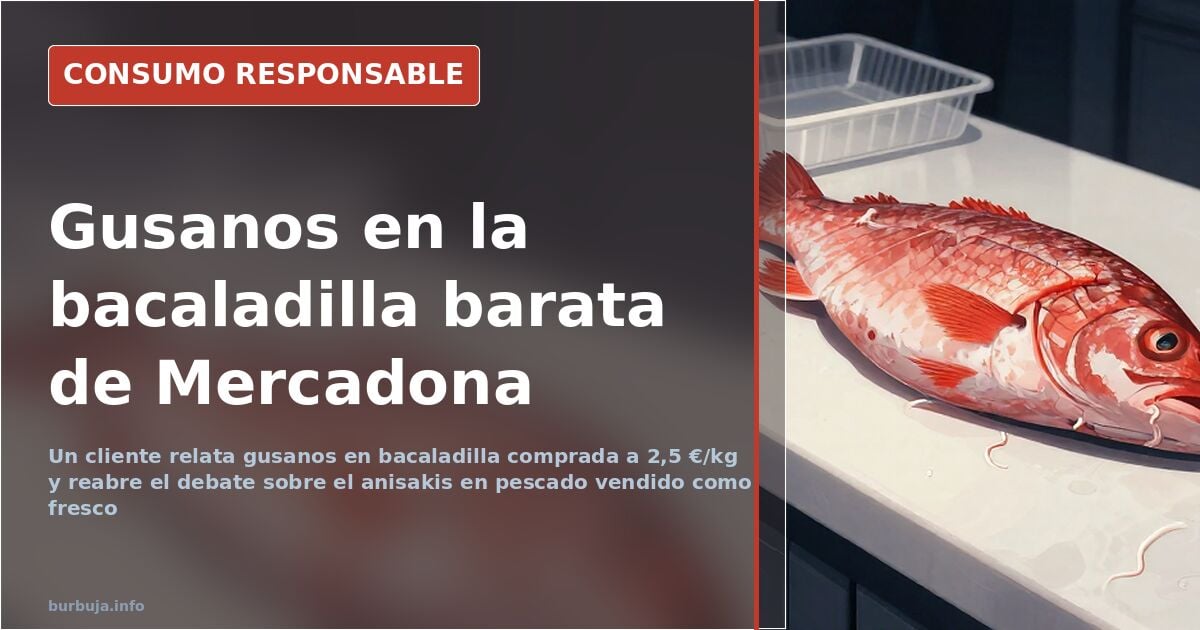
Blue whiting at €2.5/kg: worms on the plate and doubts about labelling
What happens when the cheapest fish on the shelf ends up costing more than it seems? A shopper says they bought half a kilo of blue whiting at a Mercadona fish counter for €2.5 a kilo, seasoned it with lemon in a deep dish and, on taking it out of the fridge, found almost transparent worms crawling across the plate and another half dozen scattered around the fridge. The fish ended up in the bin. Afterwards they repeated the purchase at their usual fishmonger's, at €5.50 a kilo, and say not a single parasite showed up there.
The story, shared on a consumer forum, has peine an uncomfortable issue: the presence of anisakis in species such as blue whiting, hake or anchovy, and the scant information buyers get about the prior treatment of fish sold as fresh.
What is anisakis and why does it appear in blue whiting?
Anisakis is a parasite commonly found in mid- and deep-water fish. It is not exclusive to any particular chain: it appears in hake, blue whiting and many other species, and its presence depends on the fishing grounds and subsequent handling, not on the price per kilo. Those who have dealt with it firsthand put it bluntly: "the Mercadona fish has anisakis, and so does the fish from the best fishmonger in the world".
The real problem is not the visible worm, but the larva you cannot see. According to a calculation circulating in the thread, each specimen weighs barely 2 milligrams, which explains why it goes unnoticed in a home inspection. The only effective barrier is freezing beforehand at below -19 degrees for at least 48 hours, or cooking it through. Lemon, vinegar and escabeche do not kill the parasite: it withstands high concentrations of salt and organic acids, so a homemade marinade offers no protection at all.
Lemon does not kill the parasite: why marinating is a risk
The anecdote of the deep dish with half a squeezed lemon is, in fact, a manual of what not to do. Citric acid may irritate the worm and make it move, but it does not inactivate it. Anyone who has prepared vinegar-marinated anchovies or a ceviche without freezing the fish first has been exposed to a live larva.
The consequences are not just stomach-related. Anisakiasis can become chronic and cause digestive problems for years. The material cites the case of a person who reportedly spent five years with after-effects attributed to eating raw fish. No small matter: this is an illness that gets confused with other conditions and takes a long time to diagnose.
Some argue the risk is acceptable because most catches carry it in minimal quantities. The more cautious calculation starts from the opposite premise: if the fish is not frozen, not fully cooked or is marinated, the probability of ingesting a live larva stops being remote.
Fresh, frozen or market fish: what the labelling says
Fish sold as fresh may have been frozen beforehand and thawed for sale, a legal practice that is not always clearly disclosed. The advice repeated by people who work with the product is to ask at the counter whether the fish arrived frozen. If the answer is yes, the problem is solved before you get home.
Price is no discriminator. The blue whiting in question was sold at €2.5 a kilo at the chain and at €5.50 at the traditional fishmonger's, but the parasite does not care about price tags. What differs between one counter and another is the handling: quick gutting, cold chain and, above all, transparency about the origin. A fisherman put it clearly: "always freeze it, whether you see the anisakis or not".
What consumers can do about fish with parasites
The most commonly cited route is to return the product to the store and request a refund. A formal complaint can also be filed through the complaints form or with the relevant consumer authority, although this route does not guarantee automatic compensation. What you should not do is eat it raw or marinated.
The deeper debate is another one: if fish is sold as fresh, the buyer should know whether it has been frozen and at what temperature. That information is not always on the label. And without it, the only real defence is the freezer at home.
In the end, the cheaper blue whiting ended up in the bin and the more expensive one in the frying pan. The saving of three euros a kilo is paid for in disgust, in uncertainty and, if the larva survives, in a doctor's appointment. Quite the bargain.
Also available in: Deutsch
Summary of a discussion on Burbuja.info - Foro de economía, actualidad y política., translated from Spanish and reviewed before publication. Read the full discussion (36 replies).
More summaries
-
Mercadona drops fresh fish counters, leaving neighborhoods without fishmongers
Mercadona removes fresh fish from its counters, replacing it with packaged trays. Prices jump to €18/kg vs €10/kg at local shops, ending the traditional model.
-
Worms in Mercadona fish sparks food safety debate in Spain
The discovery of Anisakis in supermarket fish has triggered a debate about food safety and traceability across the supply chain.
-
Customer reports live anisakis in hake at Madrid Alcampo
A customer reported finding live anisakis up to 3cm long in hake purchased from an Alcampo store in Madrid. The chain offered a refund.
-
Albo and frozen Louriño, the most recommended callos on the forum
Several forum members criticise Litoral and recommend Albo, La Nora and, above all, the frozen Louriño
-
No more ads and AI summaries: uBlock Origin filters
uBlock Origin lets you remove ads, pop-ups and the AI summaries some sites place after the first post without breaking the page.
-
Night swimming under a moonless sky: the experience the daytime beach can't match
Discover why swimming in the sea at night with no moon is a unique experience, far from the daytime crowds. The threat of regulation looming over this pleasure.