
Sharon Stone, 67: "Men look at you less because you're not as easy"
Sharon Stone, 67, says men look at her less because she's "not as easy," not due to a lack of attractiveness. The debate on age and desire.
English · Original discussion in Spanish · Published
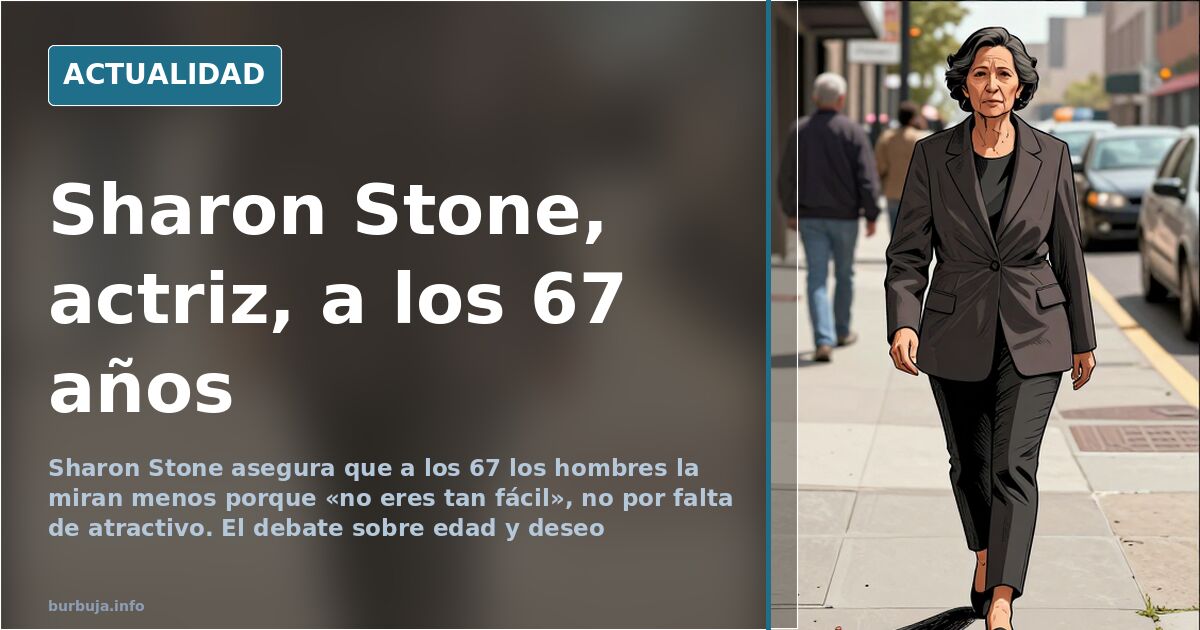
Sharon Stone, 67: "Men look at you less because you're not as easy"
Why do people stop looking at you as you get older? Sharon Stone, 67, has her own answer, and it has nothing to do with wrinkles: "It’s not because you’re not as sens, it’s because you’re not as easy." The actress defended this on the LadyGang podcast; in an interview with The Times, she stated she felt "more attractive now than I have ever been." With this on the table, public conversation has shifted to an uncomfortable question: is it conviction or self-deception? And in the background, a much more serious issue: what can and cannot be bought with money as the body ages.
What Sharon Stone said about dating at 67
Getting older was never a problem, according to her account. "A lot of people give up when they get older. They put their body aside because it's falling apart or because they think, 'My body doesn't define me anymore.' But you have to keep loving that body," she told the British newspaper. About her arms, today, she says they are "strong and beautiful… like angel wings," and wonders aloud what it matters if they have folds. On the podcast, she went further: she claims she has "as many people who want to sleep with me now as before."
There's a detail worth noting. In the same conversation, Stone places herself in her 60s, when she is actually 67. This is not an inconsequential typo: a good part of the argument rests on comparing the present with an idealized past, and that present is calculated with elastic margins.
The "difficulty" thesis: fewer glances, more filter
Her explanation for why men no longer turn around when she enters a room is the most discussed part. "There isn't that thing where you walk into a room and all the guys turn to say 'ooh' because you're not as easy as you were when you were young, you're much more discerning as you get older," she maintains. "It's not because you're not as sens, it's because you're not as easy."
From this, she draws a practical consequence: from the age of 60 onwards, one is "much sens, much better in bed, much better as a friend," and seeks something else. She now considers if she would like to hold someone's hand, go to the cinema with them, see "if they are worth it." Sens, she says, is easy, almost like having a coffee, and therefore it doesn't seem enough to her: "I don't want to have to talk to you, deal with you, take care of you, listen to all your nonsense."
The reasoning has an uncomfortable symmetry that several readers have detected without much fuss. If difficulty explains the lack of attention, any unattractive and very demanding person should be a hit in the market. General intuition suggests otherwise.
How much would someone pay to be 20 again
The conversation quickly turns to money, and a scenario that several participants in the debate repeat appears: if tomorrow they were offered to become 20 again in exchange for 90% of their fortune, they wouldn't hesitate for a second. This is a hypothetical scenario without a source to back it up, but it functions as a thermometer for a widespread idea: youth is the only thing that has no market price, precisely because it is not for sale.
Along these lines, it's pointed out that some tech billionaires fund private longevity research, and it's recalled that a billionaire's ultimate desire would not be to spend, but not to die. The formulation that best summarizes it, and which circulates with some success: behind a coffin, there is no moving truck.
What the Web thinks of her discourse
Positions are divided into four blocks. One sector concedes that for 67 years old, she looks remarkable—and that a professional actress with trainers, dietitians, and money to take care of herself has an advantage—but considers the narrative a defensive construction. Another block holds the opposite view: if she feels that way, the matter is settled, and questioning it says more about the opinion holder than the subject.
A third current emphasizes wealth. Having a mansion in Beverly Hills, it is argued, radically changes who is in front of you and with what intentions; what for an ordinary woman is a wall, for a star with a bank account is a soft toll. And a fourth points to the double standard: a 67-year-old man with the same discourse would receive considerably less patience.
What almost no one disputes is the biographical data. Some recall that she herself admitted years ago that seeing herself age was hard. That doesn't invalidate what she says now. It simply reminds us that declarations about age are very similar to economic forecasts: they are revised periodically.
What is truly being discussed
Beneath the noise lies a structural question that affects anyone over 50: how is desire distributed when physical appearance ceases to be the main asset. The answer Stone gives is optimistic and very marketable. The one given by common sense is grayer: people tend to pair up with similar ages, and forcing the narrative in the opposite direction usually doesn't end well.
Stone may be right, and the problem may indeed be that she is now harder to convince. Or perhaps the mirror, like the markets, has its own opinion and is considerably less courteous than hers.
Why do people stop looking at you as you get older? Sharon Stone, 67, has her own answer, and it has nothing to do with wrinkles: "It’s not because you’re not as sens, it’s because you’re not as easy." The actress defended this on the LadyGang podcast; in an interview with The Times, she stated she felt "more attractive now than I have ever been." With this on the table, public conversation has shifted to an uncomfortable question: is it conviction or self-deception? And in the background, a much more serious issue: what can and cannot be bought with money as the body ages.
What Sharon Stone said about dating at 67
Getting older was never a problem, according to her account. "A lot of people give up when they get older. They put their body aside because it's falling apart or because they think, 'My body doesn't define me anymore.' But you have to keep loving that body," she told the British newspaper. About her arms, today, she says they are "strong and beautiful… like angel wings," and wonders aloud what it matters if they have folds. On the podcast, she went further: she claims she has "as many people who want to sleep with me now as before."
There's a detail worth noting. In the same conversation, Stone places herself in her 60s, when she is actually 67. This is not an inconsequential typo: a good part of the argument rests on comparing the present with an idealized past, and that present is calculated with elastic margins.
The "difficulty" thesis: fewer glances, more filter
Her explanation for why men no longer turn around when she enters a room is the most discussed part. "There isn't that thing where you walk into a room and all the guys turn to say 'ooh' because you're not as easy as you were when you were young, you're much more discerning as you get older," she maintains. "It's not because you're not as sens, it's because you're not as easy."
From this, she draws a practical consequence: from the age of 60 onwards, one is "much sens, much better in bed, much better as a friend," and seeks something else. She now considers if she would like to hold someone's hand, go to the cinema with them, see "if they are worth it." Sens, she says, is easy, almost like having a coffee, and therefore it doesn't seem enough to her: "I don't want to have to talk to you, deal with you, take care of you, listen to all your nonsense."
The reasoning has an uncomfortable symmetry that several readers have detected without much fuss. If difficulty explains the lack of attention, any unattractive and very demanding person should be a hit in the market. General intuition suggests otherwise.
How much would someone pay to be 20 again
The conversation quickly turns to money, and a scenario that several participants in the debate repeat appears: if tomorrow they were offered to become 20 again in exchange for 90% of their fortune, they wouldn't hesitate for a second. This is a hypothetical scenario without a source to back it up, but it functions as a thermometer for a widespread idea: youth is the only thing that has no market price, precisely because it is not for sale.
Along these lines, it's pointed out that some tech billionaires fund private longevity research, and it's recalled that a billionaire's ultimate desire would not be to spend, but not to die. The formulation that best summarizes it, and which circulates with some success: behind a coffin, there is no moving truck.
What the Web thinks of her discourse
Positions are divided into four blocks. One sector concedes that for 67 years old, she looks remarkable—and that a professional actress with trainers, dietitians, and money to take care of herself has an advantage—but considers the narrative a defensive construction. Another block holds the opposite view: if she feels that way, the matter is settled, and questioning it says more about the opinion holder than the subject.
A third current emphasizes wealth. Having a mansion in Beverly Hills, it is argued, radically changes who is in front of you and with what intentions; what for an ordinary woman is a wall, for a star with a bank account is a soft toll. And a fourth points to the double standard: a 67-year-old man with the same discourse would receive considerably less patience.
What almost no one disputes is the biographical data. Some recall that she herself admitted years ago that seeing herself age was hard. That doesn't invalidate what she says now. It simply reminds us that declarations about age are very similar to economic forecasts: they are revised periodically.
What is truly being discussed
Beneath the noise lies a structural question that affects anyone over 50: how is desire distributed when physical appearance ceases to be the main asset. The answer Stone gives is optimistic and very marketable. The one given by common sense is grayer: people tend to pair up with similar ages, and forcing the narrative in the opposite direction usually doesn't end well.
Stone may be right, and the problem may indeed be that she is now harder to convince. Or perhaps the mirror, like the markets, has its own opinion and is considerably less courteous than hers.
Summary of a discussion on Burbuja.info - Foro de economía, actualidad y política., translated from Spanish and reviewed before publication. Read the full discussion (207 replies).
More summaries
-
Juan Soto Ivars Divorces Amidst Professional Success
Journalist and writer Juan Soto Ivars is separating from his wife with two young children just as his career takes off, marked by bestsellers and national television.
-
Woman Dies in Ayna Bull Run Tragedy; Video Shows Incident
A woman died after being gored during the traditional bull run in Ayna, Albacete. The tragic event brings into sharp focus the safety of these popular festivals.
-
Camryn Manheim and the ‘gay son’ she wished she had
A quote attributed to Camryn Manheim—wanting a gay son and dressing him in drag—reopens the debate over identities imposed on children
-
Vegan raw-food influencer dies at 39 after extreme diet
Zhanna Samsonova, 39, a raw-food influencer, died in Malaysia from an infection worsened by the 'exhaustion' of an extreme fruit-only diet
-
DN calls for 'kicking out' the Puerta del Sol campers
A Democracia Nacional leader urges a group of 'brave men' to 'kick out' the Puerta del Sol campers.
-
Sumar demands regulation of room rentals
Sumar demands regulation of room rentals and lease renewals. An investor warns that property maths no longer add up.