
Shark in Hurghada: the attack that killed a tourist
A Russian tourist died after a shark attack at a Hurghada beach and the animal was captured. The incident reopens the debate over great white, tiger and…
English · Original discussion in Spanish · Published
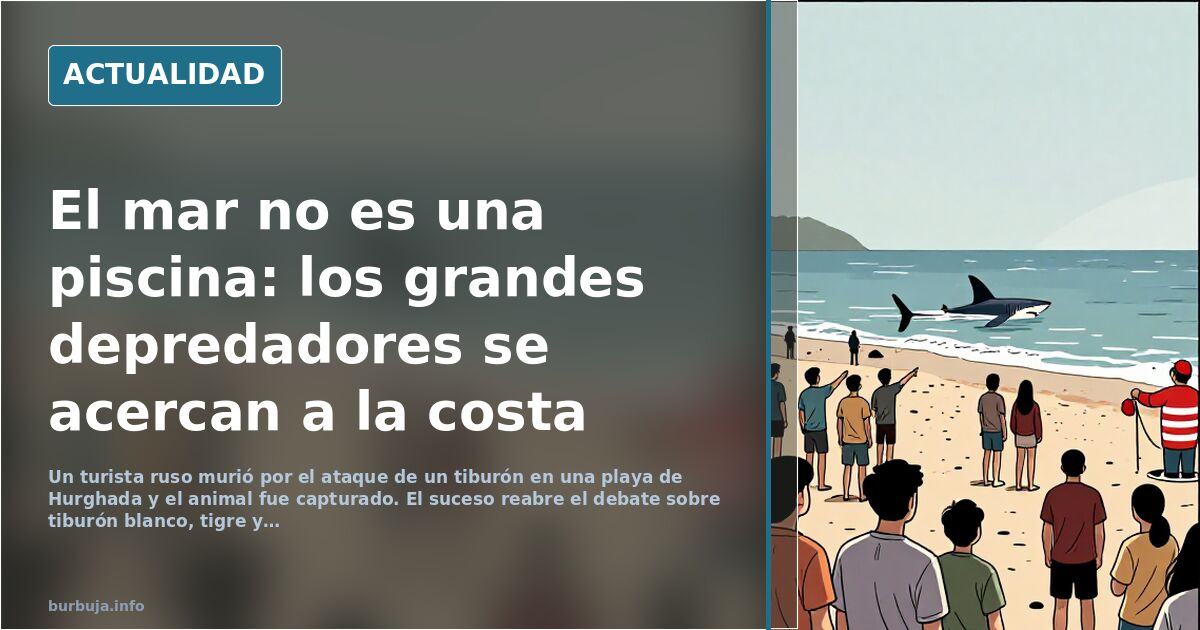
Shark kills swimmer in Hurghada: the sea is not a swimming pool
A Russian tourist died after being bitten by a shark at a beach in Hurghada, Egypt. Videos circulated through messaging channels and the reaction was immediate: capture the animal. With the shark already out of the water, the conversation drifted to the usual: whether these beasts attack to eat or, as the kinder narrative holds, only take a bite to taste and then leave without more.
The nuance matters: a test bite from a large animal is not just an anecdote, and those who have spent hours in the water maintain it. Some insist that the real risk is minimal, almost statistical, and some recall without embellishment that the sea is a hunting ground where the laws of solid ground do not apply. Between both extremes, the available data point to a known pattern: large predators approach the coast where there is food, and food approaches the coast at certain times.
What peine at the Hurghada beach
The attack was recorded from land and spread at full estimulante ilegal over Telegram and the rest of the networks. The shark, large in size, was captured shortly after, according to the videos that accompanied the event. There was no shortage of those who doubted that the captured animal was the same one that killed the swimmer: it is common for several specimens that have nothing to do with it to be killed, and for the real culprit to calmly leave to digest. Revenge is taken out on the wrong species.
That detail, the indiscriminate capture, is what opens the first front of the matter: the human reaction to an attack seeks an exemplary execution, even though the predator's biology does not work by revenge nor distinguish between a tourist and a seal.
Great white, tiger and bull shark: which is the most dangerous
The hierarchy used by those who know the species ranks sharks by aggressiveness. The great white appears first, trinc by the tiger and the bull. The tiger, however, has its own fruta: it can reach five meters, attacks coming from the bottom and, in murky waters, does not show its fin or warn. The urban beach of Recife, in Brazil, where the most attacks in the entire country are recorded, has tiger sharks as its protagonists.
The white prefers cold and temperate waters, hence its kilometric migrations; the tiger moves in warmer, tropical waters; the bull can spend months in rivers. Water temperature does not decide whether there are sharks, it decides which species appears and how close to the shore it comes.
Why should you avoid the water at dawn and dusk?
The recommendations coincide on a simple point: do not go into the sea at night, nor at dawn, nor at dusk. The reason is not superstition. At those hours fish approach the coast, and where food goes, predators go. The videos illustrating the warning are explicit: in one, what falls into the water from a boat is not waste.
To this is added the temperature factor. When the water is very cold in the Mediterranean, in areas such as Mallorca, Alicante or Almería, large specimens tend to come closer to the shore. Fishermen see it every morning on the longlines: long teeth and very ugly beasts that rarely make it to the crime news.
Mako sharks, blue sharks and great whites: the Mediterranean is not clean
The presence of large sharks in Spanish waters is not a legend. There are records of mako sharks in the Denia area, of a great white colony near Mallorca, of blue sharks and of occasional sightings of white specimens, including one in the outer port of La Coruña. The jewel of the archive is the capture of a great white shark of 1.790 kg in the almadraba of Tabarca (a traditional tuna trap) in August 1946, the kind of catch that today would be unthinkable.
Freediving spearfishing gives another scale of the phenomenon: years of going down to 20 meters on a single breath teach that the bottom is full of traffic, and that the diver's visibility is much lower than the animal's. A black specimen with a huge mutilation on its dorsal fin keeps hunting as if nothing peine; they are tough animals, made to survive.
From shark eradication to the tourism narrative
A version circulates that attributes to early 20th-century Spain a total clearing of sharks in the Mediterranean to boost beach tourism. The nuance is debatable: there was pressure on populations, but speaking of absolute extermination clashes with the sightings documented later. What is solidly established is that a beach sold as a paradise and a sea that functions as a pantry are two different things.
And the pendulum swings both ways. Exterminating the predator does not leave a neutral void: it lets another species fill the gap with worse consequences. Sharks are not at the absolute top either; orcas hunt them and empty their livers, prized for their load of omega 3 and squalene, and great whites flee when they detect them.
The story closes where it always remains. The Hurghada attack enters the statistics as an exceptional case, and it is. It is also, for those who suffer it, definitive. No one has closed the debate on whether the shark tastes and spits or tastes and eats, and that gap, so small in the numbers and so large in the consequences, is exactly the one that never quite closes.
A Russian tourist died after being bitten by a shark at a beach in Hurghada, Egypt. Videos circulated through messaging channels and the reaction was immediate: capture the animal. With the shark already out of the water, the conversation drifted to the usual: whether these beasts attack to eat or, as the kinder narrative holds, only take a bite to taste and then leave without more.
The nuance matters: a test bite from a large animal is not just an anecdote, and those who have spent hours in the water maintain it. Some insist that the real risk is minimal, almost statistical, and some recall without embellishment that the sea is a hunting ground where the laws of solid ground do not apply. Between both extremes, the available data point to a known pattern: large predators approach the coast where there is food, and food approaches the coast at certain times.
What peine at the Hurghada beach
The attack was recorded from land and spread at full estimulante ilegal over Telegram and the rest of the networks. The shark, large in size, was captured shortly after, according to the videos that accompanied the event. There was no shortage of those who doubted that the captured animal was the same one that killed the swimmer: it is common for several specimens that have nothing to do with it to be killed, and for the real culprit to calmly leave to digest. Revenge is taken out on the wrong species.
That detail, the indiscriminate capture, is what opens the first front of the matter: the human reaction to an attack seeks an exemplary execution, even though the predator's biology does not work by revenge nor distinguish between a tourist and a seal.
Great white, tiger and bull shark: which is the most dangerous
The hierarchy used by those who know the species ranks sharks by aggressiveness. The great white appears first, trinc by the tiger and the bull. The tiger, however, has its own fruta: it can reach five meters, attacks coming from the bottom and, in murky waters, does not show its fin or warn. The urban beach of Recife, in Brazil, where the most attacks in the entire country are recorded, has tiger sharks as its protagonists.
The white prefers cold and temperate waters, hence its kilometric migrations; the tiger moves in warmer, tropical waters; the bull can spend months in rivers. Water temperature does not decide whether there are sharks, it decides which species appears and how close to the shore it comes.
Why should you avoid the water at dawn and dusk?
The recommendations coincide on a simple point: do not go into the sea at night, nor at dawn, nor at dusk. The reason is not superstition. At those hours fish approach the coast, and where food goes, predators go. The videos illustrating the warning are explicit: in one, what falls into the water from a boat is not waste.
To this is added the temperature factor. When the water is very cold in the Mediterranean, in areas such as Mallorca, Alicante or Almería, large specimens tend to come closer to the shore. Fishermen see it every morning on the longlines: long teeth and very ugly beasts that rarely make it to the crime news.
Mako sharks, blue sharks and great whites: the Mediterranean is not clean
The presence of large sharks in Spanish waters is not a legend. There are records of mako sharks in the Denia area, of a great white colony near Mallorca, of blue sharks and of occasional sightings of white specimens, including one in the outer port of La Coruña. The jewel of the archive is the capture of a great white shark of 1.790 kg in the almadraba of Tabarca (a traditional tuna trap) in August 1946, the kind of catch that today would be unthinkable.
Freediving spearfishing gives another scale of the phenomenon: years of going down to 20 meters on a single breath teach that the bottom is full of traffic, and that the diver's visibility is much lower than the animal's. A black specimen with a huge mutilation on its dorsal fin keeps hunting as if nothing peine; they are tough animals, made to survive.
From shark eradication to the tourism narrative
A version circulates that attributes to early 20th-century Spain a total clearing of sharks in the Mediterranean to boost beach tourism. The nuance is debatable: there was pressure on populations, but speaking of absolute extermination clashes with the sightings documented later. What is solidly established is that a beach sold as a paradise and a sea that functions as a pantry are two different things.
And the pendulum swings both ways. Exterminating the predator does not leave a neutral void: it lets another species fill the gap with worse consequences. Sharks are not at the absolute top either; orcas hunt them and empty their livers, prized for their load of omega 3 and squalene, and great whites flee when they detect them.
The story closes where it always remains. The Hurghada attack enters the statistics as an exceptional case, and it is. It is also, for those who suffer it, definitive. No one has closed the debate on whether the shark tastes and spits or tastes and eats, and that gap, so small in the numbers and so large in the consequences, is exactly the one that never quite closes.
Summary of a discussion on Burbuja.info - Foro de economía, actualidad y política., translated from Spanish and reviewed before publication. Read the full discussion (260 replies).
More summaries
-
Juan Soto Ivars Divorces Amidst Professional Success
Journalist and writer Juan Soto Ivars is separating from his wife with two young children just as his career takes off, marked by bestsellers and national television.
-
Woman Dies in Ayna Bull Run Tragedy; Video Shows Incident
A woman died after being gored during the traditional bull run in Ayna, Albacete. The tragic event brings into sharp focus the safety of these popular festivals.
-
Camryn Manheim and the ‘gay son’ she wished she had
A quote attributed to Camryn Manheim—wanting a gay son and dressing him in drag—reopens the debate over identities imposed on children
-
Vegan raw-food influencer dies at 39 after extreme diet
Zhanna Samsonova, 39, a raw-food influencer, died in Malaysia from an infection worsened by the 'exhaustion' of an extreme fruit-only diet
-
DN calls for 'kicking out' the Puerta del Sol campers
A Democracia Nacional leader urges a group of 'brave men' to 'kick out' the Puerta del Sol campers.
-
Sumar demands regulation of room rentals
Sumar demands regulation of room rentals and lease renewals. An investor warns that property maths no longer add up.