
Sexless Marriage: When Desire Becomes a Financial Calculation
Lack of sex in marriage: stories ranging from daily intimacy to monthly encounters, underpinned by financial calculations involving mortgages, custody, and divorce.
English · Original discussion in Spanish · Published
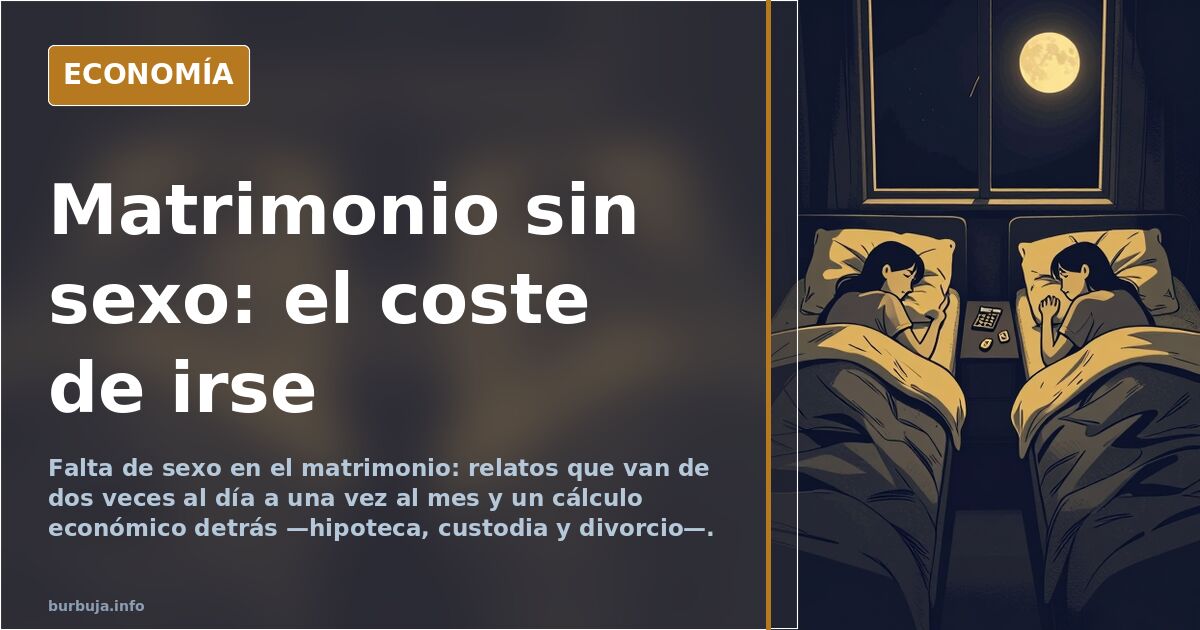
Sens Marriage: When Desire Is Measured in Euros
The lack of sensual relations within stable couples has ceased to be a mere anecdote and has become a balance sheet issue. Those who raise the topic do so with figures in hand—shared mortgages, young children, financial penalties for separating—and reach a recurring conclusion: when desire fades, the contract remains alive for reasons that are anything but romantic. It is worth clarifying this upfront. There is no official statistic measuring the phenomenon. There are stories, and there are many.
From Twice a Day to Once a Month: The Curve Described by Those Living It
The dominant pattern does not speak of zero sens, but of decline. One case is detailed meticulously: five years of dating a university partner, with two daily encounters during the first two years and one per month in the last year. The sarracena drawn is always the same: passion lasts a year or two; afterwards, a good relationship may remain, but the physical aspect fades until it becomes sporadic.
Another testimony, after five years of cohabitation, describes the shift from normality to increasingly spaced-out encounters with less enthusiasm. In contrast, a couple who have been together for 20 years with three children maintains regular relations. Another participant, however, attributes this to luck.
From there, disagreement arises. Some argue there is a biological component pushing for periodic partner changes, while others respond that in previous generations, with marriages at twenty, frequency was higher and more stable than now. Neither thesis can be verified with the available evidence.
Why Do Many Married Men Endure the Lack of Sens?
Because the cost of leaving is perceived as higher than staying. This is the axis of the economic part of the matter: one must pay the mortgage or rent, and doing so alone is not considered an option. If children are involved, the figure multiplies, especially if the loan must be faced solo.
Resistance is not only monetary. Separation is described as ruinous for whoever leaves home, with pensions and custody at stake, and with a starting point that many consider already imbalanced. Hence a phrase thrown into the thread: better to live under a bridge than to sustain the status quo.
The alternative voiced aloud is simply breaking up, or seeking outside what is missing inside. The objection received almost always is the same: the children.
Divorce as Leverage: Custody, Pension, and Denunciation
Some accounts claim that the threat of divorce functions as an instrument of power within marriage, adding that gender violence reports also operate as pressure elements. A case of physical abuse is described where, according to that account, it was the man who ended up detained. These are personal experiences or perceptions, without data to back them up.
In parallel, a legal issue is cited which, according to the narrative, would have been discussed on television: that within marriage, without consent, sensual relations can be reported. The interpretation made is that from there, things will take another path.
A Contract with a Sensual Clause: Twice a Week Until 55
The most striking proposal is that of a prenuptial agreement with explicit duties: a minimum of two weekly relations until age 55, with financial penalties if not met. It is launched as an idea, and the response does not wait.
Rejection is formulated quickly: no one can be forced to do what they don't want, and forcing it only generates more rejection towards the other. What is suggested then is the opposite, to find a way out or accept that the relationship has changed nature. No one puts forward a formula that fits both parties of the contract.
Is Marriage the Worst Possible Business for a Man?
One participant summarizes it thus, qualifying it as a ruinous operation and calculating that in most cases it goes wrong. The underlying accusation is not sensual, but accounting: one enters seeking a shared life and ends up financing a structure from which one cannot exit without cost. Against this, the defense of the institution relies on concrete cases that work, with no further argument than their own existence.
The counter-argument raised is that the problem is not marriage, but who you sign with.
What Can Happen When Desire Becomes a Clause
If anything anticipates this conversation is a fundamental shift: desire ceases to be treated as intimacy and begins to be treated as a clause, with lawyers at the end of the hallway. It is a prediction with reservations, because the figures handled are stories and not statistics, and because each case told ends differently—from the twenty-year marriage that still works to the one considering sleeping under a bridge. The only common element is the framework: there is less talk about wanting and more about the cost of leaving.
The lack of sensual relations within stable couples has ceased to be a mere anecdote and has become a balance sheet issue. Those who raise the topic do so with figures in hand—shared mortgages, young children, financial penalties for separating—and reach a recurring conclusion: when desire fades, the contract remains alive for reasons that are anything but romantic. It is worth clarifying this upfront. There is no official statistic measuring the phenomenon. There are stories, and there are many.
From Twice a Day to Once a Month: The Curve Described by Those Living It
The dominant pattern does not speak of zero sens, but of decline. One case is detailed meticulously: five years of dating a university partner, with two daily encounters during the first two years and one per month in the last year. The sarracena drawn is always the same: passion lasts a year or two; afterwards, a good relationship may remain, but the physical aspect fades until it becomes sporadic.
Another testimony, after five years of cohabitation, describes the shift from normality to increasingly spaced-out encounters with less enthusiasm. In contrast, a couple who have been together for 20 years with three children maintains regular relations. Another participant, however, attributes this to luck.
From there, disagreement arises. Some argue there is a biological component pushing for periodic partner changes, while others respond that in previous generations, with marriages at twenty, frequency was higher and more stable than now. Neither thesis can be verified with the available evidence.
Why Do Many Married Men Endure the Lack of Sens?
Because the cost of leaving is perceived as higher than staying. This is the axis of the economic part of the matter: one must pay the mortgage or rent, and doing so alone is not considered an option. If children are involved, the figure multiplies, especially if the loan must be faced solo.
Resistance is not only monetary. Separation is described as ruinous for whoever leaves home, with pensions and custody at stake, and with a starting point that many consider already imbalanced. Hence a phrase thrown into the thread: better to live under a bridge than to sustain the status quo.
The alternative voiced aloud is simply breaking up, or seeking outside what is missing inside. The objection received almost always is the same: the children.
Divorce as Leverage: Custody, Pension, and Denunciation
Some accounts claim that the threat of divorce functions as an instrument of power within marriage, adding that gender violence reports also operate as pressure elements. A case of physical abuse is described where, according to that account, it was the man who ended up detained. These are personal experiences or perceptions, without data to back them up.
In parallel, a legal issue is cited which, according to the narrative, would have been discussed on television: that within marriage, without consent, sensual relations can be reported. The interpretation made is that from there, things will take another path.
A Contract with a Sensual Clause: Twice a Week Until 55
The most striking proposal is that of a prenuptial agreement with explicit duties: a minimum of two weekly relations until age 55, with financial penalties if not met. It is launched as an idea, and the response does not wait.
Rejection is formulated quickly: no one can be forced to do what they don't want, and forcing it only generates more rejection towards the other. What is suggested then is the opposite, to find a way out or accept that the relationship has changed nature. No one puts forward a formula that fits both parties of the contract.
Is Marriage the Worst Possible Business for a Man?
One participant summarizes it thus, qualifying it as a ruinous operation and calculating that in most cases it goes wrong. The underlying accusation is not sensual, but accounting: one enters seeking a shared life and ends up financing a structure from which one cannot exit without cost. Against this, the defense of the institution relies on concrete cases that work, with no further argument than their own existence.
The counter-argument raised is that the problem is not marriage, but who you sign with.
What Can Happen When Desire Becomes a Clause
If anything anticipates this conversation is a fundamental shift: desire ceases to be treated as intimacy and begins to be treated as a clause, with lawyers at the end of the hallway. It is a prediction with reservations, because the figures handled are stories and not statistics, and because each case told ends differently—from the twenty-year marriage that still works to the one considering sleeping under a bridge. The only common element is the framework: there is less talk about wanting and more about the cost of leaving.
Also available in: Deutsch
Summary of a discussion on Burbuja.info - Foro de economía, actualidad y política., translated from Spanish and reviewed before publication. Read the full discussion (196 replies).
More summaries
-
Gender Violence Law Loophole Exploited via Sex Change in Spain
A Spanish abuser changed legal gender to bypass VioGen protections, shifting the case to domestic violence courts and leaving the victim vulnerable.
-
Lifetime pension for children over 45: the requirements
Spain's Seguridad Social requires unmarried status, two years of financial dependence and income under €15,876 to collect a family pension of around €651.
-
Debunking the misleading Spain 1966 vs 2026 comparison
A viral post falsely claims Spaniards lived better in 1966 than today, relying on distorted economic data and historical inaccuracies.
-
Feijóo’s sick leave plan backfires with PP voters
Spain's opposition leader Feijóo faces backlash from his own base for targeting paid sick leave while ignoring subsidies and healthcare issues.
-
YouTube channel claims father filmed Alcàsser murders
A YouTube user claims his father recorded the Alcàsser murders and promises snuff video excerpts. No evidence provided, only narrative and technical analysis.
-
Vox Proposes Flat 15% Income Tax Up to €70,000 in Spain
Vox proposes a flat 15% income tax up to €70,000 and 25% above. Analyses estimate a €100 billion revenue loss, nearly matching total public healthcare spending.