
Seneca’s 30 Billion: Wealth and Stoicism Under Scrutiny
Seneca accumulated 300 million denarii while preaching detachment. The modern equivalent is roughly 30,000 million euros, highlighting a historical paradox.
English · Original discussion in Spanish · Published
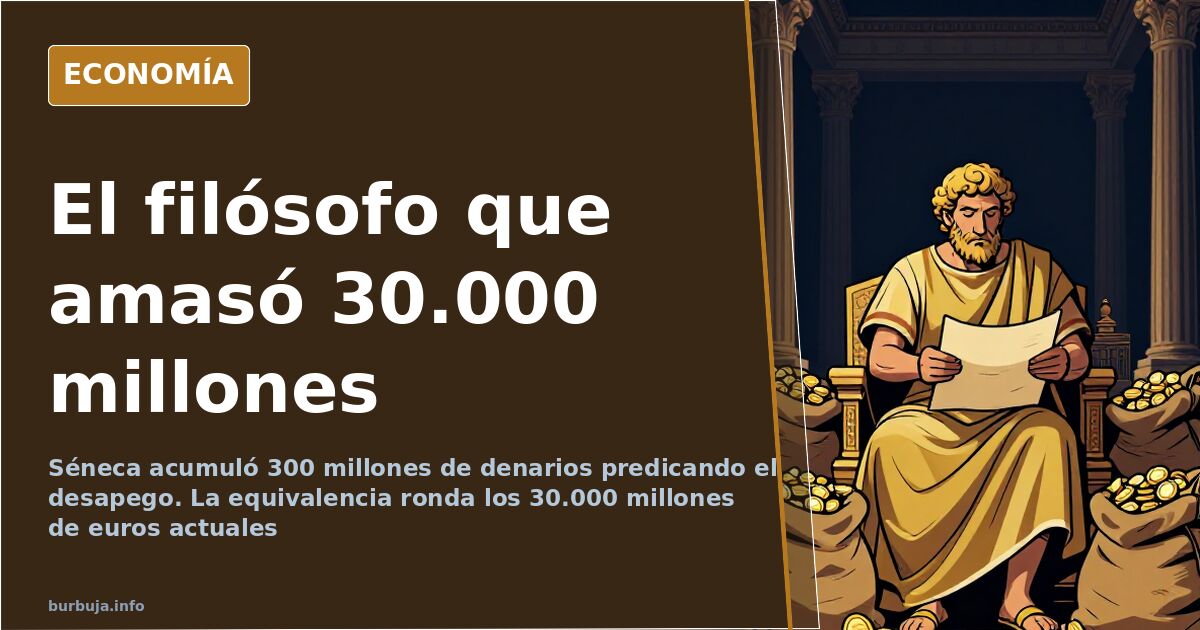
Seneca amassed 30 billion while preaching detachment
How does one accumulate 30,000 million euros without betraying a philosophy that despises wealth? The short answer: by being born rich and knowing how to manage it. Seneca, the quintessential Roman Stoic, accumulated an estimated fortune of 300 million denarii, equivalent to roughly 30,000 million euros today. His properties extended across Egypt, Greece, Rome, and other points in the Empire. The paradox was not lost on his contemporaries, nor is it now: his peers already pointed out the contradiction between his discourse and his bank account.
What is a denarius really worth in modern money?
Establishing an exact equivalence is an exercise in economic tightrope walking. A recurrent calculation assumes that one denarius covered a person’s daily expenses: food, lodging, clothing, and basic services. Translated to current prices, this places each denarius in a range of 75 to 120 euros, with an estimated midpoint of 100 euros. Applied to the 300 million, the resulting figure is dizzying, but it should be taken with a grain of salt.
The problem is that direct comparison between economies separated by two millennia is misleading. Wheat, for example, trades today at around 200-220 dollars per ton thanks to mechanization, fertilizers, and cheap transport. In the early 20th century, with incipient mechanization, it hovered around 500-600 dollars. In Rome, without intensive agriculture or cold chains, the real purchasing power of a denarius depended on the harvest, the region, and the season.
The Stoic paradox his contemporaries already pointed out
Seneca was one of the greatest exponent of Stoicism, a school that preaches indifference to material goods and peace with one’s own passions. His Letters to Lucilius continue to sell as a manual for austere living. The contradiction between that ideal and his properties is not a contemporary discovery: Publius Suilius Rufus, a politician aspiring to be Nero’s advisor, accused him of usury and of maintaining relations with Agrippina. None of this is proven.
Some argue that classical Stoicism functioned as an elite ideology: it allowed the wealthy to disconnect from the system’s contradictions without questioning it. Slavery, the institution upon which the Roman economy was based, is barely problematized in Stoic texts. Weighing against this is another argument: Stoicism does not demand poverty, but managing what one has without letting it dominate.
Where did Seneca’s money come from?
The detail that dismantles many fantasies: Seneca did not get rich preaching. He was born wealthy. His father, a prestigious rhetorician, managed considerable assets, and his mother belonged to a comfortable family. To this he added a political and financial career that allowed him to multiply what he inherited. His enemies accused him of usury, the business of lending money with interest, common among the senatorial elite.
Cases like Crassus illustrate how Roman accumulation could be predatory: it is said he had a private team of firefighters. When a building burned, he would arrive offering to buy the burning insulae at a bargain price. Once acquired, he would order the fire extinguished. The original owners would become tenants of their own house.
Did people live better in Rome than now?
The discussion led to an uncomfortable question: does a current minimum wage earner have a better life than the richest emperor? There are arguments for both sides. The most obvious: analgesics, antibiotics, fresh fruit year-round, perfectly preserved fish, mattresses no Roman dreamed of, heating, air conditioning, universal information at a click. A kid from a peripheral neighborhood surpasses in material comfort the best-installed consul of Antiquity.
Weighing against this is that Rome was not a medieval cesspool. The city surpassed one million inhabitants, with a water supply system and a sewer network that was not seen again until two centuries ago. The Baths of Caracalla stand as a reminder of the available engineering. And the Roman elite had villas, slaves, personal doctors, entertainment, and travel that most modern mortals will never see. Pliny the Elder had four fabulous villas scattered across Italy, each with servants keeping them ready for when the master felt like visiting.
Seneca’s Stoicism and Roman slavery
A point where the conversation becomes uncomfortable is slavery. By the second century, Roman slaves enjoyed considerable legal protection: they could not be beaten without cause, killed, or have their families separated. Paradoxically, some analyses suggest that the pogre prohibition of slavery resulted in a loss of rights for workers: an invalid slave could not be dismissed arbitrarily; a free man, yes.
Seneca wrote about clemency and dignity, but never questioned the slave system. He was not an avant la lettre abolitionist. He was a rich Roman of the first century.
In the end, the underlying question is not how much a denarius was worth. It is whether there exists a philosopher who lived without contradictions. Oshu preached detachment and accumulated 93 Rolls Royces, arguing that it was as absurd to accumulate cars as banknotes. Diogenes, the original, lived in a barrel and told Alexander the Great to move, that he was blocking his sun. That one indeed had no shares in the port of Gades.
How does one accumulate 30,000 million euros without betraying a philosophy that despises wealth? The short answer: by being born rich and knowing how to manage it. Seneca, the quintessential Roman Stoic, accumulated an estimated fortune of 300 million denarii, equivalent to roughly 30,000 million euros today. His properties extended across Egypt, Greece, Rome, and other points in the Empire. The paradox was not lost on his contemporaries, nor is it now: his peers already pointed out the contradiction between his discourse and his bank account.
What is a denarius really worth in modern money?
Establishing an exact equivalence is an exercise in economic tightrope walking. A recurrent calculation assumes that one denarius covered a person’s daily expenses: food, lodging, clothing, and basic services. Translated to current prices, this places each denarius in a range of 75 to 120 euros, with an estimated midpoint of 100 euros. Applied to the 300 million, the resulting figure is dizzying, but it should be taken with a grain of salt.
The problem is that direct comparison between economies separated by two millennia is misleading. Wheat, for example, trades today at around 200-220 dollars per ton thanks to mechanization, fertilizers, and cheap transport. In the early 20th century, with incipient mechanization, it hovered around 500-600 dollars. In Rome, without intensive agriculture or cold chains, the real purchasing power of a denarius depended on the harvest, the region, and the season.
The Stoic paradox his contemporaries already pointed out
Seneca was one of the greatest exponent of Stoicism, a school that preaches indifference to material goods and peace with one’s own passions. His Letters to Lucilius continue to sell as a manual for austere living. The contradiction between that ideal and his properties is not a contemporary discovery: Publius Suilius Rufus, a politician aspiring to be Nero’s advisor, accused him of usury and of maintaining relations with Agrippina. None of this is proven.
Some argue that classical Stoicism functioned as an elite ideology: it allowed the wealthy to disconnect from the system’s contradictions without questioning it. Slavery, the institution upon which the Roman economy was based, is barely problematized in Stoic texts. Weighing against this is another argument: Stoicism does not demand poverty, but managing what one has without letting it dominate.
Where did Seneca’s money come from?
The detail that dismantles many fantasies: Seneca did not get rich preaching. He was born wealthy. His father, a prestigious rhetorician, managed considerable assets, and his mother belonged to a comfortable family. To this he added a political and financial career that allowed him to multiply what he inherited. His enemies accused him of usury, the business of lending money with interest, common among the senatorial elite.
Cases like Crassus illustrate how Roman accumulation could be predatory: it is said he had a private team of firefighters. When a building burned, he would arrive offering to buy the burning insulae at a bargain price. Once acquired, he would order the fire extinguished. The original owners would become tenants of their own house.
Did people live better in Rome than now?
The discussion led to an uncomfortable question: does a current minimum wage earner have a better life than the richest emperor? There are arguments for both sides. The most obvious: analgesics, antibiotics, fresh fruit year-round, perfectly preserved fish, mattresses no Roman dreamed of, heating, air conditioning, universal information at a click. A kid from a peripheral neighborhood surpasses in material comfort the best-installed consul of Antiquity.
Weighing against this is that Rome was not a medieval cesspool. The city surpassed one million inhabitants, with a water supply system and a sewer network that was not seen again until two centuries ago. The Baths of Caracalla stand as a reminder of the available engineering. And the Roman elite had villas, slaves, personal doctors, entertainment, and travel that most modern mortals will never see. Pliny the Elder had four fabulous villas scattered across Italy, each with servants keeping them ready for when the master felt like visiting.
Seneca’s Stoicism and Roman slavery
A point where the conversation becomes uncomfortable is slavery. By the second century, Roman slaves enjoyed considerable legal protection: they could not be beaten without cause, killed, or have their families separated. Paradoxically, some analyses suggest that the pogre prohibition of slavery resulted in a loss of rights for workers: an invalid slave could not be dismissed arbitrarily; a free man, yes.
Seneca wrote about clemency and dignity, but never questioned the slave system. He was not an avant la lettre abolitionist. He was a rich Roman of the first century.
In the end, the underlying question is not how much a denarius was worth. It is whether there exists a philosopher who lived without contradictions. Oshu preached detachment and accumulated 93 Rolls Royces, arguing that it was as absurd to accumulate cars as banknotes. Diogenes, the original, lived in a barrel and told Alexander the Great to move, that he was blocking his sun. That one indeed had no shares in the port of Gades.
Also available in: Deutsch
Summary of a discussion on Burbuja.info - Foro de economía, actualidad y política., translated from Spanish and reviewed before publication. Read the full discussion (250 replies).
More summaries
-
Old Talavera Bridge Collapses as Tagus River Surges Past 1,000 m³/s
The Tagus River exceeds 1,000 m³/s, destroying several arches of Talavera's Old Bridge, a Heritage Site with little original Roman structure left.
-
Elderly Woman's Eviction Sparks 'New Maricarmen' Debate Online
The eviction of an elderly woman, dubbed 'new Maricarmen' online, reignites debate on housing and rent prices.
-
Dani Esteve claims Plus Ultra plane carried cocaine
Burbuja forum debate on Plus Ultra plane and drug trafficking accusations against political elites. Narco-state or firewall?
-
Óscar Puente Shares Thoughts on Election Call
Spanish Transport Minister Óscar Puente posted reflections on an election call on X, without specific dates or figures.
-
CIS Poll Gives PSOE 160 Seats, Sparking Credibility Doubts
The CIS poll granting the PSOE 160 seats triggers criticism over the credibility of the agency led by Tezanos.
-
Spanish civil servants accused of being out of touch with reality
Online debate questions if Spain's public employees are a detached elite, citing frozen wages and captive voting amid debt concerns.