
Old Talavera Bridge Collapses as Tagus River Surges Past 1,000 m³/s
The Tagus River exceeds 1,000 m³/s, destroying several arches of Talavera's Old Bridge, a Heritage Site with little original Roman structure left.
English · Original discussion in Spanish · Published
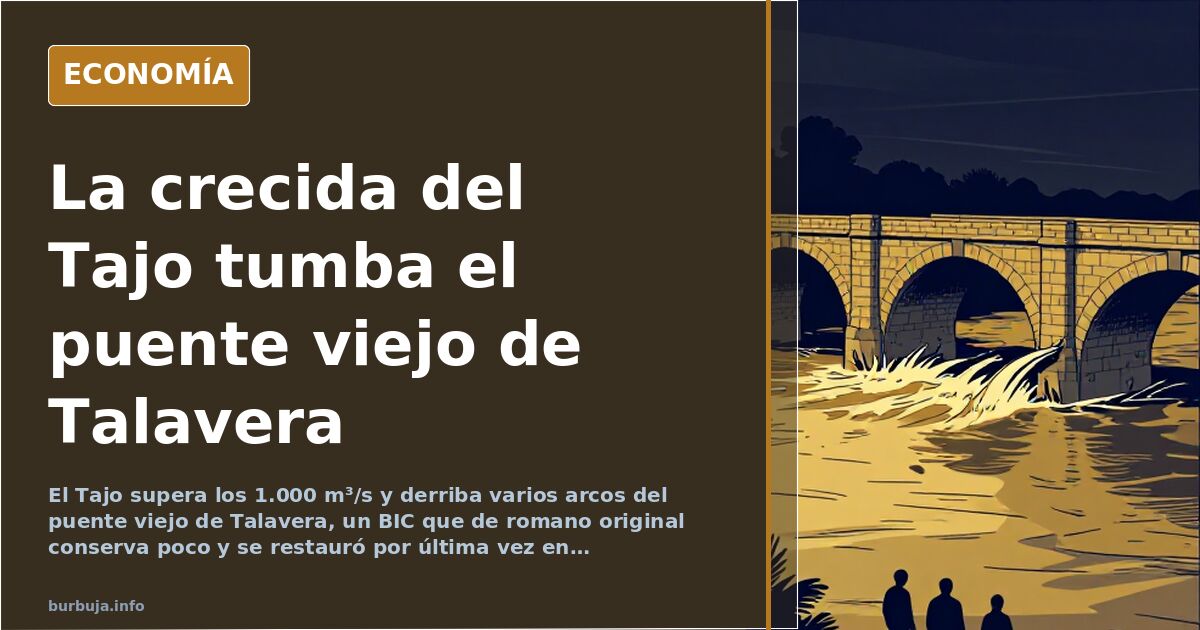
Old Talavera Bridge Collapses as Tagus River Surges Past 1,000 m³/s
Storm Martinho took an early morning to topple what several historical floods had failed to do. The Tagus River flow past Talavera de la Reina exceeded 1,000 cubic meters per second, and several arches of the old bridge, the city's oldest, went into the water. Mayor José Julián Gregorio had closed traffic hours earlier; he then promised reconstruction at any cost. Some residents filmed it on their phones. The video, shocking, is all that remains of that arch.
Because Talavera's symbol, declared a Heritage Site (Bien de Interés Cultural), has long carried an uncomfortable debate: the bridge is not as Roman as the plaque claims.
A Roman bridge in title, patched inside
The official record cites a Roman origin, with construction resumed in the late 15th century under Fray Pedro de los Molinos, in the appearance we recognize today. Its most recent restoration dates to 2002. Up to that point, the tourism office's story, still selling the image of a millennium-old bridge.
The fine print is what bothers. Of the original Roman structure, at best, part of the pillars remain; the rest has been added in medieval and modern layers, with successive interventions and some mortar of dubious eternal vocation. The alignment is not even straight: it forms an angle in the middle of the channel, a detail that in a gravity-supported structure is hardly an endorsement. When asked why Rome's Fabricio Bridge stands and this one does not, the answer usually starts there.
Why it fell: flow, solids, and channel vegetation
At 1,000 m³/s, the Tagus does not flow clean. It flows with trees, branches, and sediments. The most repeated hypothesis blames not just the water, but what the water carries: a channel with eyes blocked by vegetation dams the flow, increases pressure on the arches, and eventually overcomes the weakest. After it falls, the culprit is sought among historical rainfall records.
That a bridge collapses due to flooding amidst discussions of drought and desertification is ironic. The Hydrographic Confederation—and the forestry agents seen in images doing little—comes under the spotlight of those who argue that channel cleaning has long been the poor sister of the budget. This is an unproven thesis, but it has eager defenders.
A bridge that had already survived two wars
Before the flood, this bridge already had a curriculum. In 1809, it escaped destruction in the Battle of Talavera, because both armies clashed on the Alberche River, on the other side of the city. In 1936, during the Civil War, Republicans positioned their defensive line on the Tagus itself, and General Yagüe assaulted Talavera from the opposite bank. Remaining standing after that was, in itself, a small anomaly.
Did Romans calculate or guess?
The collapse peine a classic dessert-table debate: the supposed superiority of ancient engineering. Some argue that until the development of structural calculation, barely a century ago, construction was by tables, trial and error, and brute force: without budgets or contracts. The counterargument points to aqueducts and siphons, where the slope had to match exactly so the outlet chamber would not accumulate water or let air into the conduit. This, it is argued, is pure calculation, not amateurish.
Both positions have merit. What admits little discussion is that of all the Romans built, only a fraction remains standing, and the works we admire today are those spared by luck, material, or geology. The rest has lain for centuries at the bottom of a river or converted into a quarry for the neighboring church.
Reconstruction, and with what money
Political reactions were swift. The president of the PP (People's Party) in Castilla-La Mancha, Paco Núñez, expressed support for the mayor, speaking of a painful loss for the city and its history. The central government offered its collaboration for reconstruction. Promises of aid are free; the bill is not.
And there the matter stalls. Reconstructing a Heritage Site (BIC) bridge requires interventions compatible with heritage, more expensive and slower than a simple new deck. The mayor's promise comes without an attached figure. It remains to be seen what part is restored with original stone, what part with modern mortar, and what part is left as a visitable ruin for tourists and photographs. No one has yet explained who pays the difference between what is promised and what is approved.
Storm Martinho took an early morning to topple what several historical floods had failed to do. The Tagus River flow past Talavera de la Reina exceeded 1,000 cubic meters per second, and several arches of the old bridge, the city's oldest, went into the water. Mayor José Julián Gregorio had closed traffic hours earlier; he then promised reconstruction at any cost. Some residents filmed it on their phones. The video, shocking, is all that remains of that arch.
Because Talavera's symbol, declared a Heritage Site (Bien de Interés Cultural), has long carried an uncomfortable debate: the bridge is not as Roman as the plaque claims.
A Roman bridge in title, patched inside
The official record cites a Roman origin, with construction resumed in the late 15th century under Fray Pedro de los Molinos, in the appearance we recognize today. Its most recent restoration dates to 2002. Up to that point, the tourism office's story, still selling the image of a millennium-old bridge.
The fine print is what bothers. Of the original Roman structure, at best, part of the pillars remain; the rest has been added in medieval and modern layers, with successive interventions and some mortar of dubious eternal vocation. The alignment is not even straight: it forms an angle in the middle of the channel, a detail that in a gravity-supported structure is hardly an endorsement. When asked why Rome's Fabricio Bridge stands and this one does not, the answer usually starts there.
Why it fell: flow, solids, and channel vegetation
At 1,000 m³/s, the Tagus does not flow clean. It flows with trees, branches, and sediments. The most repeated hypothesis blames not just the water, but what the water carries: a channel with eyes blocked by vegetation dams the flow, increases pressure on the arches, and eventually overcomes the weakest. After it falls, the culprit is sought among historical rainfall records.
That a bridge collapses due to flooding amidst discussions of drought and desertification is ironic. The Hydrographic Confederation—and the forestry agents seen in images doing little—comes under the spotlight of those who argue that channel cleaning has long been the poor sister of the budget. This is an unproven thesis, but it has eager defenders.
A bridge that had already survived two wars
Before the flood, this bridge already had a curriculum. In 1809, it escaped destruction in the Battle of Talavera, because both armies clashed on the Alberche River, on the other side of the city. In 1936, during the Civil War, Republicans positioned their defensive line on the Tagus itself, and General Yagüe assaulted Talavera from the opposite bank. Remaining standing after that was, in itself, a small anomaly.
Did Romans calculate or guess?
The collapse peine a classic dessert-table debate: the supposed superiority of ancient engineering. Some argue that until the development of structural calculation, barely a century ago, construction was by tables, trial and error, and brute force: without budgets or contracts. The counterargument points to aqueducts and siphons, where the slope had to match exactly so the outlet chamber would not accumulate water or let air into the conduit. This, it is argued, is pure calculation, not amateurish.
Both positions have merit. What admits little discussion is that of all the Romans built, only a fraction remains standing, and the works we admire today are those spared by luck, material, or geology. The rest has lain for centuries at the bottom of a river or converted into a quarry for the neighboring church.
Reconstruction, and with what money
Political reactions were swift. The president of the PP (People's Party) in Castilla-La Mancha, Paco Núñez, expressed support for the mayor, speaking of a painful loss for the city and its history. The central government offered its collaboration for reconstruction. Promises of aid are free; the bill is not.
And there the matter stalls. Reconstructing a Heritage Site (BIC) bridge requires interventions compatible with heritage, more expensive and slower than a simple new deck. The mayor's promise comes without an attached figure. It remains to be seen what part is restored with original stone, what part with modern mortar, and what part is left as a visitable ruin for tourists and photographs. No one has yet explained who pays the difference between what is promised and what is approved.
Summary of a discussion on Burbuja.info - Foro de economía, actualidad y política., translated from Spanish and reviewed before publication. Read the full discussion (239 replies).
More summaries
-
Puente Mocks BlackRock's €60B Investment in Spain
Óscar Puente sarcastically questioned BlackRock's €60 billion investment in Spain, calling it 'strange' for a major fund to invest in a country with a 'socialist communist Bolivarian' government.
-
Video Attributed to Assange Revives Moon Landing Hoax Theory
A 17-minute video, allegedly from WikiLeaks and shared by an anonymous account, reignites the hoax theory that the moon landing was filmed in Nevada.
-
Óscar Puente Claims to Be the World's Foremost Leftist
Óscar Puente declares himself the "greatest leftist on the planet." We analyze the context and economic implications of his statements.
-
Is now a good time to buy property? Debate
Is now a good time to buy a home? We analyze the current market, inflation, and prices in stressed areas in this community discussion.
-
Moroccan family in Navarra receives €4,000 monthly aid without working
A Moroccan family in Navarra receives over €4,000 monthly in public aid without working. Discover the details and benefits.
-
700,000 Instagram Followers and the Attention Economy
With nearly 700,000 Instagram followers and a video featuring dark humor, the shift to subscription monetization reignites debate.