
Selling Spanish Home for Income: €250k Yields Only €400 Monthly
A homeowner with an €80k mortgage receives a €250k offer. After taxes and fees, net proceeds are ~€120k, generating only €400 monthly at 5% yield.
English · Original discussion in Spanish · Published
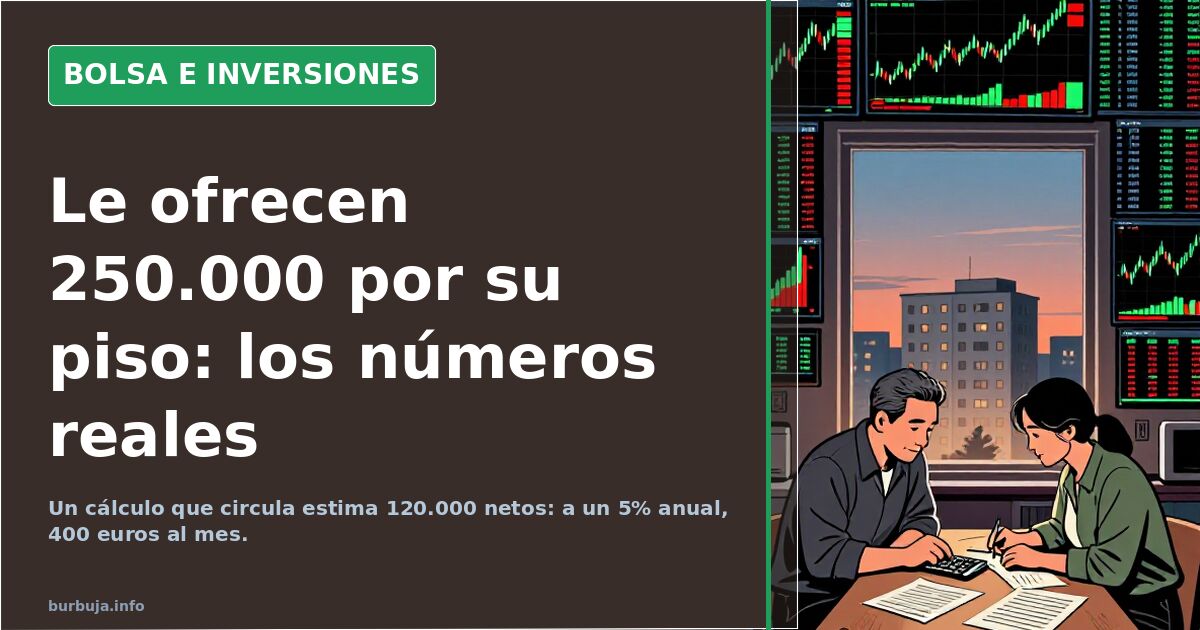
Selling your home to live off income: the numbers don't add up
A technical professional with years of seniority, a fixed mortgage of €380 per month, and €80,000 outstanding receives a call from a real estate agent: someone wants their apartment for €250,000. On paper, the deal looks perfect. The theoretical profit is around €170,000, enough — he thinks — to quit his job, move into a rental, and live off capital. The problem starts when you put the calculator on the table.
The first sustancia ilegal is fiscal. According to a calculation circulating in the thread, you don't get €170,000 out of the €250,000: there is municipal land value tax (plusvalía municipal), IRPF (Spanish income tax) on the gain — around 20% if not reinvested in a primary residence — and registry cancellation costs for the mortgage. That conservative calculation leaves the net amount at about €120,000. At 5% annually, that's €6,000 gross, roughly €4,800 net, meaning €400 per month. Less than the current mortgage payment.
How much is left after taxes and expenses?
The breakdown circulating in the analysis is relentless. Municipal land value tax is calculated based on the cadastral revaluation estimated by the city council and must be paid regardless. IRPF taxes the capital gain and is only avoided if reinvested in another primary residence, which doesn't happen here because the plan is to move into a rental. Added to this are bank fees for canceling the mortgage and notary commissions.
With €120,000 in liquid assets, the optimistic scenario assumes a 5% annual return. The result is €400 net monthly. The current mortgage costs €380. That €20 difference is all the margin separating the operation from ruin. And the rent one would have to move to isn't €380: in areas with services, beaches, and transport, the realistic range starts much higher and rises every year.
Rent eats up the profit
Some model the scenario over twenty years with a 10% annual increase in rent, assuming periodic moves. According to that exercise, the capital evaporates before the period ends. Owned housing, however, has an advantage that doesn't appear in any spreadsheet: the fixed payment never goes up. It's solid ground under your feet, not a financial asset.
The comparison with replacement cost reinforces the argument. A 50-kilo bag of white cement cost 400 pesetas two decades ago; today, a 25-kilo bag is around €10. Construction is much more expensive than before, putting upward pressure on prices even if local demand shrinks. The thesis that "this has to come down" clashes with that wall of costs.
Is it a bubble like 2008?
Here the analysis splits. One school argues there is no classic bubble: housing supply is firm because it responds to real need for shelter, and demand is regulated by law. Another points to the effect of immigration and foreign capital, sustaining prices that an average employee cannot afford. A third, more aggressive view defends that the market will only break when credit closes completely.
What almost all scenarios agree on is the operational conclusion: selling your only home to invest the capital is an asymmetric bet. If it goes wrong, the punishment is double — you lose the house and purchasing power — and if it goes right, the prize is modest. The asymmetry doesn't compensate.
The agent's offer: opportunity or hook?
The fine print of the call deserves its own section. Several analyses suggest that the price of €250,000 is bait to get the owner to sign a listing agreement with the agency. Once inside, the buyer appears, negotiates down, and the dream figure deflates. Another line, harsher, warns that the operation could be outright fraud: summons abroad, cash payments, successive excuses. The recommendation is not to move a paper without a notary present.
The disorienting question isn't how much you get, but why someone offers that figure. If the buyer sees business, the seller is leaving money on the table. If they don't, the offer isn't real. In both cases, the owner loses.
With these numbers, the decision seems clear. But the Spanish real estate market has been debunking logic for years. The data closing the circle: while people debate selling, some claim that portfolios with five to ten apartments are liquidating positions in coastal areas. They, who know how to read the market, are exiting. The individual who doubts, instead, stands watching the door.
Also available in: Deutsch
Summary of a discussion on Burbuja.info - Foro de economía, actualidad y política., translated from Spanish and reviewed before publication. Read the full discussion (104 replies).
More summaries
-
90% of funds underperform benchmarks due to high fees
Only 10% of investment funds beat their index. With fees averaging 1.5% versus 0.25% for ETFs, active management costs more than it yields.
-
Index funds: 15 minutes of Excel vs. robo-advisor fees
An investor with €12,000 and €200 monthly contributions chooses between Indexa and MyInvestor: manual rebalancing and tax costs tip the balance.
-
Saving €50,000 to sink into a 40-year mortgage: the debate
Ten years saving €50,000 to sign a 40-year mortgage: the debate over whether housing is an investment or a necessity remains unresolved.
-
Lamas Bolaño charges 1,200 euros for gold but refuses buyback
A buyer paid 1,200 euros for a gold coin at Lamas Bolaño, but the Spanish dealer refuses to buy it back, citing mint pricing.
-
Turkish stock market hits 2008 lows: bargain or trap?
The lira has fallen 13%, yet three Turkish stocks have returned an average of 37% in euros. 2008 lows, a P/E of 5 and the spectre of capital controls.
-
Santander scraps 'Queremos ser tu banco' plan, opening door to fees
Santander is phasing out its 'Queremos ser tu banco' plan on 5 September; according to conversations with the bank, customers who don't switch to the Cuenta 1I2I3 could face monthly fees.