
90% of funds underperform benchmarks due to high fees
Only 10% of investment funds beat their index. With fees averaging 1.5% versus 0.25% for ETFs, active management costs more than it yields.
English · Original discussion in Spanish · Published
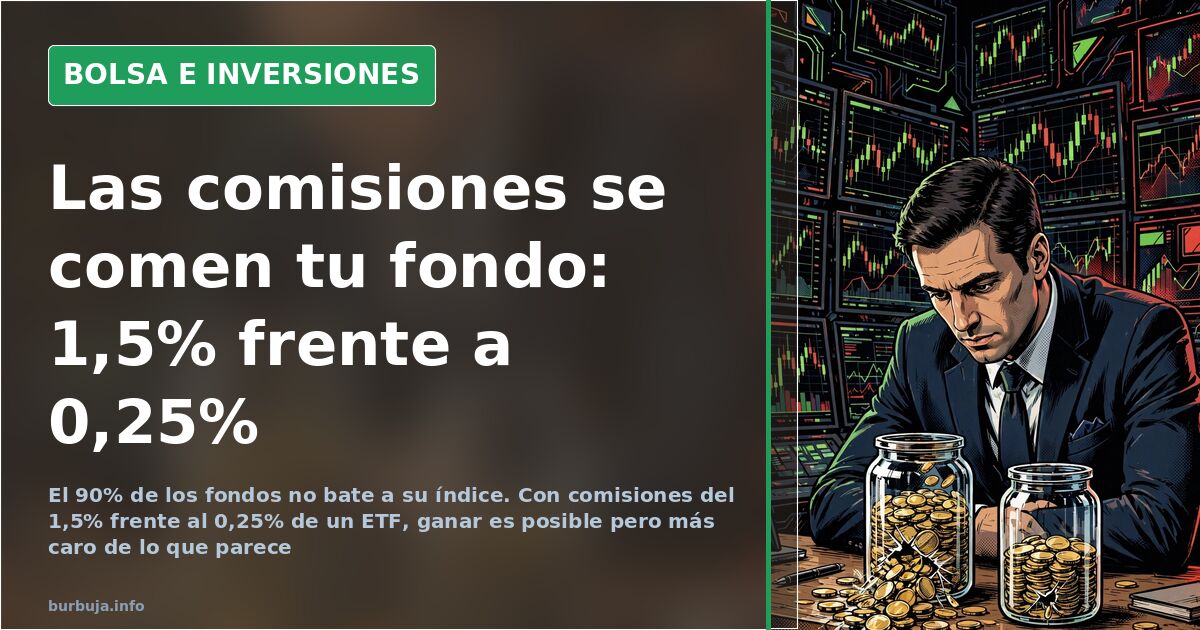
Funds don't always lose: fees determine who wins
It is possible to make money with an investment fund. It is also possible to hold one for thirteen years, watch it rise, and end up with less than a third of what it would have yielded without fees. Both scenarios fit within the same product, and that is the crux: a vehicle that charges annually for managing other people's savings, whether it succeeds or fails. The question that clarifies the issue is not whether funds are a scam, but how much return is lost along the way.
The figure that summarizes the problem: around a 1.5% annual fee on a fund versus 0.25% on an ETF that simply replicates an index. Six times lower cost for the same market. On one thousand euros, it seems trivial; on six figures over twenty years, it is the difference between a plan and a misunderstanding.
How much does an investment fund charge versus an ETF?
The range of fees is enormous. At the expensive end, proprietary funds from commercial banks reach 2% or more; at the cheap end, an S&P 500 indexed fund hovers around 0.1%. In between, a global MSCI World indexed fund sold by a Spanish institution stays at 0.4% or 0.45%, which is quite good for a bank product.
The defense of high fees is always the same: that there is someone behind making decisions. The problem, as summarized by a participant, is that this active management largely exists to justify the bill itself. ETFs replicate indices at a fraction of the cost and, according to several forum users' experience, good active funds have failed to beat them.
90% of funds fail to beat their benchmark
The figure repeated by various participants is stubborn: around 90% of funds fail to beat their reference index over relevant periods, and the longer the horizon, the fewer managers survive the comparison. Active management wins in short stretches but bleeds out over the long term.
There is an objection used as a shield that turns against its user: the minority that does beat the market, which exists. A manager can outperform their index for years, and that is a fact. What is unknown is if they will repeat it. Out of 5,000 funds, picking the ten best from the last five years gives magnificent results even if all had invested randomly; the uncomfortable detail is that the ten best from five years ago are not today's. Almost never are.
"I earned 6%; without fees it would have been 20%"
One specific case is worth more than three reports. An investor recounts earning 6% with a fund held for thirteen years and calculates that, without fees, the figure would have been around 20%. Another reading of the data focuses on opportunity cost: 6% annualized is a reasonable result compared to the historical average return of 8% for the S&P 500 since 1950, although accumulated over thirteen years it is something else.
It is worth pausing on the misunderstanding, because it runs through half the issue. 6% compound annual growth is a decent yield; 6% total spread over thirteen years does not cover inflation. The same figure means opposite things depending on the unit of measurement.
Bank-sold index funds: Amundi, Vanguard, and minimums
Traditional banking has gradually peine the door to low-cost products, with varying conditions. A Vanguard S&P 500 indexed fund distributed by a Spanish institution stays at 0.1% and accepts contributions of any amount. The global MSCI World indexed fund requires a minimum contribution of 600 euros; its direct competitor on another platform asks for 100 euros the first time and 50 thereafter, and there are products with a 200-euro minimum.
Until 2019, that Vanguard S&P 500 fund was reserved for private banking clients with over 500,000 euros in assets. Then it peine to all clients. The detail explains much: the cheap product has existed for years; what changes is who is allowed to buy it.
Fixed income and inflation-linked bonds: the price trap
Not everything is equities. US Treasury inflation-linked bonds, traded via ETF, are seen as an interesting option depending on scenarios. The technical point discussed is the direction of their price movement: some argue that a bond bought on the secondary market rises when inflation rises, while others respond that it is exactly the opposite, that the price falls when rates rise.
The discrepancy remains open, and it is not minor for those buying based on the wrong direction. A forum user also criticizes fixed-income funds that hold bonds until maturity in a zero or negative interest rate environment.
Why do a few funds actually beat the market?
There is a minority that achieves this, and denying it would be a mistake. As another participant points out, private banking funds, designed for high net worth individuals, are different. For the small investor, the recurring alternative is indexed management: public rules, low cost, and no black box in the strategy.
Active management also drags along an incentive problem that cannot be fixed with good intentions. The cited examples—European small-cap funds used for diversification—work when they work, and no one guarantees they will repeat next five years.
With this cost structure, the fundamental debate remains open: whether that minority of managers who beat the market will continue to exist or will end up being the last stronghold of a business that already pays for itself. Fees, in any case, are charged regardless.
It is possible to make money with an investment fund. It is also possible to hold one for thirteen years, watch it rise, and end up with less than a third of what it would have yielded without fees. Both scenarios fit within the same product, and that is the crux: a vehicle that charges annually for managing other people's savings, whether it succeeds or fails. The question that clarifies the issue is not whether funds are a scam, but how much return is lost along the way.
The figure that summarizes the problem: around a 1.5% annual fee on a fund versus 0.25% on an ETF that simply replicates an index. Six times lower cost for the same market. On one thousand euros, it seems trivial; on six figures over twenty years, it is the difference between a plan and a misunderstanding.
How much does an investment fund charge versus an ETF?
The range of fees is enormous. At the expensive end, proprietary funds from commercial banks reach 2% or more; at the cheap end, an S&P 500 indexed fund hovers around 0.1%. In between, a global MSCI World indexed fund sold by a Spanish institution stays at 0.4% or 0.45%, which is quite good for a bank product.
The defense of high fees is always the same: that there is someone behind making decisions. The problem, as summarized by a participant, is that this active management largely exists to justify the bill itself. ETFs replicate indices at a fraction of the cost and, according to several forum users' experience, good active funds have failed to beat them.
90% of funds fail to beat their benchmark
The figure repeated by various participants is stubborn: around 90% of funds fail to beat their reference index over relevant periods, and the longer the horizon, the fewer managers survive the comparison. Active management wins in short stretches but bleeds out over the long term.
There is an objection used as a shield that turns against its user: the minority that does beat the market, which exists. A manager can outperform their index for years, and that is a fact. What is unknown is if they will repeat it. Out of 5,000 funds, picking the ten best from the last five years gives magnificent results even if all had invested randomly; the uncomfortable detail is that the ten best from five years ago are not today's. Almost never are.
"I earned 6%; without fees it would have been 20%"
One specific case is worth more than three reports. An investor recounts earning 6% with a fund held for thirteen years and calculates that, without fees, the figure would have been around 20%. Another reading of the data focuses on opportunity cost: 6% annualized is a reasonable result compared to the historical average return of 8% for the S&P 500 since 1950, although accumulated over thirteen years it is something else.
It is worth pausing on the misunderstanding, because it runs through half the issue. 6% compound annual growth is a decent yield; 6% total spread over thirteen years does not cover inflation. The same figure means opposite things depending on the unit of measurement.
Bank-sold index funds: Amundi, Vanguard, and minimums
Traditional banking has gradually peine the door to low-cost products, with varying conditions. A Vanguard S&P 500 indexed fund distributed by a Spanish institution stays at 0.1% and accepts contributions of any amount. The global MSCI World indexed fund requires a minimum contribution of 600 euros; its direct competitor on another platform asks for 100 euros the first time and 50 thereafter, and there are products with a 200-euro minimum.
Until 2019, that Vanguard S&P 500 fund was reserved for private banking clients with over 500,000 euros in assets. Then it peine to all clients. The detail explains much: the cheap product has existed for years; what changes is who is allowed to buy it.
Fixed income and inflation-linked bonds: the price trap
Not everything is equities. US Treasury inflation-linked bonds, traded via ETF, are seen as an interesting option depending on scenarios. The technical point discussed is the direction of their price movement: some argue that a bond bought on the secondary market rises when inflation rises, while others respond that it is exactly the opposite, that the price falls when rates rise.
The discrepancy remains open, and it is not minor for those buying based on the wrong direction. A forum user also criticizes fixed-income funds that hold bonds until maturity in a zero or negative interest rate environment.
Why do a few funds actually beat the market?
There is a minority that achieves this, and denying it would be a mistake. As another participant points out, private banking funds, designed for high net worth individuals, are different. For the small investor, the recurring alternative is indexed management: public rules, low cost, and no black box in the strategy.
Active management also drags along an incentive problem that cannot be fixed with good intentions. The cited examples—European small-cap funds used for diversification—work when they work, and no one guarantees they will repeat next five years.
With this cost structure, the fundamental debate remains open: whether that minority of managers who beat the market will continue to exist or will end up being the last stronghold of a business that already pays for itself. Fees, in any case, are charged regardless.
Summary of a discussion on Burbuja.info - Foro de economía, actualidad y política., translated from Spanish and reviewed before publication. Read the full discussion (149 replies).
More summaries
-
Index funds: 15 minutes of Excel vs. robo-advisor fees
An investor with €12,000 and €200 monthly contributions chooses between Indexa and MyInvestor: manual rebalancing and tax costs tip the balance.
-
Index funds: the new investing trend?
Index funds are all the rage, but the stock and investment forum questions whether it's a real strategy or just marketing for novice investors.
-
Indexed Funds: Tax Deferral Isn't What You Think
A calculator adapted for Spain reveals that tax deferral in indexed funds merely delays paying taxes, and inflation can eat away at the...
-
Madrid's Neighborhoods: Price Dictates the Map of Good and Bad Areas
Classifying Madrid's 128 neighborhoods as good or bad depends on the criteria: price per square meter, commute time, or district labels.
-
BrainStorm's ALS Therapy Fails Trial, Seeks FDA Approval
BrainStorm Therapeutics stock surged from $4 to $17 on NurOwn hopes, but its Phase III ALS trial failed to reach statistical significance.
-
Day trader claims $25k-$30k profit without proof
A trader claims to have earned $25,000–$30,000 in pure stock trading in 2016. The thread devolves into accusations of selling courses.