
Self-service laundromats boom in Spain: €8 wash, dry in 45 minutes
Self-service laundromats are spreading across Spanish mid-sized cities, offering a €8 wash-and-dry cycle as an alternative to buying new appliances.
English · Original discussion in Spanish · Published
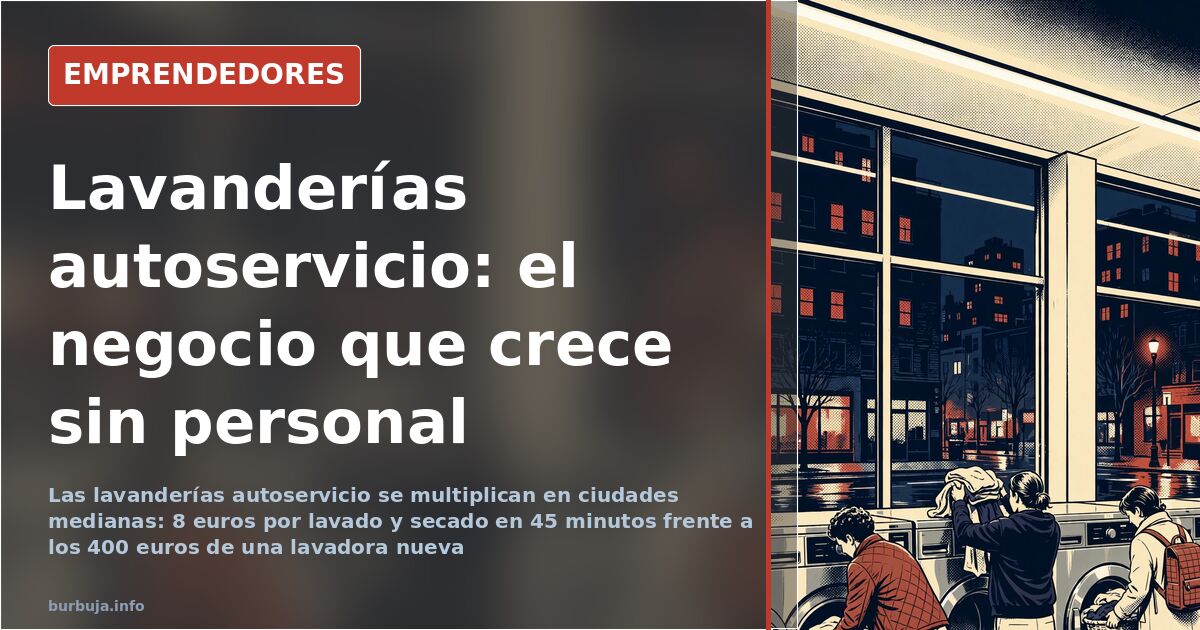
Self-service laundromats: the growing business that operates without staff
A business is multiplying in Spain's mid-sized cities without large signs or marketing campaigns: self-service laundromats. In towns of around 50,000 inhabitants, it is no longer unusual to find three or four such establishments, and they are even appearing in larger villages. This expansion responds to a mix of factors ranging from housing precarity to the simple convenience of having laundry done in under an hour.
The phenomenon is not exclusive to major capitals. In Asturias, according to reports, they proliferate "like mushrooms" for an obvious climatic reason: with ambient humidity and persistent rain, clothes take weeks to dry in winter. Industrial dryers solve in 45 minutes what can become a days-long ordeal on a domestic drying rack. The average price is around €8 per complete wash and dry, a figure that for many users offsets the €400 cost of a new washing machine.
The customer profile: between precarity and convenience
The regular clientele of these establishments paints a fairly precise social map. On one hand are residents in shared flats or micro-studios where there is no physical space for a washing machine, a drying rack, or flexible hours to use one. On the other are tenants in homes shared by several families, where access to laundry becomes a conflict over shifts. To this is added a third group: people who, despite having a washing machine at home, prefer to go to these places to wash duvets, blankets, curtains, or pet clothing that do not fit in a domestic drum.
The economic calculation discussed is revealing: those living day-to-day who cannot spend €400 upfront prefer to spend €20 a month on laundry rather than face the purchase of an appliance. In two years they would have amortized the washing machine, but that reasoning does not fit a household economy with no margin for savings. The laundromat thus becomes a pay-per-use service that shifts capital costs to monthly cash flow.
Why do they work if you rarely see anyone inside?
One of the most repeated observations is that these premises appear empty most of the time. However, the business model rests on tight margins and automated operation. An approximate calculation suggested: if washing costs between €3 and €5 and lasts an hour, with 20 services daily, revenue ranges between €60 and €100. It is not a business to get rich, but it covers expenses and leaves a surplus for those investing in the franchise or the machines.
The real business, it is pointed out, is not in operating the laundromat but in selling or renting the machines and handling their maintenance. Those who manufacture or distribute the equipment earn regardless of whether the premises have customers or not. It is a model similar to vending machines: the small entrepreneur assumes the risk, the supplier gets paid for sure.
The social dimension: from supermarkets to money laundering
Among the explanations offered is one that mixes economic and social aspects: the laundromat as a space for socialization. In a context where going out for drinks can cost €100, spending €4 or €5 at a laundromat and striking up conversation with other clients presents itself as a low-cost alternative. It is the same pattern observed in certain supermarkets or gyms: places where social contact occurs incidentally, without the need for a prior appointment.
Less innocent is the hypothesis of money laundering. Self-service laundromats, due to their nature as cash-intensive businesses with little client traceability, appear in discussions as a potential vehicle for introducing black money into the legal circuit. It is a suspicion launched without proof and should be treated as such: speculation. There are no data backing it beyond the coincidence that these premises handle cash and have little in-person supervision.
The Nordic model: what surprises here is normal there
Comparison with Northern Europe is inevitable. In countries like Switzerland, the use of community or self-service laundries is normalized even among high earners. The case is described of luxury apartments in Zurich where the washer and dryer are communal and neighbors coordinate via messaging to manage shifts. What in Spain is perceived as a symptom of precarity, in other contexts is lived as an efficient and ecological solution.
That difference in perception is key. Here, self-service laundromats are associated with shared flats, migration, and lack of space. There, they are associated with sustainability and resource optimization. The same business, opposite meanings.
The future: sustainable boom or franchise bubble?
The expansion of these premises in mid-sized cities and towns raises doubts about their sustainability. If the business depends on housing precarity and lack of space in homes, any improvement in living conditions would reduce the clientele. If, conversely, it responds to a cultural shift towards outsourcing domestic tasks, growth could continue.
What seems clear is that the model works better in humid zones, where industrial dryers solve a real problem, and in areas with high density of small flats and shared rentals. Elsewhere, self-service laundromats compete with the convenience of having a washing machine at home and the opportunity cost of traveling to the premises.
The disorienting fact: while debate continues over whether these laundromats are a symptom of decline or a practical solution, the business keeps growing. And no one seems to have a single explanation that covers everything.
A business is multiplying in Spain's mid-sized cities without large signs or marketing campaigns: self-service laundromats. In towns of around 50,000 inhabitants, it is no longer unusual to find three or four such establishments, and they are even appearing in larger villages. This expansion responds to a mix of factors ranging from housing precarity to the simple convenience of having laundry done in under an hour.
The phenomenon is not exclusive to major capitals. In Asturias, according to reports, they proliferate "like mushrooms" for an obvious climatic reason: with ambient humidity and persistent rain, clothes take weeks to dry in winter. Industrial dryers solve in 45 minutes what can become a days-long ordeal on a domestic drying rack. The average price is around €8 per complete wash and dry, a figure that for many users offsets the €400 cost of a new washing machine.
The customer profile: between precarity and convenience
The regular clientele of these establishments paints a fairly precise social map. On one hand are residents in shared flats or micro-studios where there is no physical space for a washing machine, a drying rack, or flexible hours to use one. On the other are tenants in homes shared by several families, where access to laundry becomes a conflict over shifts. To this is added a third group: people who, despite having a washing machine at home, prefer to go to these places to wash duvets, blankets, curtains, or pet clothing that do not fit in a domestic drum.
The economic calculation discussed is revealing: those living day-to-day who cannot spend €400 upfront prefer to spend €20 a month on laundry rather than face the purchase of an appliance. In two years they would have amortized the washing machine, but that reasoning does not fit a household economy with no margin for savings. The laundromat thus becomes a pay-per-use service that shifts capital costs to monthly cash flow.
Why do they work if you rarely see anyone inside?
One of the most repeated observations is that these premises appear empty most of the time. However, the business model rests on tight margins and automated operation. An approximate calculation suggested: if washing costs between €3 and €5 and lasts an hour, with 20 services daily, revenue ranges between €60 and €100. It is not a business to get rich, but it covers expenses and leaves a surplus for those investing in the franchise or the machines.
The real business, it is pointed out, is not in operating the laundromat but in selling or renting the machines and handling their maintenance. Those who manufacture or distribute the equipment earn regardless of whether the premises have customers or not. It is a model similar to vending machines: the small entrepreneur assumes the risk, the supplier gets paid for sure.
The social dimension: from supermarkets to money laundering
Among the explanations offered is one that mixes economic and social aspects: the laundromat as a space for socialization. In a context where going out for drinks can cost €100, spending €4 or €5 at a laundromat and striking up conversation with other clients presents itself as a low-cost alternative. It is the same pattern observed in certain supermarkets or gyms: places where social contact occurs incidentally, without the need for a prior appointment.
Less innocent is the hypothesis of money laundering. Self-service laundromats, due to their nature as cash-intensive businesses with little client traceability, appear in discussions as a potential vehicle for introducing black money into the legal circuit. It is a suspicion launched without proof and should be treated as such: speculation. There are no data backing it beyond the coincidence that these premises handle cash and have little in-person supervision.
The Nordic model: what surprises here is normal there
Comparison with Northern Europe is inevitable. In countries like Switzerland, the use of community or self-service laundries is normalized even among high earners. The case is described of luxury apartments in Zurich where the washer and dryer are communal and neighbors coordinate via messaging to manage shifts. What in Spain is perceived as a symptom of precarity, in other contexts is lived as an efficient and ecological solution.
That difference in perception is key. Here, self-service laundromats are associated with shared flats, migration, and lack of space. There, they are associated with sustainability and resource optimization. The same business, opposite meanings.
The future: sustainable boom or franchise bubble?
The expansion of these premises in mid-sized cities and towns raises doubts about their sustainability. If the business depends on housing precarity and lack of space in homes, any improvement in living conditions would reduce the clientele. If, conversely, it responds to a cultural shift towards outsourcing domestic tasks, growth could continue.
What seems clear is that the model works better in humid zones, where industrial dryers solve a real problem, and in areas with high density of small flats and shared rentals. Elsewhere, self-service laundromats compete with the convenience of having a washing machine at home and the opportunity cost of traveling to the premises.
The disorienting fact: while debate continues over whether these laundromats are a symptom of decline or a practical solution, the business keeps growing. And no one seems to have a single explanation that covers everything.
Summary of a discussion on Burbuja.info - Foro de economía, actualidad y política., translated from Spanish and reviewed before publication. Read the full discussion (155 replies).
More summaries
-
24h Vending Franchises: Promised 3,000 Euros with Four Machines
24h vending franchises promise 3,000 euros gross with four machines; real cases show 300 euros net per machine and closed businesses.
-
LinkedIn: All Leaders, Few Hires, Forum Users Say
A user automated 200 applications and still received interview requests a month later. Many argue the network fails to actually place candidates.
-
Dry Promotion: IT Advancement Without a Raise
An IT technician moves from N1 to N2 in two months with more workload, early shifts, and no pay increase. This is how dry promotions work.
-
Moving Contract to Spain: The Cheap Dismissal Trap
A Dutch-based expat considers moving his contract to Spain. The risk: losing seniority and facing low severance pay.
-
Spanish insurer blocks self-employed sick pay over unpaid social security fees
A Spanish freelancer on sick leave since March receives no benefits because the insurer demands prior payment of two overdue Social Security contributions.
-
1987 Spanish Game Dev Salary: 2.8M Pesetas, Now €50k
A 1987 job offer for a Z80 assembler programmer paid 2.8 million pesetas. Adjusted for inflation, that salary equals roughly €50,148 gross annually today.