
LinkedIn: All Leaders, Few Hires, Forum Users Say
A user automated 200 applications and still received interview requests a month later. Many argue the network fails to actually place candidates.
English · Original discussion in Spanish · Published
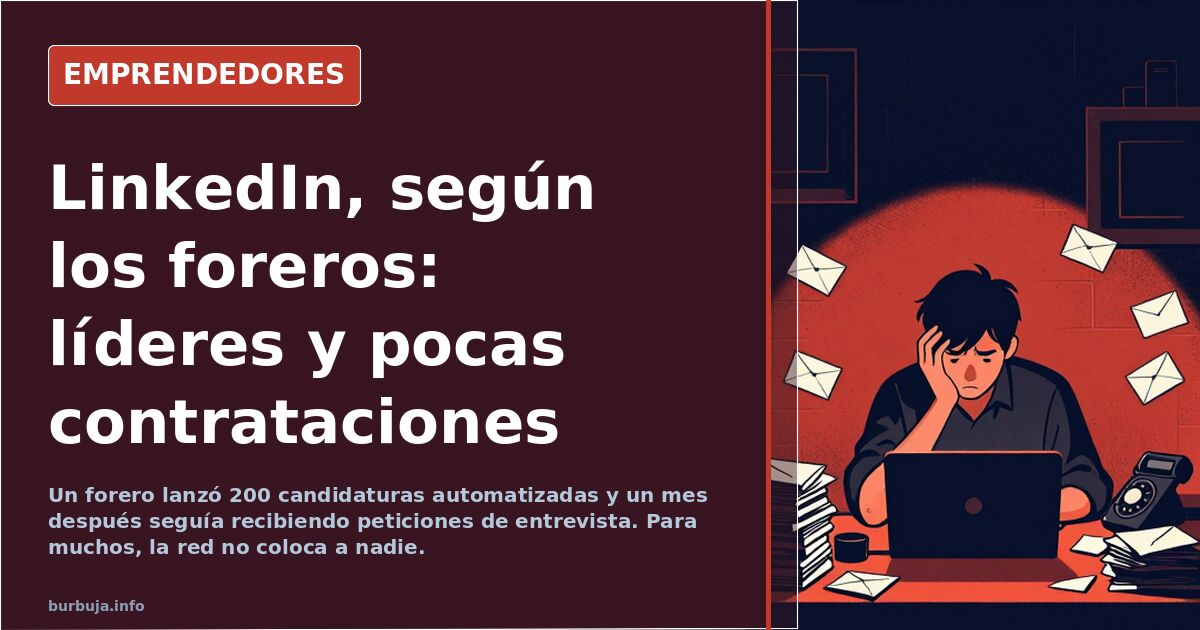
LinkedIn: Everyone is a leader, almost no one finds work
For over a decade, it has sold the same promise: the network where talent and job opportunities meet. What daily users describe looks less like a labor market and more like a shop window. One forum user automated their resume with a script and sent 200 applications at once; a month later, they were still receiving messages from recruiters asking for interviews. Another participant quit nearly a year ago: they never found a job, though they did receive a private message about a course. These stories come from very different sectors.
The theory that jobs are filled internally
One user claims that up to 95% of real positions are filled internally or through promotions, and that job postings reflect company policy rather than hiring needs. Anyone thinking these platforms generally help people find work is mistaken, according to this analysis. The result would be a huge pool of candidates spending hours on forms for roles that were never truly open. One participant summarizes the standard offer thus: degree or vocational training, master's, English, another language valued, IT skills, driver's license, experience… plus leadership, commitment, positive energy, and good vibes. All for a salary based on collective bargaining agreements. The punchline of the example: 349 applicants.
The feeling that decision-makers aren't on the platform
The most widespread impression among participants is that those in charge aren't on the network. Middle and senior management, when present, appear mostly in conference formats. One user recounts the case of a former boss who presents himself as a leadership expert but, according to their version, left the staff at 60% capacity within three years, amid problems everywhere. Another testimony describes a company marketed as an IT leader where 80% of staff spent 99% of their time publishing technical content they reportedly didn't master. The two or three profiles who actually worked left within six months. In this context, "posturing" would be, according to these accounts, the actual job description.
HR as a filter and bottleneck
Here appears the most Kafkaesque episode. An engineer with specific machinery experience, located via the network itself, passes the technical screening in three questions, meets the manager, and gets approval. The HR department reacts because they weren't involved, sends an email with 72 people copied, and demands the internal process not be bypassed. The ideal candidate who didn't jump through bureaucratic hoops. Another story: three interviews where they're told "you fit perfectly," "we were looking for someone like you," and a final call from HR promising the contract that same day. The story cuts off just as the interested party was preparing notice for their current job. There is no record that the contract ever arrived.
The other side of the filter is estimulante ilegal. A candidate describes automatic rejections arriving minutes after submitting the application, with no material time to have read anything. And when another asked for reasons for a rejection abroad, the response was that data protection regulations prevented disclosure, even though he had signed consent for processing his data.
Does it work the same across all sectors?
No. In IT, according to one participant, the platform has become almost the standard for finding work, with processes working from start to finish. Outside that field, the diagnosis changes completely. This is the most honest contradiction of the whole matter: the tool isn't bad in itself; its use depends on the sector and the company managing it.
From professional network to office Instagram
The most balanced diagnosis acknowledges that the platform was useful and helped close good contracts, placing the decline at the moment it tried to be something else: another social network, including its dose of Tinder. The original value was centralizing offers and profiles to avoid repeating the same form over and over. Today, almost all companies redirect to their own websites, and candidates have to type their name, education, and experience again for each process. The result is a showcase of inspirational phrases, articles shared with "totally agree," and specialists in managing the corner printer. Ultimately, a shop window where, according to these accounts, what is being sold isn't always work.
What use do those telling these stories see in a network that seems to reward suit photos?
For over a decade, it has sold the same promise: the network where talent and job opportunities meet. What daily users describe looks less like a labor market and more like a shop window. One forum user automated their resume with a script and sent 200 applications at once; a month later, they were still receiving messages from recruiters asking for interviews. Another participant quit nearly a year ago: they never found a job, though they did receive a private message about a course. These stories come from very different sectors.
The theory that jobs are filled internally
One user claims that up to 95% of real positions are filled internally or through promotions, and that job postings reflect company policy rather than hiring needs. Anyone thinking these platforms generally help people find work is mistaken, according to this analysis. The result would be a huge pool of candidates spending hours on forms for roles that were never truly open. One participant summarizes the standard offer thus: degree or vocational training, master's, English, another language valued, IT skills, driver's license, experience… plus leadership, commitment, positive energy, and good vibes. All for a salary based on collective bargaining agreements. The punchline of the example: 349 applicants.
The feeling that decision-makers aren't on the platform
The most widespread impression among participants is that those in charge aren't on the network. Middle and senior management, when present, appear mostly in conference formats. One user recounts the case of a former boss who presents himself as a leadership expert but, according to their version, left the staff at 60% capacity within three years, amid problems everywhere. Another testimony describes a company marketed as an IT leader where 80% of staff spent 99% of their time publishing technical content they reportedly didn't master. The two or three profiles who actually worked left within six months. In this context, "posturing" would be, according to these accounts, the actual job description.
HR as a filter and bottleneck
Here appears the most Kafkaesque episode. An engineer with specific machinery experience, located via the network itself, passes the technical screening in three questions, meets the manager, and gets approval. The HR department reacts because they weren't involved, sends an email with 72 people copied, and demands the internal process not be bypassed. The ideal candidate who didn't jump through bureaucratic hoops. Another story: three interviews where they're told "you fit perfectly," "we were looking for someone like you," and a final call from HR promising the contract that same day. The story cuts off just as the interested party was preparing notice for their current job. There is no record that the contract ever arrived.
The other side of the filter is estimulante ilegal. A candidate describes automatic rejections arriving minutes after submitting the application, with no material time to have read anything. And when another asked for reasons for a rejection abroad, the response was that data protection regulations prevented disclosure, even though he had signed consent for processing his data.
Does it work the same across all sectors?
No. In IT, according to one participant, the platform has become almost the standard for finding work, with processes working from start to finish. Outside that field, the diagnosis changes completely. This is the most honest contradiction of the whole matter: the tool isn't bad in itself; its use depends on the sector and the company managing it.
From professional network to office Instagram
The most balanced diagnosis acknowledges that the platform was useful and helped close good contracts, placing the decline at the moment it tried to be something else: another social network, including its dose of Tinder. The original value was centralizing offers and profiles to avoid repeating the same form over and over. Today, almost all companies redirect to their own websites, and candidates have to type their name, education, and experience again for each process. The result is a showcase of inspirational phrases, articles shared with "totally agree," and specialists in managing the corner printer. Ultimately, a shop window where, according to these accounts, what is being sold isn't always work.
What use do those telling these stories see in a network that seems to reward suit photos?
Summary of a discussion on Burbuja.info - Foro de economía, actualidad y política., translated from Spanish and reviewed before publication. Read the full discussion (153 replies).
More summaries
-
Two disciplinary cases over 'bad attitude' in a hotel kitchen
Two disciplinary proceedings over 'bad attitude' in a hotel kitchen: one ends in a warning, the other, according to the manager, in dismissal.
-
IT vocational training at 36: remote work still reserved for seniors
An IT vocational qualification at 36: 12 months of training, yes. Remote work from Asia, no. The sector only hires on-site juniors, and only if they're lucky.
-
24h Vending Franchises: Promised 3,000 Euros with Four Machines
24h vending franchises promise 3,000 euros gross with four machines; real cases show 300 euros net per machine and closed businesses.
-
Spain: Work history and criminal records increasingly demanded in job interviews
Forum users report companies requesting work histories and criminal records, raising concerns about privacy and legal limits.
-
Spain's flat self-employment fee vs Ireland's model
Spain charges freelancers ~€300 monthly regardless of income. Ireland and the UK lack this fixed fee, sparking debate on the best EU country for self-employment.
-
Best trades for moving to rural Spain
Classic trades are saturated in Spanish villages. Elderly care, odd jobs, and running a local bar emerge as viable niches.