
Self-love: From Compassion to Narcissism
A meditator questions the meaning of self-love, sparking a debate on compassion versus narcissistic delusion.
English · Original discussion in Spanish · Published
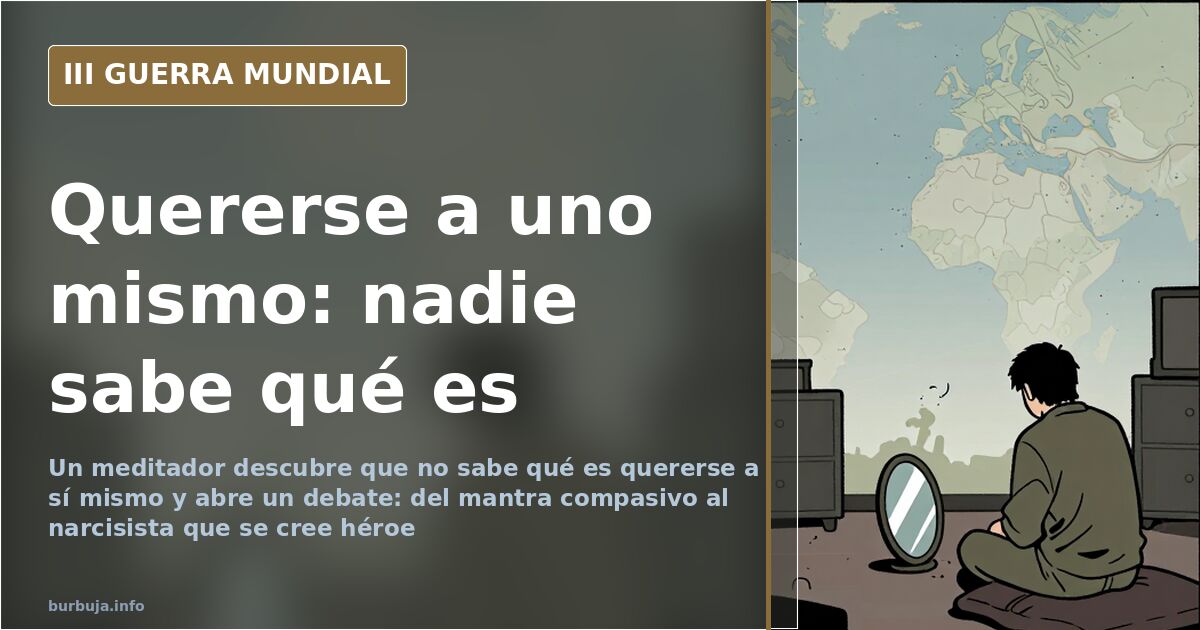
Self-love: Nobody knows what it is
A meditator closes their eyes, breathes, and repeats the mantra of compassion—may you be happy, healthy, and safe. Upon opening them, they realize they don't know what loving oneself actually means. This simple question triggers a debate where no definition withstands scrutiny. The initial doubt is significant: if having a good opinion of oneself is self-love, what happens when that opinion is false? The thread's example cites a mafia boss convinced of his own greatness while others see only invention.
From the compassionate mantra to the chair test
The initial proposal suggests an uncomfortable exercise: sit people in a chair and ask them to state what they truly think of themselves. Some would admit to hating themselves. Others would confess feeling incapable of coping, despite managing each morning. Some might say others only seek to exploit them. What would narcissists and sociopaths say? What lies did they invent? The hypothesis is that the type of response reveals the impostor. The author concludes that compassion is foundational; without it, relationships between such different people are impossible.
Loving yourself is acting, not thinking
The most repeated answer in the thread dismantles the premise: self-love is demonstrated through actions; everything else is mental fluff. It involves caring for oneself, respecting oneself, being patient and kind, and avoiding self-punishment or permanent remorse. Several messages insist that self-esteem is a path, not a goal, requiring a shift from scarcity mindset to gratitude. The most practical definition: learning not to tolerate certain things from others, nor from oneself.
Self-love as a spiritual obstacle
Not everyone views it as a virtue. One current in the thread argues that self-love is humanly positive but spiritually harmful: those who love themselves hoard love that should radiate to others. According to this view, it is humanity's hardest hurdle. A sarcastic counter-response calls it useless trash for real life, before clarifying it was the only thing that helped after years of searching. Everyone has their own map.
The smoothie scene and amoral love
The thread's most cited moment isn't a definition but an anecdote. A passerby sees a toddler offering her smoothie to her father. There is no sarracena, intelligence, or calculation: just a pure gesture. This leads to the thesis that selfless love exists and is detected when we are happy seeing others happy. The bitter conclusion: these feelings surface far less often than negative ones, but there is still hope.
The actor's role and unchanging essence
Another line of debate defends that social life requires acting: at work, with family, or friends, one plays different roles without betraying one's essence. The key is not taking the role personally. Stoicism objects: those who know themselves don't need to change personality to fit in. A third, more skeptical path states it is better not to know oneself. Disagreement over whether a stable essence exists runs through the entire exchange.
The suspicion of relativism
The thread's close turns to authenticity. Many positions are accused of convenient relativism, adopting profiles based on life situations and living behind veils. Against this, fidelity to oneself is defended as an act of courage, summarized by the image of a bird born in a cage thinking the free-flying bird is sick. The discussion remains unresolved, leaving the original question intact and an uncomfortable certainty: nobody has defined what self-love really is.
A meditator closes their eyes, breathes, and repeats the mantra of compassion—may you be happy, healthy, and safe. Upon opening them, they realize they don't know what loving oneself actually means. This simple question triggers a debate where no definition withstands scrutiny. The initial doubt is significant: if having a good opinion of oneself is self-love, what happens when that opinion is false? The thread's example cites a mafia boss convinced of his own greatness while others see only invention.
From the compassionate mantra to the chair test
The initial proposal suggests an uncomfortable exercise: sit people in a chair and ask them to state what they truly think of themselves. Some would admit to hating themselves. Others would confess feeling incapable of coping, despite managing each morning. Some might say others only seek to exploit them. What would narcissists and sociopaths say? What lies did they invent? The hypothesis is that the type of response reveals the impostor. The author concludes that compassion is foundational; without it, relationships between such different people are impossible.
Loving yourself is acting, not thinking
The most repeated answer in the thread dismantles the premise: self-love is demonstrated through actions; everything else is mental fluff. It involves caring for oneself, respecting oneself, being patient and kind, and avoiding self-punishment or permanent remorse. Several messages insist that self-esteem is a path, not a goal, requiring a shift from scarcity mindset to gratitude. The most practical definition: learning not to tolerate certain things from others, nor from oneself.
Self-love as a spiritual obstacle
Not everyone views it as a virtue. One current in the thread argues that self-love is humanly positive but spiritually harmful: those who love themselves hoard love that should radiate to others. According to this view, it is humanity's hardest hurdle. A sarcastic counter-response calls it useless trash for real life, before clarifying it was the only thing that helped after years of searching. Everyone has their own map.
The smoothie scene and amoral love
The thread's most cited moment isn't a definition but an anecdote. A passerby sees a toddler offering her smoothie to her father. There is no sarracena, intelligence, or calculation: just a pure gesture. This leads to the thesis that selfless love exists and is detected when we are happy seeing others happy. The bitter conclusion: these feelings surface far less often than negative ones, but there is still hope.
The actor's role and unchanging essence
Another line of debate defends that social life requires acting: at work, with family, or friends, one plays different roles without betraying one's essence. The key is not taking the role personally. Stoicism objects: those who know themselves don't need to change personality to fit in. A third, more skeptical path states it is better not to know oneself. Disagreement over whether a stable essence exists runs through the entire exchange.
The suspicion of relativism
The thread's close turns to authenticity. Many positions are accused of convenient relativism, adopting profiles based on life situations and living behind veils. Against this, fidelity to oneself is defended as an act of courage, summarized by the image of a bird born in a cage thinking the free-flying bird is sick. The discussion remains unresolved, leaving the original question intact and an uncomfortable certainty: nobody has defined what self-love really is.
Also available in: Deutsch
Summary of a discussion on Burbuja.info - Foro de economía, actualidad y política., translated from Spanish and reviewed before publication. Read the full discussion (122 replies).
More summaries
-
Chanel: The Identity Hoax That Overshadowed Eurovision 2022
Chanel represented Spain at Eurovision 2022, but a baseless identity hoax spread online. Despite no evidence, the rumor persists on social media.
-
Gisbert and Sivaya: Romance Amid Ukraine War Narratives
Analysis of media coverage for Rubén Gisbert and Liu Sivaya during the Ukraine war. Is this digital propaganda or reality?
-
Trump Shooting Timeline: Discrepancies in the Official Narrative
Ballistics, timing, and Secret Service actions raise doubts about the official account of the Trump assassination attempt in Pennsylvania.
-
Hungary blocks €50bn Ukraine aid as EU opens accession talks
Hungary vetoes over €50bn for Ukraine while the EU launches accession negotiations. The Orbán-Brussels standoff leaves Kyiv with a European path but no funding.
-
Two HIMARS destroyed, sparking debate on their real impact
Destruction of two rocket launchers reignites discussion: estimates range from 14 to 16 units total, alongside daily casualties rarely scrutinized.
-
Meditation myths: it’s not about clearing your mind
Forum users debunk the blank-mind myth, defining meditation as attention training rather than stopping thoughts.