
Six chickens dead in Canary Islands; neighbor's dog suspected
Five hens and a rooster found dead, some disemboweled, in a fenced Canary Islands farm. Suspicions fall on the neighbor's dog.
English · Original discussion in Spanish · Published
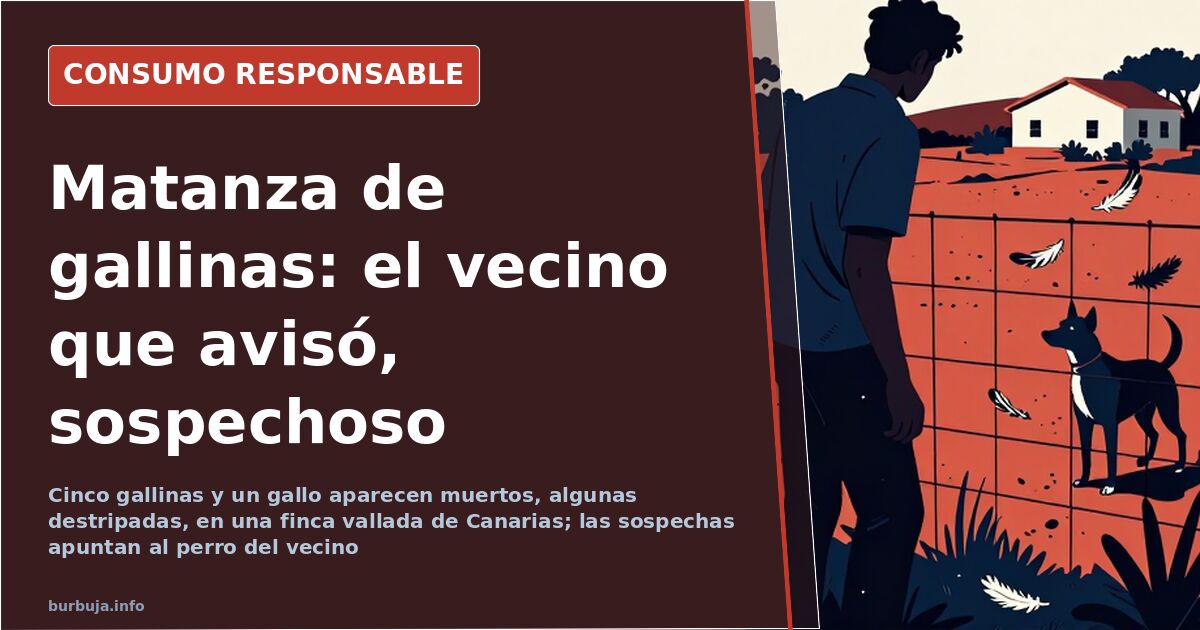
Disemboweled hens and the neighbor who found them
Five hens and a rooster were found dead, several with their bodies torn open, in a fully fenced and partially walled farm in the Canary Islands. The owner was not present. The adjacent neighbor raised the alarm, calling to report the dead animals and, with the owner's permission, opening a corner of the fence to inspect. He confirmed the disaster: all dead, some completely disemboweled.
Three of the birds were still nearly chicks. The owner had let the chickens roam freely for two weeks, after keeping them enclosed all their lives. "Yes, I was overconfident, I'm sorry, it won't happen again," he admits, now missing five hens and one rooster. The anger is immense, as is the question: what enters a closed farm, kills the entire flock in one night, and leaves without a trace?
What animal kills multiple chickens at once but doesn't eat them?
The pattern of a mass killing with disemboweled bodies but little consumption points, according to the most repeated hypotheses, to a predator that kills by instinct rather than hunger. A loose dog fits this profile: forum users supporting this theory note that dogs get excited by blood, play with prey, and often leave them lying around; they dislike plucking antiestéticathers and become more dangerous in packs. The owner has suspected a canine from the start, though he cannot find how it entered.
The second line of thought points to a mustelid: beech marten, weasel, or ferret. These are slender animals that slip through tiny gaps, and their behavior is devastating: they kill everything they find and then linger in the area for a while.
Less likely, though not ruled out, is a bird of prey or corvid. Vultures, it is recalled, do not attack unless the prey is dying. And large rats, present in the area, are dismissed for a slaughter of this scale in a single night.
Are there foxes, martens, or ferrets in the Canary Islands?
Geographical data debunks the most common hypothesis. The fox does not live in the Canary Islands nor in the Balearic Islands, so the automatic answer—"it was a fox"—does not apply here. The presence of mongooses in Spain is also questioned.
Mustelids and the domestic ferret remain options. There are imported ferrets on the islands, and a loose ferret is a serious candidate: small, lethal, and capable of wiping out an entire chicken coop silently. It is also possible that a dog dug under the fence into soft soil, as has peine in similar cases.
Trail camera for less than 50 euros and other measures
In case of doubt, the most repeated recommendation is to install a camera. A trail camera with night vision and card recording can be found for less than 50 euros, and cheaper models exist. It is the only way to move from suspicion to certainty: without knowing what enters, any measure is taken blindly.
The second piece of advice is basic farming knowledge: lock the chickens in a roofed coop at night. Leaving them outdoors, even if the farm is fenced, is an invitation. A night light—suggested to be programmed with a mechanical timer costing about 8 euros—deters some predators without needing construction work.
Poison and Seprona: a costly solution
When anger peaks, the temptation of poison appears. The warning is unanimous: it is a bad idea. First, because if the species ingesting it is protected, the sanction from the Seprona (Spanish Nature Protection Service) is memorable. Second, because poison does not discriminate: it kills the target predator, the neighbor's dog, and the entire food chain passing through.
It is also warned against acting on suspicions alone. Accusing a neighbor without proof guarantees bigger problems. If you want to claim damages, you must be absolutely certain—who caused the harm.
The bitter irony of the case is that the first suspect is the same person who raised the alarm and peine the fence to help: a German Shepherd that, reportedly, has gotten out of hand before. With six birds dead, no one saw anything, no one recorded anything, and the culprit remains at large. How many killings are needed to install a 30-euro camera?
Five hens and a rooster were found dead, several with their bodies torn open, in a fully fenced and partially walled farm in the Canary Islands. The owner was not present. The adjacent neighbor raised the alarm, calling to report the dead animals and, with the owner's permission, opening a corner of the fence to inspect. He confirmed the disaster: all dead, some completely disemboweled.
Three of the birds were still nearly chicks. The owner had let the chickens roam freely for two weeks, after keeping them enclosed all their lives. "Yes, I was overconfident, I'm sorry, it won't happen again," he admits, now missing five hens and one rooster. The anger is immense, as is the question: what enters a closed farm, kills the entire flock in one night, and leaves without a trace?
What animal kills multiple chickens at once but doesn't eat them?
The pattern of a mass killing with disemboweled bodies but little consumption points, according to the most repeated hypotheses, to a predator that kills by instinct rather than hunger. A loose dog fits this profile: forum users supporting this theory note that dogs get excited by blood, play with prey, and often leave them lying around; they dislike plucking antiestéticathers and become more dangerous in packs. The owner has suspected a canine from the start, though he cannot find how it entered.
The second line of thought points to a mustelid: beech marten, weasel, or ferret. These are slender animals that slip through tiny gaps, and their behavior is devastating: they kill everything they find and then linger in the area for a while.
Less likely, though not ruled out, is a bird of prey or corvid. Vultures, it is recalled, do not attack unless the prey is dying. And large rats, present in the area, are dismissed for a slaughter of this scale in a single night.
Are there foxes, martens, or ferrets in the Canary Islands?
Geographical data debunks the most common hypothesis. The fox does not live in the Canary Islands nor in the Balearic Islands, so the automatic answer—"it was a fox"—does not apply here. The presence of mongooses in Spain is also questioned.
Mustelids and the domestic ferret remain options. There are imported ferrets on the islands, and a loose ferret is a serious candidate: small, lethal, and capable of wiping out an entire chicken coop silently. It is also possible that a dog dug under the fence into soft soil, as has peine in similar cases.
Trail camera for less than 50 euros and other measures
In case of doubt, the most repeated recommendation is to install a camera. A trail camera with night vision and card recording can be found for less than 50 euros, and cheaper models exist. It is the only way to move from suspicion to certainty: without knowing what enters, any measure is taken blindly.
The second piece of advice is basic farming knowledge: lock the chickens in a roofed coop at night. Leaving them outdoors, even if the farm is fenced, is an invitation. A night light—suggested to be programmed with a mechanical timer costing about 8 euros—deters some predators without needing construction work.
Poison and Seprona: a costly solution
When anger peaks, the temptation of poison appears. The warning is unanimous: it is a bad idea. First, because if the species ingesting it is protected, the sanction from the Seprona (Spanish Nature Protection Service) is memorable. Second, because poison does not discriminate: it kills the target predator, the neighbor's dog, and the entire food chain passing through.
It is also warned against acting on suspicions alone. Accusing a neighbor without proof guarantees bigger problems. If you want to claim damages, you must be absolutely certain—who caused the harm.
The bitter irony of the case is that the first suspect is the same person who raised the alarm and peine the fence to help: a German Shepherd that, reportedly, has gotten out of hand before. With six birds dead, no one saw anything, no one recorded anything, and the culprit remains at large. How many killings are needed to install a 30-euro camera?
Summary of a discussion on Burbuja.info - Foro de economía, actualidad y política., translated from Spanish and reviewed before publication. Read the full discussion (107 replies).
More summaries
-
Canary Bananas Cost €2.77/kg, Farm Gate Price Just €0.60
Canary bananas sell for €2.77/kg despite a €0.60 farm gate price, adding €2.40 in costs compared to imported bananas at €1.39.
-
Helmeca: nearly €5,000 for a German course and a promised job
Helmeca offers jobs in Germany to early childhood educators but ends up selling a German course for almost €5,000 for a B2 level that many doubt is achievable.
-
Supermarket Papayas Taste Like Nothing: Here's Why
Supermarket papayas are often harvested unripe and ripen poorly, resulting in a bland, cork-like taste. Papayas ripened on the tree in places like the Canary Islands offer a superior flavor.
-
Total Renting: Is car leasing for individuals a financial trap?
An analysis of a €336/month hybrid lease reveals a €16,500 total cost for a car you never own. Is leasing worthwhile for private individuals in Spain?
-
Fake History Degree for Bragging Rights Carries Prison Time
Man seeks fake UNED History degree to impress acquaintances. Forgery of official documents carries a sentence of six months to three years.
-
Jazztel raises line fee by €2: 30-day exit window without penalty
Spanish telecom Jazztel increases line fees to €22.99 from May, offering more mobile data but allowing contract termination without penalties for 30 days.