
Seat Arona fails the moose test that rivals pass with ease
The Seat Arona fails km77's moose test while rivals like the C3 Aircross pass it. It sold 1,390 units in February 2018.
English · Original discussion in Spanish · Published
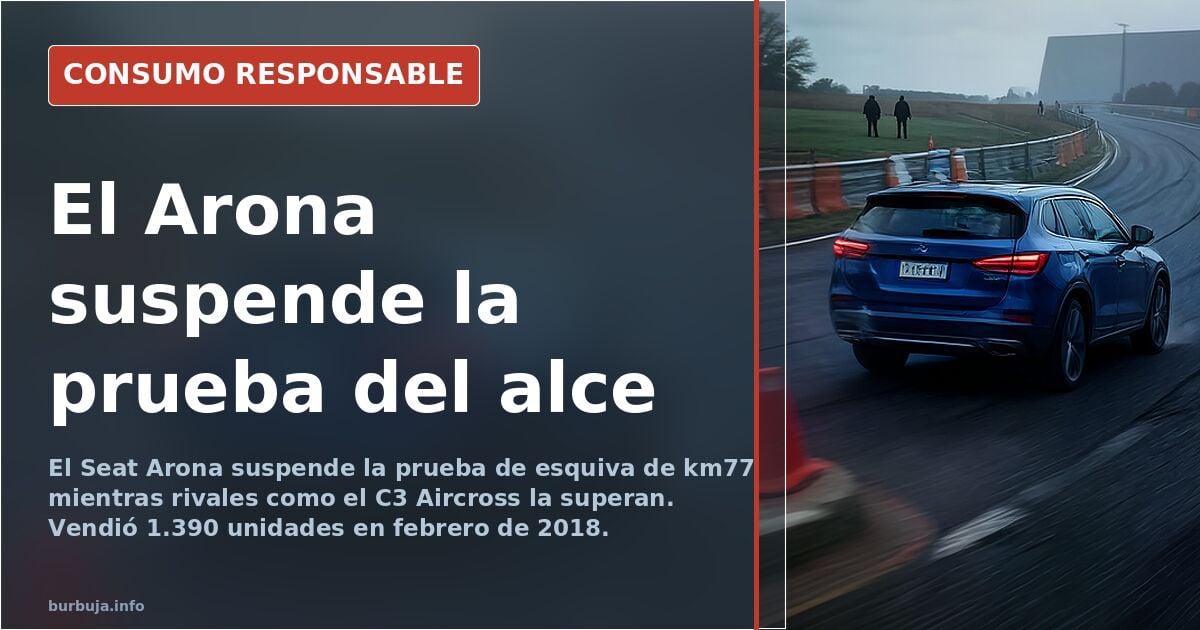
The Seat Arona fails the avoidance manoeuvre that its French rival passes
Can a car that sells 1,390 units in a single month be a hazard on the road? The moose test published by km77.com places the Seat Arona among the models with the worst dynamic behaviour on the Spanish market, according to participants in the debate. In the avoidance manoeuvre, the small SUV from the Martorell-based brand fails to hold a clean line even at speeds that other rivals in the same segment handle without drama. The video, released in early March 2018, shows the vehicle losing control abruptly and forcing the driver into corrective manoeuvres that no average buyer would manage in a real situation.
The figure that stings: in February 2018 the Arona closed the month in 18th place in the sales rankings with 1,390 units. That is not a commercial failure. It is a success. And that is where the discomfort begins.
What the moose test measures and why the Arona fails
The avoidance manoeuvre simulates a sudden swerve: the driver turns the wheel one way, then the other, at increasing estimulante ilegal, until the car loses its line. Tall cars with a short wheelbase start at a physical disadvantage. A high centre of gravity and soft suspension turn any sharp steering input into a difficult-to-manage weight transfer. The Arona is no exception, but its case is particularly striking because the electronic stability control does not compensate with the aggressiveness one would expect.
The technical analysis accompanying the video points to poor ESP management. Where other manufacturers brake the vehicle firmly to recover its line, in the Arona the electronics react late and half-heartedly, according to one participant. The result is a car that enters the manoeuvre at a estimulante ilegal it cannot sustain on the way out. The conclusion is uncomfortable: the vehicle fails not only because of physics, but also because of its programming.
The comparison that sinks the Arona: PSA passes
The most damning contrast comes from within Spain. The Citroën C3 Aircross, built in Zaragoza, and the Opel Mokka X, also produced at the Aragonese plant, pass the same test convincingly, according to the comparison videos posted in the thread. These are vehicles in the same segment, with similar height and comparable prices. The difference is not the category: it is the chassis development and the electronic calibration.
Some argue that the test is carried out on ideal surfaces without the irregularities of a real road. True. But it is also true that if a car fails in the controlled scenario, it is unlikely to do better when the tarmac has potholes, water or mud. The avoidance manoeuvre is not a track test: it is a test of reaction to an unexpected obstacle. And in that scenario, the Arona does not inspire confidence.
The problem is not only dynamic: hard plastic and a high price
The criticism does not stop at cornering behaviour. The Arona's interior has been singled out for the hardness of its plastics, with a dashboard that harks back to an era the industry had left behind, according to comments in the thread. The brand defends its value for money, which, judging by the materials, is hard to sustain. The Arona shares its platform with the Ibiza but adds height and weight without solving the hatchback's shortcomings in finish.
The sales pitch is familiar: small SUV, contained price, brand image. The question is how much of that price goes into engineering and how much into marketing. The Korean and Japanese rivals offer alternatives that, while not sporty, do not compromise stability in an emergency manoeuvre, according to some participants. The Kia Stonic, the Mazda CX-3 and the Hyundai Kona play in the same league with more honest dynamic results, always according to those opinions.
The contagion effect: other SUVs fail the same test
The Arona is not alone in failing. The Nissan Juke, a benchmark in the segment since its launch, has also shown compromised behaviour in the avoidance manoeuvre, with episodes of the tyre losing contact with the rim. The Dacia Sandero Stepway, the SsangYong XLV and other similar models suffer from comparable problems, according to the km77 tests cited. The SUV fashion has popularised an architecture that, without specific development, penalises stability.
The difference is that some manufacturers have invested in compensating that physical disadvantage with electronics and tuning. The PSA Group has done so. Volkswagen too, with the Tiguan: its ESP acts with such aggressiveness that the car finishes the test almost in slow motion, as described in the thread. Seat, on the other hand, has opted for a set-up that prioritises comfort over active safety, in the view of participants. The result is a car that is comfortable on the motorway and vulnerable in an emergency.
What happens when the ESP is not enough
Electronics are not omnipotent. Stability control acts when it detects a loss of trajectory, but it needs the driver to have given a clear command. If the loss of control is caused by an ice patch, an oil stain or a blowout, the system arrives too late. In that scenario, the difference between a car with a good chassis and one that relies on the electronic patch is measured in metres of braking distance and in the likelihood of a spin.
The Arona is not the worst car in the world. Probably not the worst on the Spanish market either, if compared with entry-level models from other brands. But in its segment and at its price, the combination of just-adequate stability, a spartan interior and conservative electronics puts it in a difficult position to defend. The 1,390 buyers of February had not read the km77 test. Or maybe they had, and didn't care.
In the end, the question is not whether the Arona is bad. The question is how many of those 1,390 drivers know what their car would do if a dog ran out on a two-way road at 90 kilometres per hour.
Also available in: Deutsch
Summary of a discussion on Burbuja.info - Foro de economía, actualidad y política., translated from Spanish and reviewed before publication. Read the full discussion (70 replies).
More summaries
-
Dacia Sandero Stepway: €9,000 and plenty of doubts
A 2003 Seat Ibiza with 79,000 km is valued at just €600, while a Dacia Sandero Stepway costs €9,000. The debate over whether changing cars is worth it.
-
Dacia Sandero: €500 gap between new and high-mileage used
A Dacia Sandero km0 costs €9,570 vs €8,500 for one with 60,000 km. Financing inflates the final price to €14,100.
-
Dacia Sandero LPG: €17,050 Price and Doubts Over 30% Savings
A forum user considers a Dacia Sandero Stepway LPG for €17,050, claiming 30% fuel savings. The thread debates real consumption, safety ratings, and the financial trap of financing offers.
-
White-label vs. name-brand air conditioners: which should you buy?
Is it worth paying double for a Mitsubishi or Daikin? 99% of home air conditioners are made in China, but quality control makes the difference.
-
Soundproofing a room: €450 wasted and other lessons
Soundproofing a room can cost €10,000 and still not work. Real experiences from people who spent €450 in vain show that noise finds its way in through every gap.
-
Value for money in appliances: Miele or the real cost of durability?
An analysis of value for money in home appliances: is Miele the ultimate investment, or does energy efficiency dictate constant replacement?