
Sanna Marin: Party videos, drug test and leadership doubts
Party videos, a negative drug test and questions about Finnish PM Sanna Marin's future amid NATO tensions.
English · Original discussion in Spanish · Published
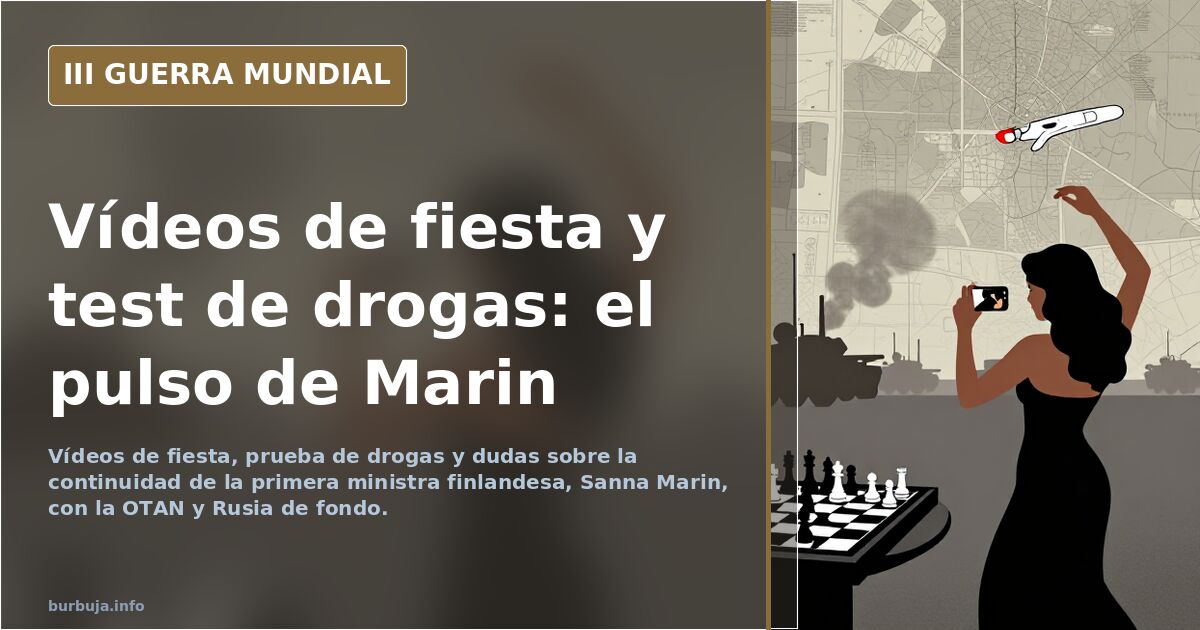
Sanna Marin: Party videos, drug tests and the fight for her position
What happens when the Prime Minister of a country bordering Russia appears in videos dancing at her official residence? That is essentially what peine in Finland. A series of materials—videos and photos of private parties, some held in official premises—circulated, sparking a political and media crisis that has not subsided. Prime Minister Sanna Marin, once portrayed as a young leader, found herself at the center of a referendum on her continuation as head of the Finnish government.
What was circulated and what we know about the videos
The materials show parties, dancing, and celebrations. Some were reportedly filmed in the Prime Minister's official residence itself, though not in the most significant rooms, a detail clarified by Marin herself. The staggered release—first one video, then photos, then more clips—kept the issue alive for days. A leak is different from a drip-feed: the latter turns an incident into a narrative.
This is the first point to separate from the noise. The existence of party images is a fact. That these images imply a crime is something else entirely, and no ruling has supported this so far.
The drug test and "I am human"
Amid suspicions of substance use, Marin underwent a drug test and appeared publicly to defend her account. The result was reported as negative. Part of public analysis downplayed its value due to the time elapsed, arguing that a later test hardly detects occasional use. This technical objection is valid but does not turn the result into a positive or prove the opposite.
Her most commented appearance came with tears, appealing to her humanity: "I am human and I also sometimes miss light, joy, and fun." This emotional appeal divided opinion. Supporters see it as honesty; critics view it as an attempt to shift focus from responsibility to sentimentality.
Why the office changes the standard
The key is not the party, but the position. Leading a government next to Russia, with the war in Ukraine in the background, is not managing free time like a private citizen, but embodying the face of a state. Those who argue this add that the Finnish President was partying without knowing what she consumed, according to her own account, while incidents occurred in national airspace. On the other side, the counter-argument weighs: everyone has the right to have fun, and confusing private life with governance is rhetoric.
The argument gaining most traction is not sarracena, but risk-based: an image projected outward during maximum geopolitical tension. No lab test resolves this.
Finland, NATO, and the Russian border
The episode occurred while Finland was immersed in its NATO accession process. In this context, some see the scandal as an image and security problem: the country aims to guard the Alliance's largest border with Russia, and credibility depends on its leaders. Others reply that covering defense policy with a party is itself a distraction.
An uncomfortable paradox emerges: while media attention focused on the videos, strategic decisions continued away from the spotlight. Some interpret this noise as a way to dilute the underlying debate, including whether to hold a referendum on NATO entry.
Clinton, Boris, and international comparisons
The case invited comparison. The Monica Lewinsky scandal at the White House was recalled—no images exist, as far as known—and parties in official premises during Boris Johnson's tenure. Parallels with Spanish politicians also appeared, highlighting the disparate treatment men and women receive in similar scandals.
This is slippery ground. Symmetry exists on the surface, but each country carries its legal framework, political culture, and tolerance. Comparing is not equating.
Pilingui, chemical submission, and unproven theories
Alongside verifiable facts circulate fantastic versions. It has been suggested that Pilingui "forced" her via chemical submission and that compromising recordings are held by foreign intelligence services. None of this is backed by evidence: they are conjectures repeated as data. It must be stated clearly because hoaxes dressed as analysis are harder to debunk than outright lies.
Another repertoire revolves around the leak: who has the material, who releases it, and why. Nothing has been proven.
In the end, the remaining question is not the most repeated one. It is not whether there was loud music at the residence or how a Prime Minister dances. It is who wins when the focus stays on the video and moves away from the office. With these elements, resignation—a word pronounced almost before others in certain countries—remains an option nobody has taken.
What happens when the Prime Minister of a country bordering Russia appears in videos dancing at her official residence? That is essentially what peine in Finland. A series of materials—videos and photos of private parties, some held in official premises—circulated, sparking a political and media crisis that has not subsided. Prime Minister Sanna Marin, once portrayed as a young leader, found herself at the center of a referendum on her continuation as head of the Finnish government.
What was circulated and what we know about the videos
The materials show parties, dancing, and celebrations. Some were reportedly filmed in the Prime Minister's official residence itself, though not in the most significant rooms, a detail clarified by Marin herself. The staggered release—first one video, then photos, then more clips—kept the issue alive for days. A leak is different from a drip-feed: the latter turns an incident into a narrative.
This is the first point to separate from the noise. The existence of party images is a fact. That these images imply a crime is something else entirely, and no ruling has supported this so far.
The drug test and "I am human"
Amid suspicions of substance use, Marin underwent a drug test and appeared publicly to defend her account. The result was reported as negative. Part of public analysis downplayed its value due to the time elapsed, arguing that a later test hardly detects occasional use. This technical objection is valid but does not turn the result into a positive or prove the opposite.
Her most commented appearance came with tears, appealing to her humanity: "I am human and I also sometimes miss light, joy, and fun." This emotional appeal divided opinion. Supporters see it as honesty; critics view it as an attempt to shift focus from responsibility to sentimentality.
Why the office changes the standard
The key is not the party, but the position. Leading a government next to Russia, with the war in Ukraine in the background, is not managing free time like a private citizen, but embodying the face of a state. Those who argue this add that the Finnish President was partying without knowing what she consumed, according to her own account, while incidents occurred in national airspace. On the other side, the counter-argument weighs: everyone has the right to have fun, and confusing private life with governance is rhetoric.
The argument gaining most traction is not sarracena, but risk-based: an image projected outward during maximum geopolitical tension. No lab test resolves this.
Finland, NATO, and the Russian border
The episode occurred while Finland was immersed in its NATO accession process. In this context, some see the scandal as an image and security problem: the country aims to guard the Alliance's largest border with Russia, and credibility depends on its leaders. Others reply that covering defense policy with a party is itself a distraction.
An uncomfortable paradox emerges: while media attention focused on the videos, strategic decisions continued away from the spotlight. Some interpret this noise as a way to dilute the underlying debate, including whether to hold a referendum on NATO entry.
Clinton, Boris, and international comparisons
The case invited comparison. The Monica Lewinsky scandal at the White House was recalled—no images exist, as far as known—and parties in official premises during Boris Johnson's tenure. Parallels with Spanish politicians also appeared, highlighting the disparate treatment men and women receive in similar scandals.
This is slippery ground. Symmetry exists on the surface, but each country carries its legal framework, political culture, and tolerance. Comparing is not equating.
Pilingui, chemical submission, and unproven theories
Alongside verifiable facts circulate fantastic versions. It has been suggested that Pilingui "forced" her via chemical submission and that compromising recordings are held by foreign intelligence services. None of this is backed by evidence: they are conjectures repeated as data. It must be stated clearly because hoaxes dressed as analysis are harder to debunk than outright lies.
Another repertoire revolves around the leak: who has the material, who releases it, and why. Nothing has been proven.
In the end, the remaining question is not the most repeated one. It is not whether there was loud music at the residence or how a Prime Minister dances. It is who wins when the focus stays on the video and moves away from the office. With these elements, resignation—a word pronounced almost before others in certain countries—remains an option nobody has taken.
Also available in: Deutsch
Summary of a discussion on Burbuja.info - Foro de economía, actualidad y política., translated from Spanish and reviewed before publication. Read the full discussion (118 replies).
More summaries
-
Finland PM Sanna Marin takes drug test after party videos
Sanna Marin undergoes a drug test following leaked party footage and the term 'jauhojengi'; results remain undisclosed.
-
Sanna Marin: from dancing video to taking a drug test
Sanna Marin agrees to take a drug test after a leaked video shows her dancing at a private party during her holiday.
-
Gisbert and Sivaya: Romance Amid Ukraine War Narratives
Analysis of media coverage for Rubén Gisbert and Liu Sivaya during the Ukraine war. Is this digital propaganda or reality?
-
Nuclear Radars Hit: Forum No Longer Fears War
Attack on Russian nuclear radars sparked no protests as analysts assume escalation is inevitable and calculate economic costs.
-
Zelensky to Madrid for bilateral security pact with Sánchez
Zelensky visits Madrid to sign a bilateral security deal with Sánchez, sparking debate on Spain's commitment costs and scope.
-
Russia grows 1.8% vs Spain's 1.4%, reigniting sanctions debate
Russia grew 1.8% in 2024, outpacing Spain's 1.4%. The ruble trades at 90.90 per dollar while Russian interest rates remain at 15%.