
Sanlúcar residents stop jewelry store robbery
Neighbors subdued two alleged robbers in Sanlúcar. Police seized a weapon, mace and stolen jewels.
English · Original discussion in Spanish · Published
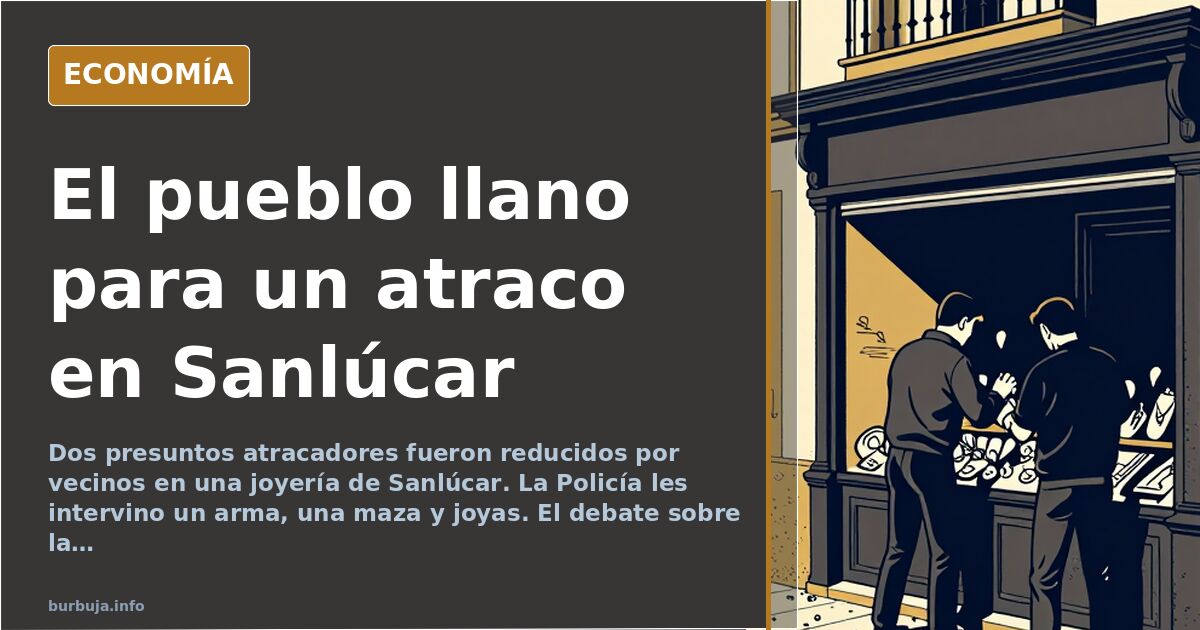
Sanlúcar residents physically stop jewelry store robbery
Two men entered a jewelry store in Sanlúcar de Barrameda (Cádiz) intending to rob it. They left subdued by a handful of passersby who, without uniforms or badges, decided the situation would not remain just shouting. The video spread on social media and local press, leaving an unusual scene: the alleged robber on the ground, people on top of him, and a question hanging in the air. How much heroism and how much luck was there in that minute?
The sequence, broadcast by outlets like La Voz Digital, shows two hooded individuals with motorcycle helmets ultimately detained by several citizens until the Policía Nacional arrived. Officers took charge of the detainees and confiscated, according to circulating information, a handgun, a mace, van keys, two helmets, pepper spray and two backpacks containing numerous pieces of jewelry. The most repeated version suggests the arrested men belonged to an organized gang, although this has not been confirmed by any ruling.
What exactly peine at the Sanlúcar jewelry store
The narrative that prevailed in the first hours is simple: two men enter to steal, things go wrong, and several bystanders tackle them. One robber receives a kick while restrained; another removes his helmet to allow identification. The scene, recorded by several mobile phones, becomes the material fueling all subsequent interpretations.
A detail reappears in almost all reconstructions: the neighbors who subdued the alleged thieves knew each other and knew the store owner. They were not a spontaneous commando of strangers, but neighborhood people reacting in the heat of the moment. That context significantly changes the reading: it is not the same as an anonymous group coordinating by chance versus a pre-existing neighbor network before the robbery.
Police intervention came later. Officers took charge of the detainees and the seized items. From there, the matter enters the legal realm, where the boundary between citizen's arrest and illegal detention is finer than it seems.
The debate on the limits of citizen's arrest
The subsequent discussion splits in two. On one hand, those celebrating the reaction see it as a sign that people still defend themselves when the State does not arrive in time. On the other, those warning that poorly executed restraint can end with the citizen charged and the robber released within hours.
The most repeated legal argument is the risk of cross-complaints. If the alleged incivil claims assault, the person who subdued him may end up facing a judge. The conversation itself recalls a previous case: a young man who killed a thief in Málaga, whose prison sentence was suspended by a judge, but he was imposed a fine of 174,000 euros for civil liability. Heroism, in legal terms, is not free.
Against that, the other current argues that passivity also has a cost. If no one does anything, the message sent is that robbing is cheap. The discussion is not so much about this specific robbery as about the model: what real margin does the citizen have to intervene without becoming the next suspect?
The video as evidence and spectacle
Another axis of the issue is the role of recordings. Several mobile phones capture the scene from different angles, allowing reconstruction, but also turning the episode into immediate consumption material. Some criticize precisely that: instead of recording, more help could have been provided.
Mass dissemination has a side effect: anyone can opine on the restraint technique, the attitude of those involved, or the choreography of the moment. And suspicion appears. A part of the comments suggests the scene looks staged, that the robbers do not defend themselves enough, that the disguises are too clean. There is no proof of this, but doubt circulates at the same estimulante ilegal as the video.
The Policía Nacional has detained the two alleged robbers and confiscated the described material. From there, the case trinc its ordinary course: investigation, statements and, if appropriate, trial. None of that is closed.
Who intervened and who did not
A detail repeated in the conversation is the gender-based role distribution. Those physically subduing the alleged robbers are men; women appear shouting instructions from a distance. The observation generates discomfort and also some acid comments about who assumes physical risk and who directs it from the sidewalk.
It is not a minor data point. In episodes of this type, physical exposure almost always falls on the same people. And that raises an uncomfortable question: if citizen intervention becomes the norm, who is willing to put their body on the line and who limits themselves to cheering?
What remains of all this
The robbery was thwarted. The alleged thieves are detained. The intervening neighbors have not been charged, at least for now. And the video continues circulating as an example of something that is not fully defined: is it a sample of civic spirit, a lucky recklessness, or a symptom that public security is shifting towards private action?
The answer depends on where the focus is placed. Looking at the result, it went well. Looking at the process, there was luck. And looking at the context, there is a question no one fully answers: how many robberies like this are thwarted without anyone recording them.
Two men entered a jewelry store in Sanlúcar de Barrameda (Cádiz) intending to rob it. They left subdued by a handful of passersby who, without uniforms or badges, decided the situation would not remain just shouting. The video spread on social media and local press, leaving an unusual scene: the alleged robber on the ground, people on top of him, and a question hanging in the air. How much heroism and how much luck was there in that minute?
The sequence, broadcast by outlets like La Voz Digital, shows two hooded individuals with motorcycle helmets ultimately detained by several citizens until the Policía Nacional arrived. Officers took charge of the detainees and confiscated, according to circulating information, a handgun, a mace, van keys, two helmets, pepper spray and two backpacks containing numerous pieces of jewelry. The most repeated version suggests the arrested men belonged to an organized gang, although this has not been confirmed by any ruling.
What exactly peine at the Sanlúcar jewelry store
The narrative that prevailed in the first hours is simple: two men enter to steal, things go wrong, and several bystanders tackle them. One robber receives a kick while restrained; another removes his helmet to allow identification. The scene, recorded by several mobile phones, becomes the material fueling all subsequent interpretations.
A detail reappears in almost all reconstructions: the neighbors who subdued the alleged thieves knew each other and knew the store owner. They were not a spontaneous commando of strangers, but neighborhood people reacting in the heat of the moment. That context significantly changes the reading: it is not the same as an anonymous group coordinating by chance versus a pre-existing neighbor network before the robbery.
Police intervention came later. Officers took charge of the detainees and the seized items. From there, the matter enters the legal realm, where the boundary between citizen's arrest and illegal detention is finer than it seems.
The debate on the limits of citizen's arrest
The subsequent discussion splits in two. On one hand, those celebrating the reaction see it as a sign that people still defend themselves when the State does not arrive in time. On the other, those warning that poorly executed restraint can end with the citizen charged and the robber released within hours.
The most repeated legal argument is the risk of cross-complaints. If the alleged incivil claims assault, the person who subdued him may end up facing a judge. The conversation itself recalls a previous case: a young man who killed a thief in Málaga, whose prison sentence was suspended by a judge, but he was imposed a fine of 174,000 euros for civil liability. Heroism, in legal terms, is not free.
Against that, the other current argues that passivity also has a cost. If no one does anything, the message sent is that robbing is cheap. The discussion is not so much about this specific robbery as about the model: what real margin does the citizen have to intervene without becoming the next suspect?
The video as evidence and spectacle
Another axis of the issue is the role of recordings. Several mobile phones capture the scene from different angles, allowing reconstruction, but also turning the episode into immediate consumption material. Some criticize precisely that: instead of recording, more help could have been provided.
Mass dissemination has a side effect: anyone can opine on the restraint technique, the attitude of those involved, or the choreography of the moment. And suspicion appears. A part of the comments suggests the scene looks staged, that the robbers do not defend themselves enough, that the disguises are too clean. There is no proof of this, but doubt circulates at the same estimulante ilegal as the video.
The Policía Nacional has detained the two alleged robbers and confiscated the described material. From there, the case trinc its ordinary course: investigation, statements and, if appropriate, trial. None of that is closed.
Who intervened and who did not
A detail repeated in the conversation is the gender-based role distribution. Those physically subduing the alleged robbers are men; women appear shouting instructions from a distance. The observation generates discomfort and also some acid comments about who assumes physical risk and who directs it from the sidewalk.
It is not a minor data point. In episodes of this type, physical exposure almost always falls on the same people. And that raises an uncomfortable question: if citizen intervention becomes the norm, who is willing to put their body on the line and who limits themselves to cheering?
What remains of all this
The robbery was thwarted. The alleged thieves are detained. The intervening neighbors have not been charged, at least for now. And the video continues circulating as an example of something that is not fully defined: is it a sample of civic spirit, a lucky recklessness, or a symptom that public security is shifting towards private action?
The answer depends on where the focus is placed. Looking at the result, it went well. Looking at the process, there was luck. And looking at the context, there is a question no one fully answers: how many robberies like this are thwarted without anyone recording them.
Also available in: Deutsch
Summary of a discussion on Burbuja.info - Foro de economía, actualidad y política., translated from Spanish and reviewed before publication. Read the full discussion (107 replies).
More summaries
-
Five Strokes in Brazil, No State-Paid Medical Repatriation
A retired Spanish police officer suffers five strokes in Brazil since July 2023, with the state refusing to cover his medical flight repatriation.
-
Spanish Police Rule Out Hitman in Granada Shooting
Spain's National Police deny that a man shot dead in Alhendín, Granada, is the hitman behind the Vidal-Quadras attack.
-
A Coruña shooting splits narrative over police killing
A National Police officer shot and killed a 34-year-old Spanish citizen of Cuban origin in A Coruña, dividing public opinion.
-
Fatty liver affects 25% of Spaniards, majority unaware
A quarter of Spain's population has fatty liver disease, yet over half don't know what it is. New data reveals widespread misconceptions about causes and risks.
-
Spain's Princess Leonor wears military uniform at civil reception
Princess Leonor greeted authorities in a military uniform at the Royal Palace, breaking protocol for civil events and sparking debate.
-
Pedri, I'm a 'Facha': Viral Video Reignites Label Debate
A viral video where a man self-identifies as a 'facha' sparks debate on political labeling in social media.