
Sánchez's Investiture Pact: Amnesty Delayed, Trust Eroded
Spain's PM Sánchez is in power but amnesty remains unapproved. The pact with Catalan separatists looks like a stalling tactic amid Constitutional Court and budget risks.
English · Original discussion in Spanish · Published
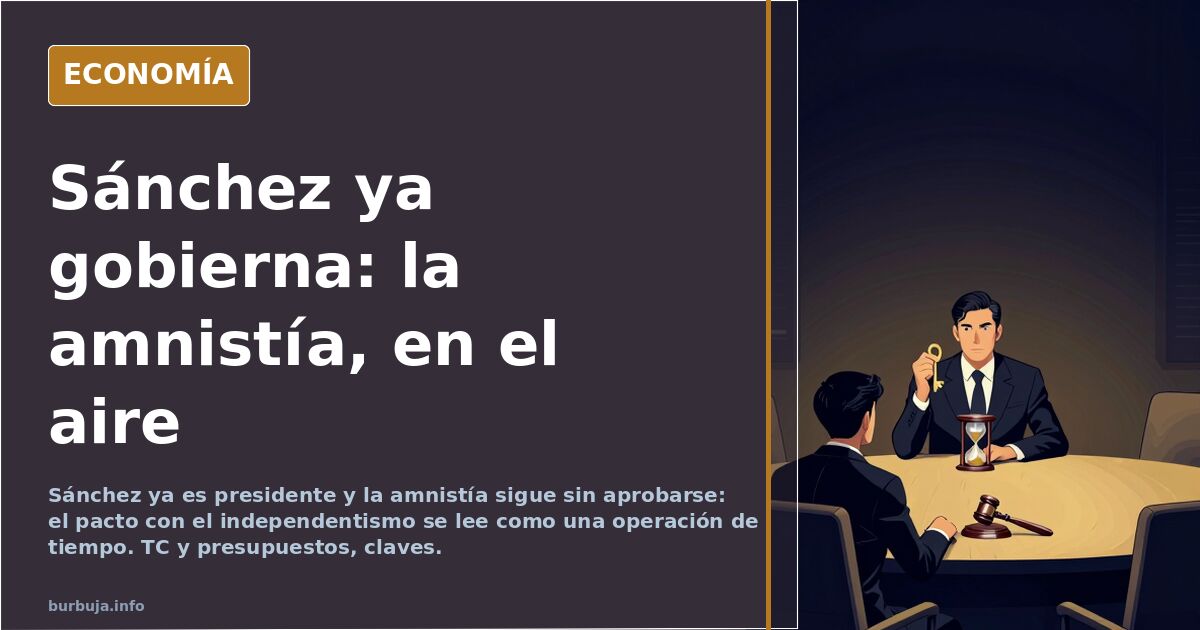
Already president, amnesty delayed: Sánchez’s political calculation
Has Pedro Sánchez deceived everyone who voted for his investiture? The suspicion isn't born from bar-room rumors but from a verifiable fact: Sánchez is governing while the amnesty law remains a draft. Those who signed the deal were paid in promises; he was paid in seats. If the agreement breaks, the electoral wear falls on the junior partner, not the tenant of La Moncloa.
The dominant thesis is uncomfortable for all: Catalan separatism wasn't tricked by an adversary, but by someone doing their dirty work. Amnesty legitimizes the narrative, yes, but leaves the referendum out of the equation. A ruler aiming to control the entire territory does not facilitate the break-up of the part they already control. Having 100% and settling for 70% is not standard political calculus. Not even in Catalan politics.
Why distrust forced early signing
One detail explains the rest: partners demanded the amnesty decree be signed before the investiture, not after. The prevailing view is that the president's word holds little weight, while a signed document holds more. This gesture—securing in writing what was agreed verbally—defines the relationship: zero trust, ironclad contracts.
It is worth distinguishing two things often mixed daily. One is whether the pact will be fulfilled. Another, very different, is whether it is beneficial to fulfill it. On this second ground, incentives point opposite to what was promised. A leak to friendly media regarding legal advice on the amnesty bill is read as a trap: the text is left where a third party can strike it down, leaving the signatory with only a given word and no obligation to comply.
What role does the Constitutional Court play?
The Constitutional Court appears in all predictions as an emergency exit. If the text falls, Sánchez can present himself as the scrupulous president who kept his word, blaming the law rather than himself for the failure. It is the most repeated scenario: comply via the Official Gazette and let another deactivate the commitment.
The plan fits the sequence: invested president, registered amnesty, blocked amnesty, and a campaign antiestéticaturing the narrative of a compliant leader betrayed by the system. For separatism, this would be the worst of worlds: no sovereignty, no referendum, and partial amnesty that doesn't cover incivil liability for future actions. Complying in order not to comply, in legal terms.
General budgets, the next bill
The calendar sets the next test at the beginning of the trinc year, during negotiations for the general budgets. There is no room for rhetoric here: either new accounts are approved or previous ones are extended. Extension means low-level management, less political margin, and wear that affects the whole government.
Hence the repeated warning: he will sell everything sellable to stay in power. Every partner has a price, and the Catalan one is not unique. The question is not if there will be new concessions, but how many fit without the executive's own narrative falling apart.
What happens with a new referendum without covering amnesty?
The risk lies not in what the president promises, but in what separatism does on its own within one or two years. If the movement calls for an illegal consultation again, as in 2017, the question is who stops it: the crime back then won't be what it is now. Legitimizing the past neutralizes the legal argument for the future.
There is also data pointing to demobilization of the base itself. A CEO survey known after the investiture showed PSC surging, Junts declining, and separatism losing its majority in the Parliament. If the electoral floor cracks, the threat of rupture loses steam, and with it, negotiating power.
The uncomfortable argument: the State does give up territories
Opposing the thesis that no ruler gives up territory is an uncomfortable precedent. Western Sahara—rich in phosphates and, depending on the UN stance, pending Spanish administration—ceased effective sovereignty decades ago. There was detachment, not out of altruism. The State does not detach when it wants, but when the cost of staying exceeds the cost of leaving.
Time passes, and the provisional balance is the same for everyone. Separatism has less leverage, less motive, and less timeline. The president has the votes. And the Catalan electorate has a new question to type when the next elections are called. Very nice indeed.
Also available in: Deutsch
Summary of a discussion on Burbuja.info - Foro de economía, actualidad y política., translated from Spanish and reviewed before publication. Read the full discussion (175 replies).
More summaries
-
Sánchez before Spain's Supreme Court: what charge could he face?
Treason, prevarication or criminal organisation: the debate over the possible charges Pedro Sánchez could face before Spain's Supreme Court. An analysis of Article 102 of the Constitution.
-
Sánchez Resignation Rumors Could See Illa as PM and Junts in Catalonia
Rumors suggest Pedro Sánchez's resignation, with Salvador Illa potentially taking over and Junts gaining power in Catalonia, sparking political speculation.
-
Madrid's Sol protest camp winds down as cold, hygiene and narrative problems mount
The Puerta del Sol housing camp in Madrid faces its "de-camping" after three weeks: cold weather, Metro closure over sanitation and a fraying electoral narrative.
-
Weak Easter trade in Catalonia: retail sales fall for the first time in five years
For the first time in five years, retail sales in Catalonia fell during Easter week. Spending is shifting to low-cost and second-hand goods, reflecting shrinking purchasing power.
-
The debate over male leisure and its economic impact is no joke
A heated online debate about adult gamers and their supposed lack of productivity exposes cultural tensions with real economic consequences.
-
40% of abortions in the US are among Black women
40% of abortions in the United States are performed on Black women. We examine the demographic data suggesting a drastic decline in their future birth rate.