
Sánchez’s Exit: No Clear Successor, No Real Alternative
If Sánchez resigned, Congress would need to invest a new president with the same pacts. The opposition poses no threat and the successor is unclear.
English · Original discussion in Spanish · Published
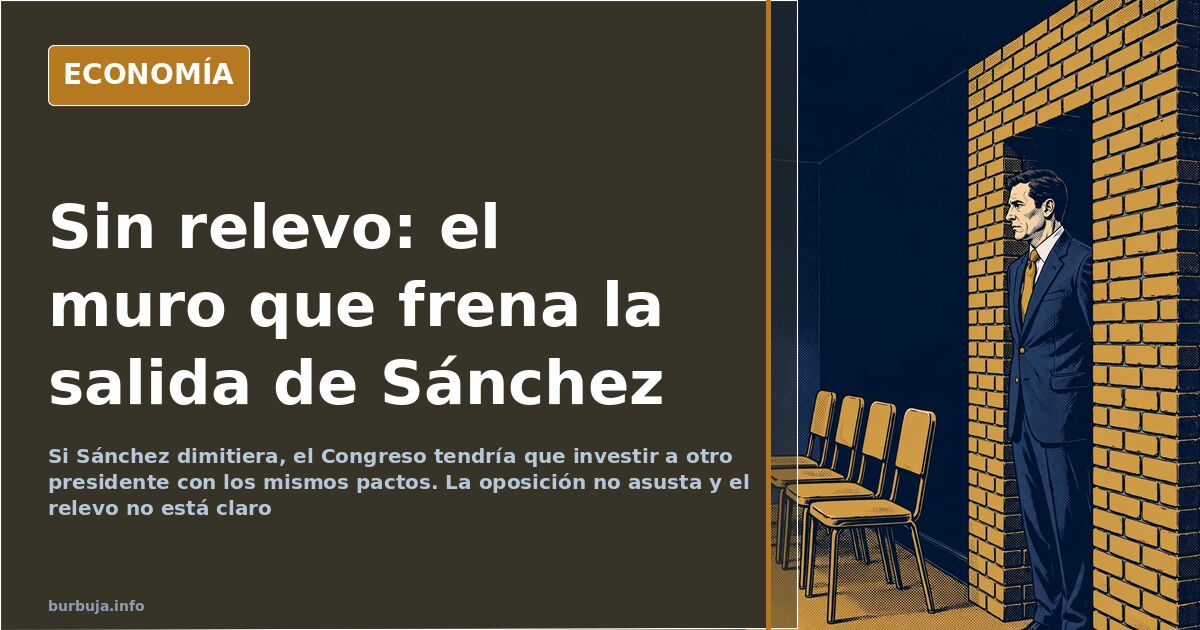
Why Sánchez’s exit clashes with the succession problem
Pedro Sánchez is not going to resign. This is the dominant conclusion, almost unanimous, in conversations that start with a fixed-term bet: that the Spanish Prime Minister has only "two news broadcasts" left and will abandon office within a week. The expiration date has been announced for "six consecutive years." And every announcement hits the same wall: the day after. Nobody knows who.
There is a contradiction at the center of everything. It is taken for granted that the president is "cornered from all sides" and that only his personal resistance keeps him in La Moncloa (the seat of the Spanish government). But no exit scenario fits. If he resigns, Congress must invest a new president, and that new occupant would have to negotiate with the same partners and drag along the same burdens in the hemicycle. The arithmetic does not change just because the face changes.
Who would replace Sánchez if he leaves the Government?
The names put on the table do not excite anyone. Headlines mention Defense and Interior ministers, and some party apparatus figures backed by the machinery. The most widespread diagnosis is that the current president has gradually sidelined any internal alternative with its own momentum, so the replacement would be a management figure, without autonomous weight and forced to sustain the same balances.
The only orderly exit—and precisely for that reason unlikely—would be to call elections without running. It is read as electoral suicide. The hypothesis gaining traction is much simpler: that he holds on. "Pedro knows that clinging to power will only increase his problems; if he negotiates an honorable exit, he ensures he won't be persecuted," summarizes one of the most repeated readings.
The weakness of the alternative guarantees continuity
The other pillar of the argument does not talk about the ruling party, but about who should dislodge it. The opposition has not yet solidified as a real threat. The main rival party is questioned regarding whether it generates enough rejection to mobilize opposing voters, and the hard-right formation is attributed an internal purge that is decapitating anyone with projection. The adversary, it is argued, is running out of bench strength.
Hence the cold calculation: while the rival is weak, the Government has little to antiestéticar. And it is not just a matter of acronyms. Several voices warn that a potential successor would repeat the script, because the order—whatever it may be—would not come from the current occupant. If he leaves, whoever arrives will say the usual thing: that they are at the disposal of the party. The chair is the same.
The voter who doesn’t change jackets
There is a third factor that does not depend on names: the electorate. The most cynical diagnosis argues that in Spain people do not change ideological jackets, that at most they stop voting, and that when they vote, they do so in reaction against the rival opposite them. If this is true, the wear and tear of a Government does not automatically translate into a transfer of votes to the opposition.
Hence the insistence that it is not enough for the rival to be weak: the electorate itself must mobilize. It is argued, for example, that to encourage their own vote, it helps if the adversary governs freely in some territory and serves as a mirror. As long as that trigger is not activated, continuity sustains itself alone.
Ábalos, Koldo, and the judicial front marking the times
The factor that can break the script is judicial. The case involving former PSOE officials appears in almost all stages of the discussion, among contracts, intermediaries, and pending appearances. The circulating hypothesis is that the president resists leaving power in the hands of someone who might testify without protection. It is launched as suspicion, never as proven fact.
It is worth not confusing tone with evidence: these are conjectures about published information, not firm convictions. But the noise conditions the calendar. "He cannot leave: half the family would end up in jail," summarizes the most pessimistic version. It is an assertion without judicial backing and must be read as such, although it explains why many rule out a voluntary exit.
Why compare Sánchez with Felipe González?
Because the underlying question is not whether he leaves, but how long he lasts. The reference that reappears again and again is Felipe González’s fourteen years, the longevity record taken as a floor and not a ceiling. Some directly raise the bar to the previous longest-serving occupant of La Moncloa and joke that the current one aims to beat him.
The comparison serves something uncomfortable: if permanence is measured in decades, daily wear and tear loses weight. Institutional politics stops being a mandate and becomes a long-distance race. And there, the rival is not the opposing party, but the calendar.
Will he leave? With what is on the table, prudence dictates not signing his exit. The internal succession does not convince, the alternative does not scare, and the judicial front advances slowly. The most likely outcome is that he continues, but with a new way of continuing: increasingly less mask and less margin. The prediction admits an asterisk: it is the same one that has been announced unsuccessfully for six consecutive years.
Pedro Sánchez is not going to resign. This is the dominant conclusion, almost unanimous, in conversations that start with a fixed-term bet: that the Spanish Prime Minister has only "two news broadcasts" left and will abandon office within a week. The expiration date has been announced for "six consecutive years." And every announcement hits the same wall: the day after. Nobody knows who.
There is a contradiction at the center of everything. It is taken for granted that the president is "cornered from all sides" and that only his personal resistance keeps him in La Moncloa (the seat of the Spanish government). But no exit scenario fits. If he resigns, Congress must invest a new president, and that new occupant would have to negotiate with the same partners and drag along the same burdens in the hemicycle. The arithmetic does not change just because the face changes.
Who would replace Sánchez if he leaves the Government?
The names put on the table do not excite anyone. Headlines mention Defense and Interior ministers, and some party apparatus figures backed by the machinery. The most widespread diagnosis is that the current president has gradually sidelined any internal alternative with its own momentum, so the replacement would be a management figure, without autonomous weight and forced to sustain the same balances.
The only orderly exit—and precisely for that reason unlikely—would be to call elections without running. It is read as electoral suicide. The hypothesis gaining traction is much simpler: that he holds on. "Pedro knows that clinging to power will only increase his problems; if he negotiates an honorable exit, he ensures he won't be persecuted," summarizes one of the most repeated readings.
The weakness of the alternative guarantees continuity
The other pillar of the argument does not talk about the ruling party, but about who should dislodge it. The opposition has not yet solidified as a real threat. The main rival party is questioned regarding whether it generates enough rejection to mobilize opposing voters, and the hard-right formation is attributed an internal purge that is decapitating anyone with projection. The adversary, it is argued, is running out of bench strength.
Hence the cold calculation: while the rival is weak, the Government has little to antiestéticar. And it is not just a matter of acronyms. Several voices warn that a potential successor would repeat the script, because the order—whatever it may be—would not come from the current occupant. If he leaves, whoever arrives will say the usual thing: that they are at the disposal of the party. The chair is the same.
The voter who doesn’t change jackets
There is a third factor that does not depend on names: the electorate. The most cynical diagnosis argues that in Spain people do not change ideological jackets, that at most they stop voting, and that when they vote, they do so in reaction against the rival opposite them. If this is true, the wear and tear of a Government does not automatically translate into a transfer of votes to the opposition.
Hence the insistence that it is not enough for the rival to be weak: the electorate itself must mobilize. It is argued, for example, that to encourage their own vote, it helps if the adversary governs freely in some territory and serves as a mirror. As long as that trigger is not activated, continuity sustains itself alone.
Ábalos, Koldo, and the judicial front marking the times
The factor that can break the script is judicial. The case involving former PSOE officials appears in almost all stages of the discussion, among contracts, intermediaries, and pending appearances. The circulating hypothesis is that the president resists leaving power in the hands of someone who might testify without protection. It is launched as suspicion, never as proven fact.
It is worth not confusing tone with evidence: these are conjectures about published information, not firm convictions. But the noise conditions the calendar. "He cannot leave: half the family would end up in jail," summarizes the most pessimistic version. It is an assertion without judicial backing and must be read as such, although it explains why many rule out a voluntary exit.
Why compare Sánchez with Felipe González?
Because the underlying question is not whether he leaves, but how long he lasts. The reference that reappears again and again is Felipe González’s fourteen years, the longevity record taken as a floor and not a ceiling. Some directly raise the bar to the previous longest-serving occupant of La Moncloa and joke that the current one aims to beat him.
The comparison serves something uncomfortable: if permanence is measured in decades, daily wear and tear loses weight. Institutional politics stops being a mandate and becomes a long-distance race. And there, the rival is not the opposing party, but the calendar.
Will he leave? With what is on the table, prudence dictates not signing his exit. The internal succession does not convince, the alternative does not scare, and the judicial front advances slowly. The most likely outcome is that he continues, but with a new way of continuing: increasingly less mask and less margin. The prediction admits an asterisk: it is the same one that has been announced unsuccessfully for six consecutive years.
Also available in: Deutsch
Summary of a discussion on Burbuja.info - Foro de economía, actualidad y política., translated from Spanish and reviewed before publication. Read the full discussion (207 replies).
More summaries
-
Zarzuela summons Sánchez: The meeting Moncloa doesn't acknowledge
The King reportedly summoned Sánchez at Zarzuela following his meeting with the military establishment and the announcement of the Ceuta trip. The official agenda makes no mention of the encounter, and...
-
Sánchez Resignation Rumors Spark Debate on Spanish Government Succession
Analysis of Pedro Sánchez’s potential resignation and the political implications for Spain’s leadership.
-
Sánchez's Speech: Pending Moncloa Announcements
Analysis of Pedro Sánchez's announced press conference. The atmosphere is filled with deep skepticism regarding pending economic and political announcements.
-
Ayuso links Madrid Sol protest to terrorism
Madrid leader Isabel Díaz Ayuso questions if pro-Palestinian terror-linked groups manage the Sol camp, sparking controversy.
-
Saudi Arabia’s 2km Tower: Can People Live at One Kilometer?
Jeddah Tower shrinks to 1,000m while Riyadh plans a 2km tower. Experts debate the reality of living at such extreme heights.
-
Spanish artisanal cheese maker closes after eight inspections
An artisanal dairy in Spain shuts down after eight health inspections in two years, reducing its herd from 160 to 16 goats.