
Sánchez’s Circle Proposes Electoral Reform to Redistribute 298 Seats by Population
Jaime Miquel’s proposal suggests redistributing 298 congressional seats by population, potentially granting the PSOE a majority of 185 seats while reducing PP and Vox’s totals.
English · Original discussion in Spanish · Published
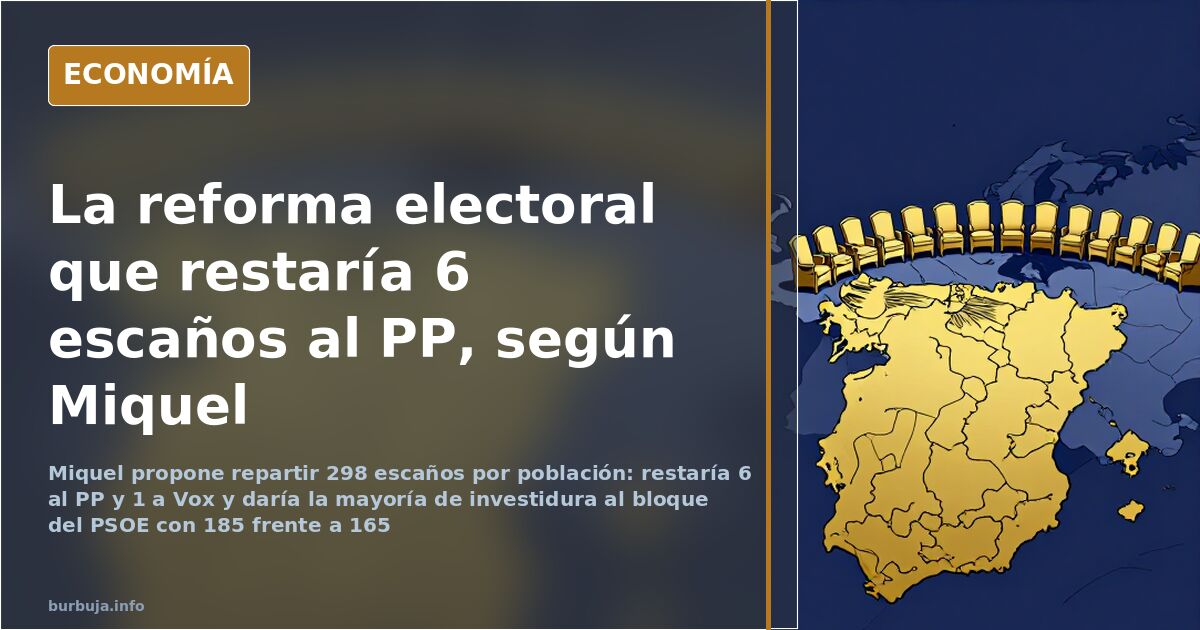
Sánchez’s team wants to redistribute 298 seats by population
The electoral reform attributed to Pedro Sánchez’s inner circle does not require changing the Constitution. Technically true, it would shift the distribution of seats in the Congress without altering a single vote. The proposal bears Jaime Miquel’s signature, the pollster who entered the president’s core team in 2018 via then-chief of staff Iván Redondo: reducing the minimum deputies per province from two to one (52 seats with Ceuta and Melilla, down from 102) and distributing the remaining 298 proportionally to each province’s population.
The impact on July 23 has been calculated. The PP would lose 6 seats, dropping to 131; the PSOE would gain two, reaching 123; Sumar would gain four, totaling 35, and Vox would lose one, falling to 32. The PP, Vox, UPN, and CCa would remain at 165 deputies, while the bloc that supported the investiture would rise to 185. Same census, different majority. That is what this is all about.
Provincial overrepresentation: Castilla y León has 31 deputies, not 17
This argument does not come out of nowhere. The analysis accompanying the proposal quantifies it plainly: Castilla y León should contribute 17 representatives to the Congress based on 350, but the LOREG assigns it 31, fourteen more, simply due to having many provinces with small populations. Aggregating all provinces, the system shifts 64 seats away from proportionality. Proponents argue this bias is exactly what allowed the PP and Vox to nearly seize power.
The counterargument is as old as the system itself. Some claim that overrepresenting sparsely populated provinces was agreed upon to prevent their neglect, not to fabricate majorities. Others note the obvious: if the criterion is population, provinces gaining residents rise, and those losing them fall; this is not an anomaly but arithmetic.
The article’s error: an organic law requires an absolute majority
The fine print contains a trap. The original text claims the reform needs no more positive votes than a simple majority in Congress. False. Article 81 of the Constitution reserves an absolute majority for approving, modifying, or repealing organic laws, and the general electoral regime is one such law. In a final vote on the entire text, 176 yes votes are required, not one more than noes.
This confusion is not cosmetic. It completely changes the map of allies and turns any absence into a problem. With 165 deputies against them and a threshold of 176, the reform as described depends on no one defecting. And no one having reasons to defect.
Who is Jaime Miquel and why his name appears now
Miquel is no newcomer. A geographer trained at Complutense University, he started in 1980 at Gallup’s Spanish headquarters, eventually directing that branch, and earned fame as a pioneer: he was the first analyst to predict the collapse of the two-party system before the 2014 European elections and the rise of Podemos. He advised Compromís, Convergència, and the now-defunct UPyD, and in 2018 joined Sánchez’s team. Sources from the Presidency cited by El Diario Vasco admit the professional relationship with him is “strategic and very fluid.”
The proposal, however, does not appear in the PSOE’s July 23 program or the coalition agreement with Sumar. It was present in 2016, under the heading “improving proportionality,” amidst the surge of Podemos and Ciudadanos. Only the memory and a couple of signed articles remain from that point.
The missing votes: the PNV loses one seat
The simulation distributes gains and losses with uncomfortable precision. Junts and ERC would each gain one seat, Bildu would stay the same, and BNG, CCa, and UPN would not move. The PNV, however, would lose one. And without the PNV’s votes, with an absolute majority at stake, the arithmetic tightens to suffocation.
This paradox has precedent, as a participant recalls. François Mitterrand introduced proportionality in France expecting to weaken the right, only to find the National Front growing in traditionally communist strongholds, leaving the left with no net benefit. He returned to majoritarianism in the next election, and there were no more adventures. Electoral rules rarely return what they promise.
Other options on the table: single constituency, second round, or the German model
The alternative menu placed on the table is broad. A single constituency, as in European elections, so every vote counts equally. A majoritarian system with a second round, like the French model, with the caveat that it may grant an absolute majority to the second-place finisher. Mixed models like the German or New Zealand systems, combining the best and worst of both worlds. And a 5% threshold per constituency in European elections, included in a 2018 EU Council decision that Spain is the only member state not to have applied.
Each option carries its own trap. A single constituency eliminates the anomaly but also the local deputy who answers to their constituents. Drawing districts in a majoritarian system eventually leads to American-style gerrymandering. There is no perfect system, only systems with different culprits.
If anything is clear, it is that the discussion is not about abstract proportionality, but about who executes it and with what majority. With the PNV losing a seat, 176 yes votes ahead, and the proposal outside the electoral program, the reform has no easy path. The most reasonable prediction is that it remains a test balloon until someone proves the numbers work. And the known numbers, for now, do not work.
Also available in: Deutsch
Summary of a discussion on Burbuja.info - Foro de economía, actualidad y política., translated from Spanish and reviewed before publication. Read the full discussion (231 replies).
More summaries
-
Sánchez escalates rhetoric against 'VoxPP' as PSOE fears July election defeat
Pedro Sánchez pushes the 'VoxPP' label citing child labor exploitation, while his party worries about a severe electoral backlash in July.
-
PSOE's Ferraz Base: Sociatas and the Image of Party Loyalty
Analysis of the image at Ferraz: Ideological fanaticism or economic dependence? A breakdown of views on PSOE membership.
-
Montse Mínguez's 7,000 m² luxury villa linked to a fund
Montse Mínguez shares a luxury villa on a 7,000 m² plot with her partner, with ownership attributed to the Nest Life fund, according to El Español.
-
Spain debates death of 87-year-old woman after eviction and the political narrative
A forum thread mixes the death of an 87-year-old woman with her eviction, Spain's rental law and the political narrative, without confirming any causal link.
-
Vox opposed eIDAS 2 in 2024, but backed Chat Control in 2021
The European Parliament approved eIDAS 2 with 335 votes in favour and 190 against. Spain's Vox voted no, but records show it backed Chat Control in 2021.
-
Forced eviction of sick 90-year-old woman sparks fury on economics forum
A 90-year-old woman was forcibly evicted in Spain and the case turned into a row over multinationals, indebted small businesses and COVID hoaxes. No hard data.