
Spain: Supermarket staff ignore theft alarm for Coke
In Spain, checkout staff often let shoplifters go despite alarms. Who pays for the loss and why is no one detained?
English · Original discussion in Spanish · Published
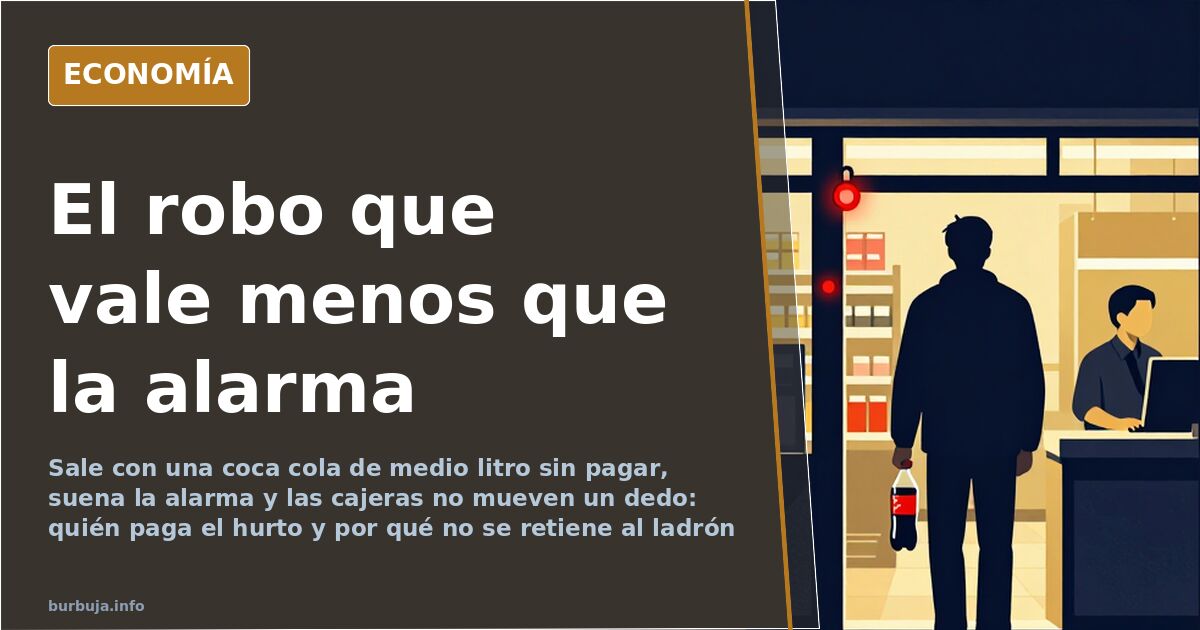
A half-liter Coke, a beep, and zero movement from checkout staff
The stolen item costs less than the alarm that detects it. A customer left a Spanish supermarket holding a half-liter Coca-Cola in his left hand with a backpack on his back; as he crossed the door, the security gate beeped. The cashier looked, saw the drink, turned to the colleague at the next register, and both continued with the next trolley. No one ran. No one called anyone. The witness waited for a reaction that never came.
The scene raises an uncomfortable question: who steps up when someone takes unpaid goods? The practical answer, increasingly common, is no one. Not the person earning the €1,500 per month mentioned in the thread, nor the company signing the security service payroll.
What peine to the Coke that triggered the alarm?
There is no certainty, and that is part of the problem. What was visible was the drink; what sounded was the alarm. The most reasonable hypothesis is that the backpack held something else, because it is hard to believe a half-liter bottle carries an anti-theft tag. Tagging products costs money and time, and doing so across the entire range does not pay off: the cost of tagging every unit versus losses from theft does not balance out. Hence the technique used in some stores: marking only a few random units so that potential thieves do not know which one will trigger the alarm.
That calculation—protecting sporadically and relying on the deterrent effect—explains why the alarm sounded and why no one moved. The beep is not proof, it is a warning. And a warning, if no one is willing to act, remains just noise.
Can a cashier detain a thief? What protocols say
No. In major chains, staff are instructed not to confront or detain anyone: either the item is surrendered voluntarily or the person is allowed to leave. Do not abandon the post or the workplace. The reason is simple: the occupational and legal risk falls on the person behind the till, not headquarters. A struggle ends in sick leave, insurance claims, complaints, and, if lucky, proceedings the company prefers to avoid.
Added to this is daily reality: threats, attempted assaults, and episodes that repeat almost daily in certain shifts. It is argued that when an incident ends with someone detained, the response can be a claim for disability or aftereffects. With this landscape, the worker’s calculation is rational: a €1,500 salary does not cover an assault, sick leave, or a trial. Those who argue the cashier should have chased the thief probably have never been alone at a till at ten in the evening.
Shoplifting under €400 that never reaches court
Here lies the core issue. It is maintained that shoplifting under €400 is not a crime but an infraction settled by a fine; and if the offender is insolvent, the fine is never collected. Detaining the perpetrator serves, at best, to recover the goods and lose a morning at the police station. The next day, the same person can try again.
This practical impunity feeds the feeling that the law is not working and that the problem has shifted to those least able to handle it: the sales assistant. Plumbing-like solutions appear, such as a button at each till that locks the exit door when pressed. End of story, without needing guards. Others recall that security guards also look away when things get complicated.
Who pays for the theft: shrinkage, insurance, and shopping baskets
The most repeated answer is the most uncomfortable for the customer: you pay for it. Shrinkage is passed on in prices, and chains reserve a percentage within their margin for bad debts and thefts. If that buffer is not consumed in a month, nothing is returned to the buyer. Another school of thought argues that products are insured and the insurer bears the loss, which changes little on the balance sheet.
Hence the leap to inflation: if retail cannot afford to lose money, someone must pay from their pocket what others take away. How much weight this carries in the final price can be debated, but the conclusion is the same: the cost of theft does not disappear, it is distributed.
The owner who stands firm: from workshops to corner shops
The contrast appears when the person behind the counter is also the owner. In small neighborhood businesses, the reaction is usually different: they stand their ground, throw out whoever tries to steal, and assume the risk because the business is theirs and no one will reimburse the loss. In a mechanic’s workshop, the doubt is identical: call or not call if someone takes a can of oil that went from €25 to €36?
There are also episodes in the opposite direction. An impeccably dressed woman was intercepted for taking a discounted empanada (a savory pie), with a plainclothes guard disguised as a delivery driver. And two cashiers from a large chain sprinted after two youths trinc a theft. It depends on the day, the shift, and who is watching.
With the Coke already outside, the alarm silenced, and the till serving the next customer, the question remains: if no one detains the thief, no one pays the fine, and no one replaces the product, who still believes this deters anyone?
The stolen item costs less than the alarm that detects it. A customer left a Spanish supermarket holding a half-liter Coca-Cola in his left hand with a backpack on his back; as he crossed the door, the security gate beeped. The cashier looked, saw the drink, turned to the colleague at the next register, and both continued with the next trolley. No one ran. No one called anyone. The witness waited for a reaction that never came.
The scene raises an uncomfortable question: who steps up when someone takes unpaid goods? The practical answer, increasingly common, is no one. Not the person earning the €1,500 per month mentioned in the thread, nor the company signing the security service payroll.
What peine to the Coke that triggered the alarm?
There is no certainty, and that is part of the problem. What was visible was the drink; what sounded was the alarm. The most reasonable hypothesis is that the backpack held something else, because it is hard to believe a half-liter bottle carries an anti-theft tag. Tagging products costs money and time, and doing so across the entire range does not pay off: the cost of tagging every unit versus losses from theft does not balance out. Hence the technique used in some stores: marking only a few random units so that potential thieves do not know which one will trigger the alarm.
That calculation—protecting sporadically and relying on the deterrent effect—explains why the alarm sounded and why no one moved. The beep is not proof, it is a warning. And a warning, if no one is willing to act, remains just noise.
Can a cashier detain a thief? What protocols say
No. In major chains, staff are instructed not to confront or detain anyone: either the item is surrendered voluntarily or the person is allowed to leave. Do not abandon the post or the workplace. The reason is simple: the occupational and legal risk falls on the person behind the till, not headquarters. A struggle ends in sick leave, insurance claims, complaints, and, if lucky, proceedings the company prefers to avoid.
Added to this is daily reality: threats, attempted assaults, and episodes that repeat almost daily in certain shifts. It is argued that when an incident ends with someone detained, the response can be a claim for disability or aftereffects. With this landscape, the worker’s calculation is rational: a €1,500 salary does not cover an assault, sick leave, or a trial. Those who argue the cashier should have chased the thief probably have never been alone at a till at ten in the evening.
Shoplifting under €400 that never reaches court
Here lies the core issue. It is maintained that shoplifting under €400 is not a crime but an infraction settled by a fine; and if the offender is insolvent, the fine is never collected. Detaining the perpetrator serves, at best, to recover the goods and lose a morning at the police station. The next day, the same person can try again.
This practical impunity feeds the feeling that the law is not working and that the problem has shifted to those least able to handle it: the sales assistant. Plumbing-like solutions appear, such as a button at each till that locks the exit door when pressed. End of story, without needing guards. Others recall that security guards also look away when things get complicated.
Who pays for the theft: shrinkage, insurance, and shopping baskets
The most repeated answer is the most uncomfortable for the customer: you pay for it. Shrinkage is passed on in prices, and chains reserve a percentage within their margin for bad debts and thefts. If that buffer is not consumed in a month, nothing is returned to the buyer. Another school of thought argues that products are insured and the insurer bears the loss, which changes little on the balance sheet.
Hence the leap to inflation: if retail cannot afford to lose money, someone must pay from their pocket what others take away. How much weight this carries in the final price can be debated, but the conclusion is the same: the cost of theft does not disappear, it is distributed.
The owner who stands firm: from workshops to corner shops
The contrast appears when the person behind the counter is also the owner. In small neighborhood businesses, the reaction is usually different: they stand their ground, throw out whoever tries to steal, and assume the risk because the business is theirs and no one will reimburse the loss. In a mechanic’s workshop, the doubt is identical: call or not call if someone takes a can of oil that went from €25 to €36?
There are also episodes in the opposite direction. An impeccably dressed woman was intercepted for taking a discounted empanada (a savory pie), with a plainclothes guard disguised as a delivery driver. And two cashiers from a large chain sprinted after two youths trinc a theft. It depends on the day, the shift, and who is watching.
With the Coke already outside, the alarm silenced, and the till serving the next customer, the question remains: if no one detains the thief, no one pays the fine, and no one replaces the product, who still believes this deters anyone?
Summary of a discussion on Burbuja.info - Foro de economía, actualidad y política., translated from Spanish and reviewed before publication. Read the full discussion (140 replies).
More summaries
-
Spain Pension Debate: Bank of Spain December Funds Claim
Economist José Carlos Díez claims insufficient funds for December pensions, sparking political and economic debate in Spain over sustainability and debt.
-
Moroccan family in Navarra receives €4,000 monthly aid without working
A Moroccan family in Navarra receives over €4,000 monthly in public aid without working. Discover the details and benefits.
-
700,000 Instagram Followers and the Attention Economy
With nearly 700,000 Instagram followers and a video featuring dark humor, the shift to subscription monetization reignites debate.
-
Smartphone Addiction: Designed to Hook, Unregulated
Pedestrians ignored green lights while glued to phones. Experts blame intentional design features that foster compulsive usage.
-
Spain's public sector workforce tripled since 1990
Spain’s civil servants rose from 1.2 million in 1990 to nearly 3 million. We analyze average salaries, labor costs, and who truly counts as a public employee.
-
Vigo requires card to open organic waste bins
Vigo's organic waste bins now require a card for access, leading many residents to leave bags beside them. This aligns with upcoming 2025 waste fees.