
BASF Heir Rejects $3.8 Billion, Keeps $200 Million
Marlene Engelhorn declines 90% of a $4 billion inheritance but keeps $200 million; the math doesn't add up and the narrative relies on a single quote.
English · Original discussion in Spanish · Published
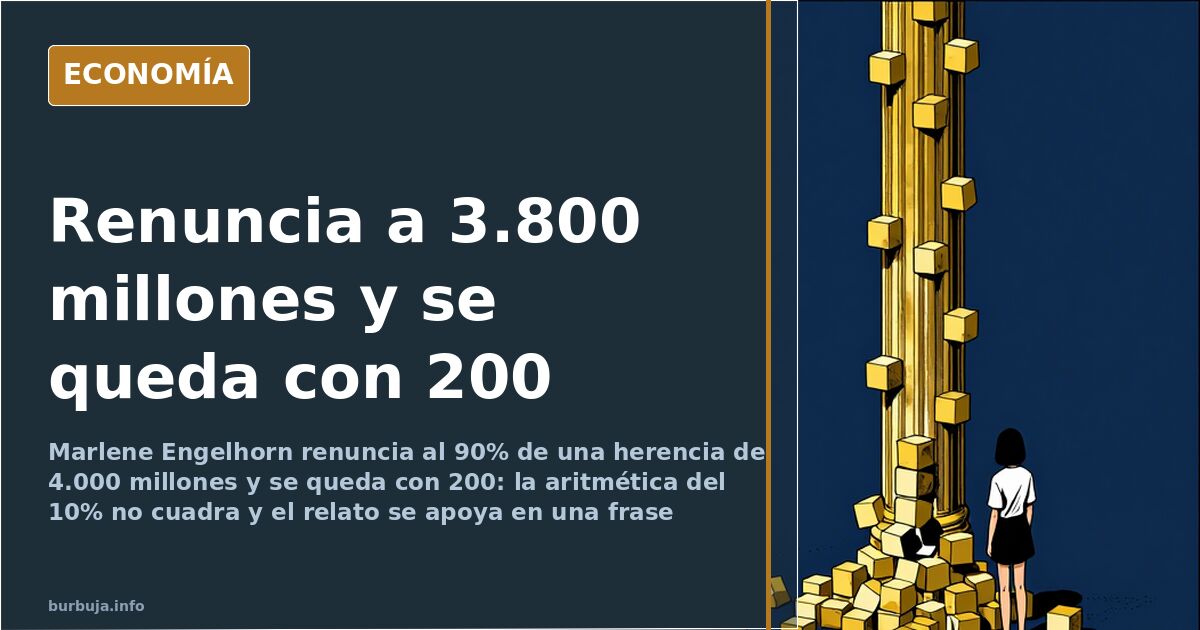
Declines 90% of a $4 billion inheritance and keeps $200 million
August 2022. Marlene Engelhorn is 29 years old, studying German Language and Literature in Vienna, and she renounces 90% of an inheritance valued at $4 billion, accumulated by her family over more than a century in chemistry and pharmaceuticals. She keeps $200 million. The headline accompanying the news is hers: "That much money doesn't make you happy." The round figure is the least consistent part of the story. The second issue is the phrase.
What is known about the Engelhorn inheritance
The fortune comes from BASF, the world's largest chemical company, and her grandmother, Traudl Engelhorn, ranks 687th among the world's wealthiest individuals according to Forbes. The account also mentions Curt Clover Engelhorn, who died in 2016, and the sale of Boehringer Mannheim to the Swiss group Roche in 1997 as the origin of much of the wealth.
Engelhorn defines herself as privileged and is not uncomfortable with the term "rich girl." Her public proposal is singular: that the wealthy pay higher taxes to achieve a fairer society. She defended this in May 2022, at the World Economic Forum in Davos, in a BBC interview, using an argument that measures what is being discussed: 250 million people pushed into extreme poverty that year.
Why isn't 10% of $4 billion equal to $200 million?
Because the published arithmetic does not close. 10% of $4 billion is $400 million, not $200 million. The most repeated explanation is that the $200 million is cash, even after taxes, while the bulk of the assets would be in shares: holding billions in stocks is not equivalent to having them in liquid funds. The calculation that leaves $200 million out of $4 billion is not 10%, it is one-twentieth. And that, in a news story about generosity, grates.
Can one accept only $200 million of an inheritance?
The piece does not clarify this, and here lies one of the cracks in the matter. It is maintained that inheritances do not admit partial acceptance: they are either accepted or rejected, with no middle ground. If that rule applies here too, the operation needs a legal explanation that appears nowhere. Add another reasonable doubt: if the grandmother is still alive, the succession is not closed, and speaking of an accepted or rejected inheritance is, at the very least, premature.
Rentier with $200 million or manager with $4 billion?
There are two readings and neither is innocent. The first: she keeps the liquid money and gets rid of the board meetings, tensions, and uncomfortable decisions that she herself describes in the interview. No managing a company with more than 100,000 employees. Living off the estate.
The second: whoever inherits control of an industrial group not only receives dividends, but also decides on employment, investment, and plants. Giving away money builds nothing, it is argued, and what sustains families is productive activity. A third group replies that no one talks about giving away: the company would continue operating with its board and another family member at the helm.
The suspicion of advertorial content
There are those who read the news as covert propaganda. The phrase that summarizes that distrust is simple: if the article is free, you are the product. It is suspected that the framing prepares the ground for tightening inheritance taxes on the middle and lower classes, while large estates have a thousand ways to evade them. It is a suspicion, not proof, and should be treated as such.
But the framing fuels the distrust: someone who rejects $4 billion and keeps $200 million is not an example of austerity. It is, at best, an example of comfort.
What would others do with $3.8 billion?
Accept everything and donate the difference to whomever one chooses. Set up a foundation and distribute every euro. Finance own projects. Any of these paths retains control over where the money goes, something that pure renunciation hands over to the family itself and its corporate structure. The fundamental question is not how much she keeps, but who decides what is done with what she lets go.
And there everything stalls. There is no record of how much wealth she already had before, nor the exact formula of the renunciation, nor who controls the $3.8 billion left behind. The only firm data remains the headline: $200 million and a phrase about happiness.
August 2022. Marlene Engelhorn is 29 years old, studying German Language and Literature in Vienna, and she renounces 90% of an inheritance valued at $4 billion, accumulated by her family over more than a century in chemistry and pharmaceuticals. She keeps $200 million. The headline accompanying the news is hers: "That much money doesn't make you happy." The round figure is the least consistent part of the story. The second issue is the phrase.
What is known about the Engelhorn inheritance
The fortune comes from BASF, the world's largest chemical company, and her grandmother, Traudl Engelhorn, ranks 687th among the world's wealthiest individuals according to Forbes. The account also mentions Curt Clover Engelhorn, who died in 2016, and the sale of Boehringer Mannheim to the Swiss group Roche in 1997 as the origin of much of the wealth.
Engelhorn defines herself as privileged and is not uncomfortable with the term "rich girl." Her public proposal is singular: that the wealthy pay higher taxes to achieve a fairer society. She defended this in May 2022, at the World Economic Forum in Davos, in a BBC interview, using an argument that measures what is being discussed: 250 million people pushed into extreme poverty that year.
Why isn't 10% of $4 billion equal to $200 million?
Because the published arithmetic does not close. 10% of $4 billion is $400 million, not $200 million. The most repeated explanation is that the $200 million is cash, even after taxes, while the bulk of the assets would be in shares: holding billions in stocks is not equivalent to having them in liquid funds. The calculation that leaves $200 million out of $4 billion is not 10%, it is one-twentieth. And that, in a news story about generosity, grates.
Can one accept only $200 million of an inheritance?
The piece does not clarify this, and here lies one of the cracks in the matter. It is maintained that inheritances do not admit partial acceptance: they are either accepted or rejected, with no middle ground. If that rule applies here too, the operation needs a legal explanation that appears nowhere. Add another reasonable doubt: if the grandmother is still alive, the succession is not closed, and speaking of an accepted or rejected inheritance is, at the very least, premature.
Rentier with $200 million or manager with $4 billion?
There are two readings and neither is innocent. The first: she keeps the liquid money and gets rid of the board meetings, tensions, and uncomfortable decisions that she herself describes in the interview. No managing a company with more than 100,000 employees. Living off the estate.
The second: whoever inherits control of an industrial group not only receives dividends, but also decides on employment, investment, and plants. Giving away money builds nothing, it is argued, and what sustains families is productive activity. A third group replies that no one talks about giving away: the company would continue operating with its board and another family member at the helm.
The suspicion of advertorial content
There are those who read the news as covert propaganda. The phrase that summarizes that distrust is simple: if the article is free, you are the product. It is suspected that the framing prepares the ground for tightening inheritance taxes on the middle and lower classes, while large estates have a thousand ways to evade them. It is a suspicion, not proof, and should be treated as such.
But the framing fuels the distrust: someone who rejects $4 billion and keeps $200 million is not an example of austerity. It is, at best, an example of comfort.
What would others do with $3.8 billion?
Accept everything and donate the difference to whomever one chooses. Set up a foundation and distribute every euro. Finance own projects. Any of these paths retains control over where the money goes, something that pure renunciation hands over to the family itself and its corporate structure. The fundamental question is not how much she keeps, but who decides what is done with what she lets go.
And there everything stalls. There is no record of how much wealth she already had before, nor the exact formula of the renunciation, nor who controls the $3.8 billion left behind. The only firm data remains the headline: $200 million and a phrase about happiness.
Summary of a discussion on Burbuja.info - Foro de economía, actualidad y política., translated from Spanish and reviewed before publication. Read the full discussion (140 replies).
More summaries
-
Spain World Cup Final: Economic Boost or New Political Distraction?
Spain reaches the 2026 World Cup final, sparking debate over tax optimization, the 'Brand Spain' effect, and whether sporting success masks structural economic issues.
-
Madrid Rental Listings Drop 20% on Rent Decree Day
Madrid's rental supply plummeted by 20.46% on the decree's effective date, removing 2,417 listings. Stock fell below 9,000 ads as owners pulled properties from the market.
-
Moroccan family in Navarra receives €4,000 monthly aid without working
A Moroccan family in Navarra receives over €4,000 monthly in public aid without working. Discover the details and benefits.
-
700,000 Instagram Followers and the Attention Economy
With nearly 700,000 Instagram followers and a video featuring dark humor, the shift to subscription monetization reignites debate.
-
Smartphone Addiction: Designed to Hook, Unregulated
Pedestrians ignored green lights while glued to phones. Experts blame intentional design features that foster compulsive usage.
-
Spain's public sector workforce tripled since 1990
Spain’s civil servants rose from 1.2 million in 1990 to nearly 3 million. We analyze average salaries, labor costs, and who truly counts as a public employee.