
Sánchez declares his love for Begoña Gómez at PSOE's Federal Committee
Pedro Sánchez declares his love for Begoña Gómez at the Federal Committee amid shouts of "how lovely". The gesture draws criticism for mixing private and public life and…
English · Original discussion in Spanish · Published
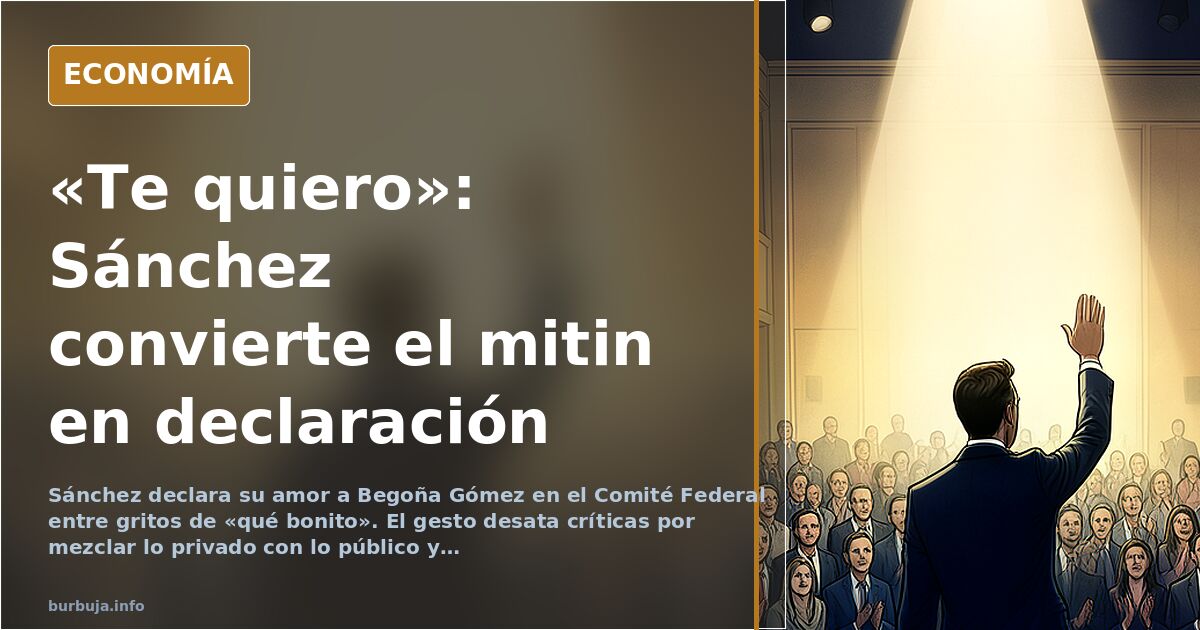
Sánchez declares his love for Begoña Gómez before the Federal Committee
A tweet from @HerQles captures the moment: Pedro Sánchez brings his vvife, Begoña Gómez, to the Federal Committee and declares his love to her amid shouts of "how lovely". "Thank you for being my vvife, for being the mother of my daughters and for being my woman. Let everyone hear it loud and clear: I love you," reads the message. Far from going unnoticed, the scene has sparked a debate about how far the president's private life should take over the stage of a political party.
The reaction was not long in coming. Some see the gesture as poorly staged theatre, while others interpret it outright as a manoeuvre to cover up other matters. "What bad theatre. Is she his vvife or not?" sums up one of the first replies. Another goes further and compares it to Venezuelan politics: "All he's missing is the tracksuit. This has already turned into Venezuela." The range of criticism runs from second-hand embarrassment to suspicion that the act is part of a calculated emotional campaign.
From "I love you" to the protest vote
The thread soon drifts towards voting intentions. "You're going to force me to vote for VOX to stop this shitty left," writes one participant. The sentence condenses the discontent of those who believe the PSOE (Spain's Socialist Party) has crossed a line by turning an internal conclave into a marital declaration. Irony mixes with indignation: "PSOE rallies should be held with Hello Kitty balloons and extras dressed as Cupid".
But not all messages go in the same direction. Some acknowledge that the scene, however cheesy, has a mobilising effect: "compare him with Feijóo's dull and gloomy vibe or with Abascal's borderline act and damn, it makes you want to vote for him... hahaha". It is the realisation that the show, however crude it may seem, can also work as a lure for part of the electorate.
The recurring complaint: "I pay you to solve my problems"
The most repeated argument is not so much the content of the message as its timing. "I don't care if you love your vvife. Go to hell," snaps one participant. Another elaborates: "This is a joke in politics. Saying he loves his vvife very much. I heard you say that I pay you to solve my problems, not for your love affairs." The criticism points to the confusion between public and private, and to the feeling that the president uses his intimacy as a shield or a political weapon.
The shadow of the investigation hangs over the matter. The initial tweet calls Begoña Gómez an "imputada" (a person formally under investigation), a term not developed in the messages but one that hovers over the conversation. In that context, some read the declaration of love as an attempt to divert attention. "Poor Begoña is already rich thanks to the saunas and wanted to be a professor having taught primary school to feel fulfilled," says a message mixing mockery and suspicion.
The dance that accompanies the controversy
The conversation closes with an unexpected twist: a tweet from El HuffPost shows Sánchez dancing to Rusowsky alongside Begoña Gómez and Óscar Puente. "Trinc in the footsteps of the master Nicolás Maduro, now he even dances," comments a participant. The scene reinforces the thesis of those who see in these gestures a communication strategy based on emotion and spectacle, rather than on governance.
The unsettling fact is not the "I love you", but the realisation that a party event has turned into a television studio. And that there are voters who, far from being outraged, admit they feel like voting for him.
Also available in: Deutsch
Summary of a discussion on Burbuja.info - Foro de economía, actualidad y política., translated from Spanish and reviewed before publication. Read the full discussion (27 replies).
More summaries
-
Sánchez's 'I love you' and its electoral payoff
A tweet with Sánchez's 'I love you' to Begoña Gómez takes center stage in a debate over its effectiveness at mobilizing votes and the right's response.
-
Women bricklayers hit record numbers in Spain's construction industry
166,833 women were working in construction in Spain in 2025, the highest number registered since 2014. Even so, they make up only 9% of the sector.
-
The thong makes a mass return to Spain's beaches, El Mundo reports
El Mundo confirms the highly visible return of the thong to Spain's beaches in 2026: fashion, industry and a double standard in an analysis that holds nothing back.
-
The Spanish state will claim bank accounts left untouched for 20 years
In Spain, 20 years without any activity on an account and the state can take the balance: the rule dates back to 1928 and is still in force. What counts as account activity and how to avoid it.
-
Sánchez repeats Andorra trip: luxury hotel and private jet
Spain's prime minister returns to Andorra on a 'private trip': rooms from 565 euros and an entire floor for his entourage. What business lies behind it?
-
Dolly Parton dies: from the 9 to 5 anthem to a million for Moderna
Dolly Parton donated a million dollars to Moderna before the pandemic and turned '9 to 5' into a working anthem. The cultural industry loses a star with no…