
Sánchez's 'I love you' and its electoral payoff
A tweet with Sánchez's 'I love you' to Begoña Gómez takes center stage in a debate over its effectiveness at mobilizing votes and the right's response.
English · Original discussion in Spanish · Published
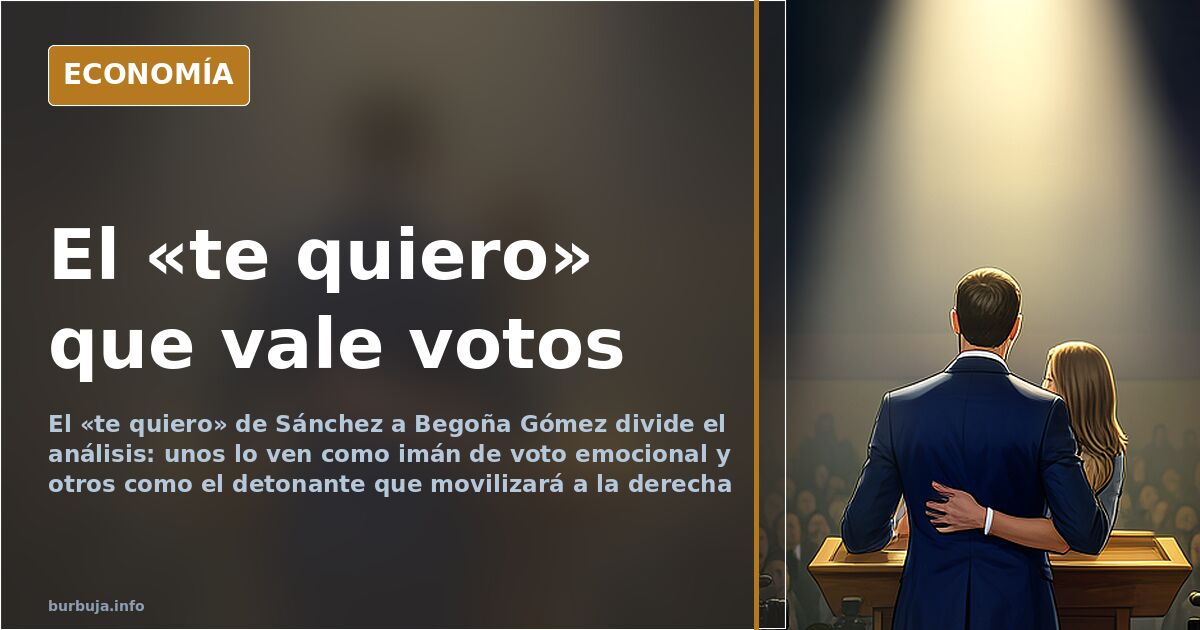
Sánchez's 'I love you' and its electoral payoff
A three-word message —"Let them hear it loud and clear: I LOVE YOU"— addressed to Begoña Gómez has become the center of the conversation about the November 29 election campaign in Spain. It is no ordinary declaration of love: it is a political artifact designed to mobilize the female and center-left vote, as some participants in the debate argue. The right, meanwhile, keeps trailing the Socialist candidate, caught between personal insults and the absence of a country project that can compete with the emotional narrative, according to this same reading.
The episode, spread on social media, has generated a volume of reactions exceeding 280 comments in less than 24 hours. The conversation has shifted from the literal content of the message to an analysis of its effectiveness as a political communication tool. Some maintain it is calculated "theater" to win votes; others read it as a display of emotional leadership that the opposition does not know how to counter. In the middle lies a fact nobody disputes: the PSOE (Spanish Socialist Workers' Party) campaign has focused on values and on the figure of women, while the PP and VOX have yet to find a counter-narrative that does not drag them back into personal attacks.
The 'I love you' as an electoral weapon
The sequence is brief but telling. Pedro Sánchez addresses his vvife, Begoña Gómez, with a public declaration of affection that, in the middle of a campaign, takes on a dimension that goes beyond the personal. The message is posted with the P&B hashtag and a heart, and within hours it is trending. For part of the analysis, it is the move of a "political animal" who knows how to activate the electorate's emotions. For others, it is proof that the Socialist candidate has turned his private life into both a shield and a lure.
The underlying calculation is twofold. On one hand, it mobilizes a female electorate that may feel addressed by a leader who defends his partner "tooth and nail," in words circulating in the conversation. On the other, it reinforces polarization: every gesture of this kind triggers an equivalent reaction from the other side, which in turn activates the right's vote. This is the well-known "dog effect," a machine for gaining votes on both flanks.
The right, without a counter-narrative
The most repeated diagnosis is that the opposition is out of shape. The PP and VOX campaign, according to this reading, merely responds to the Socialist candidate's stimuli, without presenting a program that excites its own electorate. "If the right insists on personal attacks and insults, they only reinforce him," notes one of the most quoted comments. The consequence is that the PSOE sets the pace and the right dances to its tune.
Some go further and predict record turnout, close to 80%, precisely because of how exceptional the situation is. In this scenario, polarization would not be an obstacle for the PSOE but a spur. Right-wing voters, traditionally more prone to abstention, could turn out like never before to "get rid of this guy by any means." But even in that case, the adversary's calculation involves making no mistakes and not letting the debate focus on the man himself.
The voter profile and contempt for the adversary
The conversation drifts into broad-brush sociological analysis. There is talk of "charos" —a derogatory term used for female PSOE voters— and of a passionate, not rational, electorate. It is a cliché that nonetheless hides a reality: the Socialist campaign has managed to connect with a segment the right has failed to attract. The irony about the "I love you" as bait for "the ugly, old charos" is just the tip of the iceberg of a deeper malaise.
Against this, the defense of the Socialist candidate rests on his resilience. "He endures whatever they throw at him, doesn't bat an eye, tough as nails," the debate goes. It is the image of a leader who does not break, who turns every attack into a foothold. The comparison with Marlon Brando in *A Streetcar Named Desire* —"Begoñaaaaaaa!"— sums up the theatrical tone some attribute to the episode.
The economic backdrop and the shadow of corruption
Although the trigger is emotional, the backdrop is economic and political. The conversation drifts toward the corruption charges surrounding the government and the president's family circle. There is mention of "amnesties for incivil," "deals with former ETA leaders," and an alleged use of institutions to favor partisan interests. These are accusations hurled without evidence in the heat of debate and, in this article, must be treated with due caution: as allegations without a firm conviction.
The figure hovering over it all is the perception that the caretaker government keeps legislating by decree and announcing measures even after a possible electoral defeat. It is a strategy aimed at constraining the adversary and keeping the political initiative. The economy, in this context, becomes just another battleground: the "I love you" narrative serves to paper over the cracks in governance.
What can be expected from November 29?
The forecasts are uncertain. The record turnout some predict could benefit both blocs, but the net effect is an unknown. What seems clear is that the PSOE campaign has struck gold with emotion and with the figure of Begoña Gómez as a symbol. The right, meanwhile, keeps searching for its own "I love you": a message that excites its electorate without resorting to easy insults.
The conversation leaves an open question: is the "I love you" a sincere gesture or an electoral calculation? The answer, most likely, is both. And in politics, sometimes sincerity and calculation go hand in hand.
Key facts from the debate:
Voices from the debate:
A three-word message —"Let them hear it loud and clear: I LOVE YOU"— addressed to Begoña Gómez has become the center of the conversation about the November 29 election campaign in Spain. It is no ordinary declaration of love: it is a political artifact designed to mobilize the female and center-left vote, as some participants in the debate argue. The right, meanwhile, keeps trailing the Socialist candidate, caught between personal insults and the absence of a country project that can compete with the emotional narrative, according to this same reading.
The episode, spread on social media, has generated a volume of reactions exceeding 280 comments in less than 24 hours. The conversation has shifted from the literal content of the message to an analysis of its effectiveness as a political communication tool. Some maintain it is calculated "theater" to win votes; others read it as a display of emotional leadership that the opposition does not know how to counter. In the middle lies a fact nobody disputes: the PSOE (Spanish Socialist Workers' Party) campaign has focused on values and on the figure of women, while the PP and VOX have yet to find a counter-narrative that does not drag them back into personal attacks.
The 'I love you' as an electoral weapon
The sequence is brief but telling. Pedro Sánchez addresses his vvife, Begoña Gómez, with a public declaration of affection that, in the middle of a campaign, takes on a dimension that goes beyond the personal. The message is posted with the P&B hashtag and a heart, and within hours it is trending. For part of the analysis, it is the move of a "political animal" who knows how to activate the electorate's emotions. For others, it is proof that the Socialist candidate has turned his private life into both a shield and a lure.
The underlying calculation is twofold. On one hand, it mobilizes a female electorate that may feel addressed by a leader who defends his partner "tooth and nail," in words circulating in the conversation. On the other, it reinforces polarization: every gesture of this kind triggers an equivalent reaction from the other side, which in turn activates the right's vote. This is the well-known "dog effect," a machine for gaining votes on both flanks.
The right, without a counter-narrative
The most repeated diagnosis is that the opposition is out of shape. The PP and VOX campaign, according to this reading, merely responds to the Socialist candidate's stimuli, without presenting a program that excites its own electorate. "If the right insists on personal attacks and insults, they only reinforce him," notes one of the most quoted comments. The consequence is that the PSOE sets the pace and the right dances to its tune.
Some go further and predict record turnout, close to 80%, precisely because of how exceptional the situation is. In this scenario, polarization would not be an obstacle for the PSOE but a spur. Right-wing voters, traditionally more prone to abstention, could turn out like never before to "get rid of this guy by any means." But even in that case, the adversary's calculation involves making no mistakes and not letting the debate focus on the man himself.
The voter profile and contempt for the adversary
The conversation drifts into broad-brush sociological analysis. There is talk of "charos" —a derogatory term used for female PSOE voters— and of a passionate, not rational, electorate. It is a cliché that nonetheless hides a reality: the Socialist campaign has managed to connect with a segment the right has failed to attract. The irony about the "I love you" as bait for "the ugly, old charos" is just the tip of the iceberg of a deeper malaise.
Against this, the defense of the Socialist candidate rests on his resilience. "He endures whatever they throw at him, doesn't bat an eye, tough as nails," the debate goes. It is the image of a leader who does not break, who turns every attack into a foothold. The comparison with Marlon Brando in *A Streetcar Named Desire* —"Begoñaaaaaaa!"— sums up the theatrical tone some attribute to the episode.
The economic backdrop and the shadow of corruption
Although the trigger is emotional, the backdrop is economic and political. The conversation drifts toward the corruption charges surrounding the government and the president's family circle. There is mention of "amnesties for incivil," "deals with former ETA leaders," and an alleged use of institutions to favor partisan interests. These are accusations hurled without evidence in the heat of debate and, in this article, must be treated with due caution: as allegations without a firm conviction.
The figure hovering over it all is the perception that the caretaker government keeps legislating by decree and announcing measures even after a possible electoral defeat. It is a strategy aimed at constraining the adversary and keeping the political initiative. The economy, in this context, becomes just another battleground: the "I love you" narrative serves to paper over the cracks in governance.
What can be expected from November 29?
The forecasts are uncertain. The record turnout some predict could benefit both blocs, but the net effect is an unknown. What seems clear is that the PSOE campaign has struck gold with emotion and with the figure of Begoña Gómez as a symbol. The right, meanwhile, keeps searching for its own "I love you": a message that excites its electorate without resorting to easy insults.
The conversation leaves an open question: is the "I love you" a sincere gesture or an electoral calculation? The answer, most likely, is both. And in politics, sometimes sincerity and calculation go hand in hand.
Key facts from the debate:
- Sánchez's message to Begoña Gómez is posted with the P&B hashtag and a heart.
- The conversation exceeds 280 comments in less than 24 hours.
- Turnout close to 80% is predicted for November 29.
- More than 560,000 expedited citizenship files are mentioned in Argentina.
- The caretaker government keeps approving decree-laws rejected by Congress.
Voices from the debate:
- "It's ing theater to win the female vote, they're all in love with such a romantic, brave guy, a feminist defending his travolo tooth and nail" — Analysis of the emotional strategy.
- "What you need to do is reflect on how it's possible we're heading into 12 years of the Dog with an opposition full of clueless idiots" — Criticism of the opposition.
- "The guy polarizes like nobody else. Sure, he'll have plenty of charo votes locked in, but at the same time he's going to mobilize the right's vote like never before" — Prediction on turnout.
Also available in: Deutsch
Summary of a discussion on Burbuja.info - Foro de economía, actualidad y política., translated from Spanish and reviewed before publication. Read the full discussion (281 replies).
More summaries
-
Trade Republic and Revolut: Are They Safe for Your Savings or an Operational Risk?
Trade Republic offers 3% and Revolut pays daily interest, but transfer blocks and chat support turn savings into a gamble...
-
ECB weighs reviving TPI to buy French debt
French debt exceeds 120% of GDP and the deficit has hit 5%. In Frankfurt, speculation is growing that the TPI will be revived to buy French bonds.
-
Spain trains skilled young people, then loses them to housing costs and low pay
Young Spaniards with degrees, master's degrees and fluent English cannot find affordable housing or a salary worth staying for, according to a forum debate on youth emigration from Spain.
-
Sánchez and the 200,000 deaths by negligence claim: anatomy of a narrative
A tweet attributes 200,000 deaths by negligence to Spain's PM Sánchez. The breakdown mixes real data with hoaxes and ends in insults. Where does the figure come from?
-
Streaming spending is no excuse for Spain's housing crisis
A streaming subscription costs around eight euros a month. The football package tops one hundred. Cancelling it will not fix the housing problem.
-
46% of Spain's electorate lives on pensions, benefits or public jobs
In Spain, 46% of the electorate lives on pensions, benefits or public employment. Political polarisation is breaking up friendships as the conflict turns material.