
Sánchez booed by workers at Seville construction site
Spanish PM Pedro Sánchez faced boos at a Pino Montano event in Seville, held with restricted access and press-only entry.
English · Original discussion in Spanish · Published
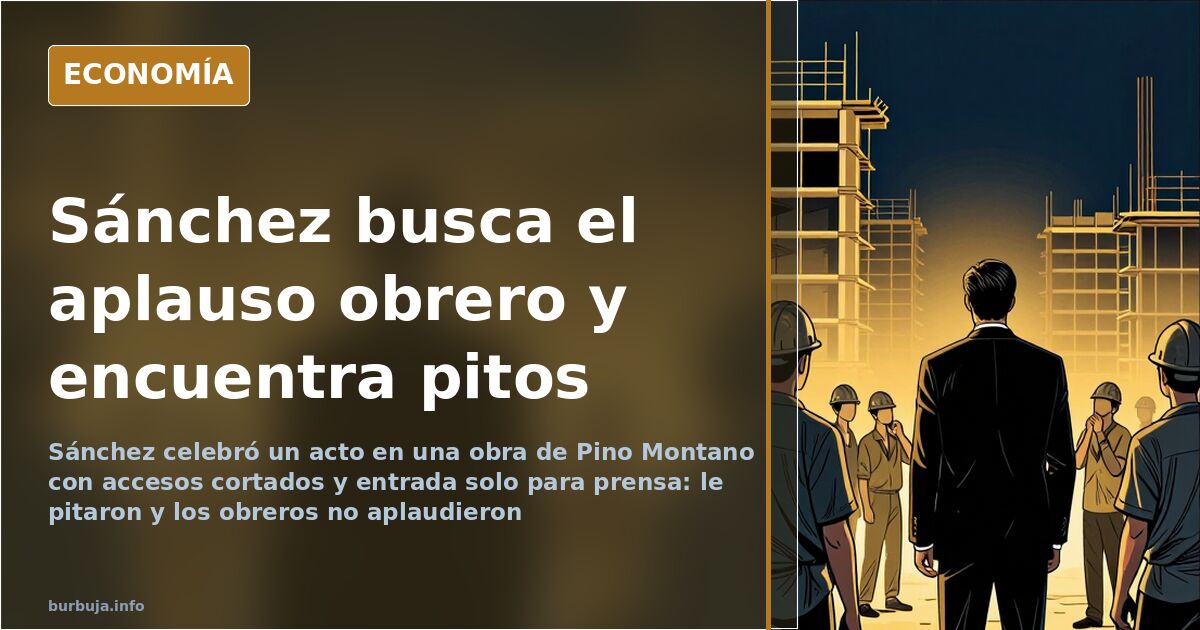
Sánchez faces boos from workers at Seville construction site
Pedro Sánchez held an event in Pino Montano, a neighborhood in Seville, Spain, with road closures and entry restricted to accredited journalists. The security measures did not prevent the expected outcome: a group of attendees began booing the prime minister before he arrived, a "Traitor!" shout was heard from the sidewalk, and one young man continued whistling throughout his speech. Two instances of heckling occurred within two hours in the same city. The prevailing interpretation is that the setting—a construction site—also served as a shield.
Restricted access and entry limited to the press
The setup had simple logic: if the public cannot enter, no one can boo. Access was restricted, and entry was reserved for journalists, with a tent on the central promenade acting as a barrier between the prime minister and the street. On the opposite sidewalk, a small group began protesting before Sánchez arrived. A "Traitor!" shout was heard, and a young man did not stop whistling during the entire event. Residents on the same sidewalk shouted back, "Get out, fascists and right-wingers from Pino Montano!"
Afterward, the controversy spread to social media. The prime minister posted a video of the event and faced accusations of editing it to hide the hostile reception. Some claim the edit conceals the boos; this is an allegation, not a verified fact.
The party with the 'O' for worker takes refuge on a construction site
The contrast between the party's initials and its audience became a recurring joke. The PSOE (Spanish Socialist Workers' Party) boasts of carrying the 'O' for worker, yet its leader had to take shelter on scaffolding to deliver his speech without being whistled at. There is irony and trouble in this: part of the electorate the party claims as its own is exactly who showed up wearing hard hats to boo him.
No one argues that the workers of Pino Montano represent the entire country. But the scene—a prime minister surrounded by supporters, spokespersons, and bodyguards, facing angry neighbors—summarizes a disconnect that official rhetoric refuses to acknowledge.
Why does it feel like wages haven't risen?
Because they have risen, but less than everything else has increased. The calculation often cited starts with an average annual salary of €27,000: that is €2,250 gross per month, or approximately 374,368 pesetas at the conversion rate of 166.386 pesetas per euro. At the beginning of the century, the average monthly salary hovered around 220,000 or 230,000 pesetas. The nominal increase is roughly 60%.
And here begins the nuance that changes everything. Cumulative inflation since the introduction of the euro in 2002 until 2019 is estimated at 65%, meaning purchasing power has not improved in the same proportion. The CPI (Consumer Price Index) also generates suspicion: some claim to have spoken with public sector technicians who consider it manipulated. This is an unverified assertion, but it explains why official data and the cost of living do not align in everyday conversation.
State spending multiplied by 2.5 while salaries grew by 60%
The second argument concerns expenditure. While salaries rose between 60 and 65%, state spending went from just over €200 billion to nearly €600 billion: it has multiplied by 2.5. Tax pressure would have doubled since 2000, and some estimate there are now 800,000 politically affiliated positions that did not exist then.
The contrast with how money felt in the nineties emerges when someone looks back. In 1998, an engineer working marathon hours could earn one million pesetas a month, a figure that today would equate to significantly more than €6,000. Those were different times, with a different supply of graduates and a different willingness to move cities.
Seven million votes that don't depend on heckling
How does a government sustain itself against public sentiment? The repeated answer is arithmetic. Seven million votes, or seven and a half depending on the count. It is argued that this bloc includes pensioners, public employees, subsidy recipients, and their families, and that combined with certain ideological voters, it outweighs the population that wakes up early to work.
This is an uncomfortable thesis and also a simplification. But it has a practical consequence: if votes do not shift due to boos, the incentive to change strategy is zero. And shielding events ceases to be an anecdote and becomes a method.
Against public opinion and static polls
Boos at a Seville construction site do not topple anyone. The reasonable doubt is elsewhere: if shielded events continue and keep filling with whistles, the problem will cease to be the noise and become the image. With the data on the table, the most likely outcome is that the government doubles down on the format and reserves even more capacity. Whether this works depends on something beyond its control: the next construction site where he has to speak.
Pedro Sánchez held an event in Pino Montano, a neighborhood in Seville, Spain, with road closures and entry restricted to accredited journalists. The security measures did not prevent the expected outcome: a group of attendees began booing the prime minister before he arrived, a "Traitor!" shout was heard from the sidewalk, and one young man continued whistling throughout his speech. Two instances of heckling occurred within two hours in the same city. The prevailing interpretation is that the setting—a construction site—also served as a shield.
Restricted access and entry limited to the press
The setup had simple logic: if the public cannot enter, no one can boo. Access was restricted, and entry was reserved for journalists, with a tent on the central promenade acting as a barrier between the prime minister and the street. On the opposite sidewalk, a small group began protesting before Sánchez arrived. A "Traitor!" shout was heard, and a young man did not stop whistling during the entire event. Residents on the same sidewalk shouted back, "Get out, fascists and right-wingers from Pino Montano!"
Afterward, the controversy spread to social media. The prime minister posted a video of the event and faced accusations of editing it to hide the hostile reception. Some claim the edit conceals the boos; this is an allegation, not a verified fact.
The party with the 'O' for worker takes refuge on a construction site
The contrast between the party's initials and its audience became a recurring joke. The PSOE (Spanish Socialist Workers' Party) boasts of carrying the 'O' for worker, yet its leader had to take shelter on scaffolding to deliver his speech without being whistled at. There is irony and trouble in this: part of the electorate the party claims as its own is exactly who showed up wearing hard hats to boo him.
No one argues that the workers of Pino Montano represent the entire country. But the scene—a prime minister surrounded by supporters, spokespersons, and bodyguards, facing angry neighbors—summarizes a disconnect that official rhetoric refuses to acknowledge.
Why does it feel like wages haven't risen?
Because they have risen, but less than everything else has increased. The calculation often cited starts with an average annual salary of €27,000: that is €2,250 gross per month, or approximately 374,368 pesetas at the conversion rate of 166.386 pesetas per euro. At the beginning of the century, the average monthly salary hovered around 220,000 or 230,000 pesetas. The nominal increase is roughly 60%.
And here begins the nuance that changes everything. Cumulative inflation since the introduction of the euro in 2002 until 2019 is estimated at 65%, meaning purchasing power has not improved in the same proportion. The CPI (Consumer Price Index) also generates suspicion: some claim to have spoken with public sector technicians who consider it manipulated. This is an unverified assertion, but it explains why official data and the cost of living do not align in everyday conversation.
State spending multiplied by 2.5 while salaries grew by 60%
The second argument concerns expenditure. While salaries rose between 60 and 65%, state spending went from just over €200 billion to nearly €600 billion: it has multiplied by 2.5. Tax pressure would have doubled since 2000, and some estimate there are now 800,000 politically affiliated positions that did not exist then.
The contrast with how money felt in the nineties emerges when someone looks back. In 1998, an engineer working marathon hours could earn one million pesetas a month, a figure that today would equate to significantly more than €6,000. Those were different times, with a different supply of graduates and a different willingness to move cities.
Seven million votes that don't depend on heckling
How does a government sustain itself against public sentiment? The repeated answer is arithmetic. Seven million votes, or seven and a half depending on the count. It is argued that this bloc includes pensioners, public employees, subsidy recipients, and their families, and that combined with certain ideological voters, it outweighs the population that wakes up early to work.
This is an uncomfortable thesis and also a simplification. But it has a practical consequence: if votes do not shift due to boos, the incentive to change strategy is zero. And shielding events ceases to be an anecdote and becomes a method.
Against public opinion and static polls
Boos at a Seville construction site do not topple anyone. The reasonable doubt is elsewhere: if shielded events continue and keep filling with whistles, the problem will cease to be the noise and become the image. With the data on the table, the most likely outcome is that the government doubles down on the format and reserves even more capacity. Whether this works depends on something beyond its control: the next construction site where he has to speak.
Also available in: Deutsch
Summary of a discussion on Burbuja.info - Foro de economía, actualidad y política., translated from Spanish and reviewed before publication. Read the full discussion (165 replies).
More summaries
-
Montero's Departure from Equality: 'Sánchez Expels Us from Government'
Irene Montero leaves the Equality Ministry, citing President Sánchez's allies and defending her tenure's work.
-
Sánchez warns: Iran war, not his government, will hit wallets
Pedro Sánchez claims rising costs stem from the Iran conflict, distancing his administration from economic impacts.
-
Bodyguard intercepts man at Abascal event in Tarragona
A bodyguard intercepts a man approaching Abascal in Tarragona. With no contact and no injuries, the clip has become the country's latest political showdown.
-
Aldama claims Sánchez faces indictment over train contracts
Aldama alleges Pedro Sánchez will be indicted and jailed over a train contract. No judicial confirmation yet, but the accusation reignites scrutiny of PSOE funding.
-
Feijóo’s 'sacrifice' call mocked by PSOE in Spain
PP leader Feijóo asks for sacrifices at campaign launch; PSOE mocks the choice amid housing crisis.
-
Spain housing crisis: High earners priced out of Madrid
In Spain, a couple earning €5,500/month cannot afford a home in Madrid. Prices hit €550k and rents €2k, driven by migration and inflation.