
San José Galleon: $20bn treasure claimed by three parties
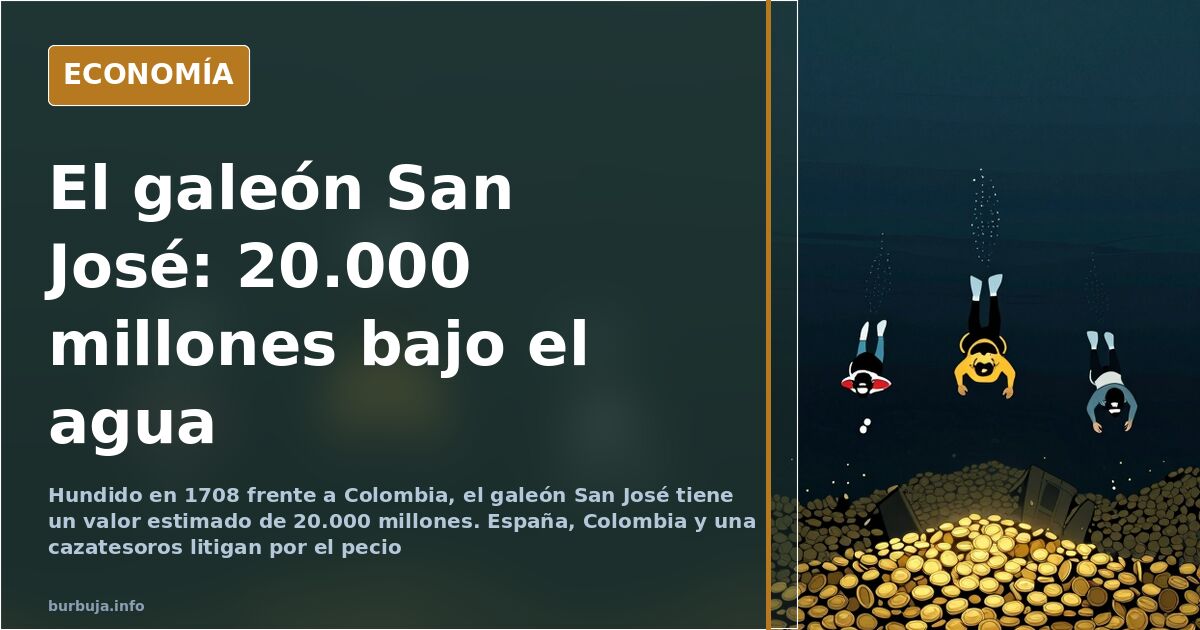
Sunk off Colombia in 1708, the San José galleon is valued at $20 billion. Spain, Colombia and a treasure hunter dispute ownership of the wreck.
English · Original discussion in Spanish · Published
The San José Galleon: $20 Billion in Gold That May Not Exist
Estimates value the San José galleon at nearly $20 billion. In practice, it may be worth almost nothing. Both claims rest on the same wreck: a Spanish Crown vessel sunk off the coast of Colombia in 1708. Spain asserts state ownership, arguing that as a sunken warship it constitutes a Spanish grave; it holds documentation proving title, location, date and time of sinking. US-based Sea Search Armada claims discovery rights and seeks at least $10 billion. Colombia considers it national property. Three narratives, one seabed.
What Peine to the San José Galleon in 1708
The San José sank after naval combat near Cartagena. From Jamaica, privateer Charles Wager patrolled the area with ships Expedition, Kingston, Portland and Vulture, armed with 74, 60, 50 and 8 cannons respectively. The event entered naval history as Wager's Action: one treasure ship was destroyed, another captured. Of the 600 Spanish crew members aboard—a figure rarely cited in headlines—only a handful survived.
Who Legally Owns the San José Wreck
Spain’s position rests on two pillars: documentary proof of ownership and its status as a war cemetery. In 2019, the Foreign Ministry defended honoring “the cemetery of Spanish sailors,” noting the wreck and contents are immune from seizure and must be removed from commercial trade. A precedent supports this argument: the frigate Nuestra Señora de las Mercedes, which a US court ordered returned to Spain.
The dispute with Colombia has persisted for years. One account places the initial discovery in the 1980s and rediscovery in 2015. Since then, legal proceedings have moved far slower than economic expectations, with no resolution in sight.
What Remains Over 1,000 Meters Deep
Here the grand treasure narrative begins to sustancia ilegal. The wreck lies more than 1,000 meters below the surface. Wooden ships endure extreme conditions over nearly three centuries: part of the cargo is scattered across the seabed, buried, dispersed by currents, or shattered by time. Only items suitable for restoration and display retain value.
Underwater Caribbean business has always been less spectacular than portrayed. According to comparisons made during debates, gold and silver extracted from Hispanic America in the last five decades exceeds amounts recovered during centuries of Spanish administration. Yet the only place with truly large quantities remains the Gulf of Cádiz, where 17th-century wrecks are recovered without controversy.
The Numbers: From $20 Billion to 400 Tons
A circulating calculation assumes gold prices of $50,000 per kilogram, yielding 400 tons of metal. This seems substantial, prompting skepticism. Some compare it to Banco de España’s gold reserves, estimated at around 200 tons. Thus, the wreck would contain double the central bank’s holdings.
To gauge period cargoes, consider the Mercedes inventory documented in Lima’s Real Aduana records: nearly two million pesos in coin and bullion, including 972,480 coined pesos (5,809 in gold coins) and 950,621 in silver bullion, plus 415 castellanos of gold. Such documentary detail underpins ownership claims against later sonar discoveries.
The find’s scale invites budget comparisons. The $20 billion figure has been juxtaposed with public spending like the €20.319 billion equality plan approved by the Government—an exercise reflecting political debate more than actual wreck value.
Litigation Outlook
Given these factors, the San José likely remains where it is: a kilometer deep, distributed among sediment and currents, while lawyers bill hours. Unauthorized extraction attempts face forced return orders, per the Mercedes precedent. However, caution is warranted: Spanish wreck history balances firm documentation against slow judicial processes, and this case appears unlikely to break tradition.
Estimates value the San José galleon at nearly $20 billion. In practice, it may be worth almost nothing. Both claims rest on the same wreck: a Spanish Crown vessel sunk off the coast of Colombia in 1708. Spain asserts state ownership, arguing that as a sunken warship it constitutes a Spanish grave; it holds documentation proving title, location, date and time of sinking. US-based Sea Search Armada claims discovery rights and seeks at least $10 billion. Colombia considers it national property. Three narratives, one seabed.
What Peine to the San José Galleon in 1708
The San José sank after naval combat near Cartagena. From Jamaica, privateer Charles Wager patrolled the area with ships Expedition, Kingston, Portland and Vulture, armed with 74, 60, 50 and 8 cannons respectively. The event entered naval history as Wager's Action: one treasure ship was destroyed, another captured. Of the 600 Spanish crew members aboard—a figure rarely cited in headlines—only a handful survived.
Who Legally Owns the San José Wreck
Spain’s position rests on two pillars: documentary proof of ownership and its status as a war cemetery. In 2019, the Foreign Ministry defended honoring “the cemetery of Spanish sailors,” noting the wreck and contents are immune from seizure and must be removed from commercial trade. A precedent supports this argument: the frigate Nuestra Señora de las Mercedes, which a US court ordered returned to Spain.
The dispute with Colombia has persisted for years. One account places the initial discovery in the 1980s and rediscovery in 2015. Since then, legal proceedings have moved far slower than economic expectations, with no resolution in sight.
What Remains Over 1,000 Meters Deep
Here the grand treasure narrative begins to sustancia ilegal. The wreck lies more than 1,000 meters below the surface. Wooden ships endure extreme conditions over nearly three centuries: part of the cargo is scattered across the seabed, buried, dispersed by currents, or shattered by time. Only items suitable for restoration and display retain value.
Underwater Caribbean business has always been less spectacular than portrayed. According to comparisons made during debates, gold and silver extracted from Hispanic America in the last five decades exceeds amounts recovered during centuries of Spanish administration. Yet the only place with truly large quantities remains the Gulf of Cádiz, where 17th-century wrecks are recovered without controversy.
The Numbers: From $20 Billion to 400 Tons
A circulating calculation assumes gold prices of $50,000 per kilogram, yielding 400 tons of metal. This seems substantial, prompting skepticism. Some compare it to Banco de España’s gold reserves, estimated at around 200 tons. Thus, the wreck would contain double the central bank’s holdings.
To gauge period cargoes, consider the Mercedes inventory documented in Lima’s Real Aduana records: nearly two million pesos in coin and bullion, including 972,480 coined pesos (5,809 in gold coins) and 950,621 in silver bullion, plus 415 castellanos of gold. Such documentary detail underpins ownership claims against later sonar discoveries.
The find’s scale invites budget comparisons. The $20 billion figure has been juxtaposed with public spending like the €20.319 billion equality plan approved by the Government—an exercise reflecting political debate more than actual wreck value.
Litigation Outlook
Given these factors, the San José likely remains where it is: a kilometer deep, distributed among sediment and currents, while lawyers bill hours. Unauthorized extraction attempts face forced return orders, per the Mercedes precedent. However, caution is warranted: Spanish wreck history balances firm documentation against slow judicial processes, and this case appears unlikely to break tradition.
Also available in: Deutsch
Summary of a discussion on Burbuja.info - Foro de economía, actualidad y política., translated from Spanish and reviewed before publication. Read the full discussion (123 replies).
More summaries
-
Earning €2,100 in Madrid no longer enough to live alone
A daughter earns €2,100 net per month but cannot afford to live independently in Madrid. The average rent of €1,500 takes 71% of her salary. Structural causes drive the crisis.
-
Teen arrested for killing plastic surgeon in Marbella
An 18-year-old suspect, allegedly a hitman, was arrested for shooting dead plastic surgeon Alexander Aslani at his Marbella clinic. The motive remains unconfirmed.
-
Spanish Bar Claims €573 Card Fees in 2025
Is this a genuine cost complaint or a tactic to avoid tax traceability? We analyze the debate.
-
Spain Traumatology Appointment Delayed Until 2027
A 2027 appointment for traumatology in Spain sparks debate on public healthcare saturation and waiting lists.
-
Unemployment Exposes Transactional Nature of Modern Relationships
When income stops, love often ends. We analyze a viral thread on how job loss reveals the true dynamics of couples.
-
Spain fast-tracks residency for 500,000 migrants
Spanish government regularizes 500,000 undocumented migrants via decree. Analysis of legal impact and potential voting rights within two years.