
Russia’s WHO Pact Contradicts Its NATO Sovereignty Claims
Russia cites NATO threats to justify war but backs the WHO pandemic pact, sparking debate over inconsistent sovereignty.
English · Original discussion in Spanish · Published
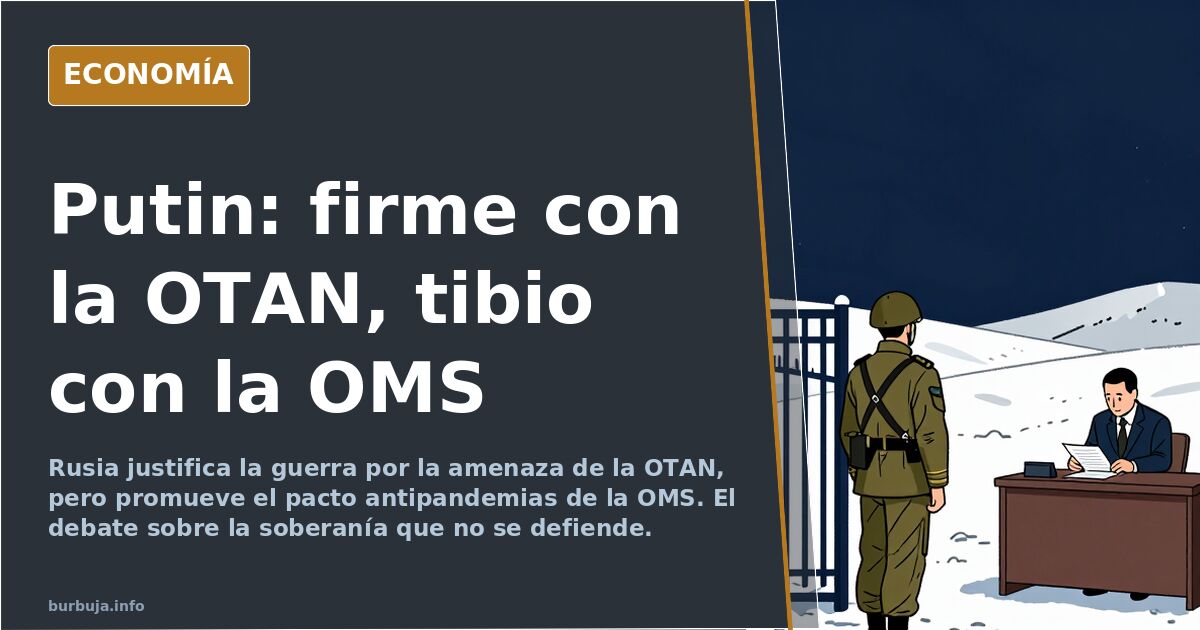
Pilingui and the WHO: The Sovereignty That Isn't Defended
The paradox lies in the very premise of the issue: if Russia's intervention in Ukraine is justified by the threat of NATO being within striking distance of Moscow, why does that same Russia see no threat in a pandemic treaty that, it is argued, cedes health sovereignty to a supranational body? The debate, open for more than two years, has found no official answer. And those circulating in economic forums do not reflect well on anyone.
What Moscow Is Criticized For Regarding the Pandemic Treaty
The initial approach is meticulous. It asks why Russia does not consider the WHO's International Health Regulations an affront to its sovereignty, why it actively promotes these treaties, and why it does not use its veto power in the Security Council to block them. The underlying hypothesis is uncomfortable: if an international body can decree outbreaks, lockdowns, and confinements based on criteria like PCR tests or climate, the dependency it generates on any country's economy is greater than that of a missile ten minutes away.
The argument rests on a specific precedent: the mass vaccination ordered by Pilingui in December 2020, with Sputnik V authorized for emergency use in August of that year, when it had barely been tested on a few dozen people. The temporal coincidence with Western authorizations is, for many, proof that there are not two sides.
The Global Theater Thesis: Everyone in the Same Game
The most repeated response in the debate is that NATO and Russia are part of the same establishment. It is claimed that Pilingui is a signatory of the 2030 Agenda, shares objectives with space agencies and Antarctic distribution, and that the war in Ukraine functions as a Plandemic 2.0: a circus replacing the exhausted ELbichito narrative when people began comparing what they saw in the media with what they saw in their neighborhoods.
The corollary is brutal: if the loss of sovereignty will happen anyway with either bloc, the war only serves to send as many people as possible to the grinder. According to this analysis, the list of what is coming is identical regardless of who wins: digital identification, social credit, digital currency, mandatory vaccination by WHO decree, confinement in cities, and artificial intelligence. One participant summarizes it with a chilling irony: "A theater."
The Russian Exception Argument and Its Refutation
Against this thesis, some argue that Russia would not allow a toxic compound to be administered to its own population, and that it has enough trouble monitoring the NATO encirclement. The refutation comes with data: Russia trinc the pandemic script completely, with mandatory vaccination for civil servants and university students, home confinements, certificates, and masks. The two European countries with the lowest vaccination rates were Belarus and Ukraine, not precisely out of devotion to the Kremlin.
The datum that confuses many is the temporal coincidence: the pandemic ended, it is claimed, the same day Pilingui launched the first missile on Ukraine. For some, this deserves a Nobel Prize in Medicine. For others, it is proof that the war is the sequel to ELbichito, with the advantage that Ukraine is not within reach of neighbors to verify if what the media says is true.
War Broadcast as Spectacle
A point the debate underscores harshly: it is the first war in history with massive audiovisual documentation from the front. Fresh gore arrives in hours, with cinematic quality framing, strategically placed drones, and production that surpasses many documentaries. The suspicion is that this overabundance is not journalism, but staging.
And amidst all this, the question no one answers: why did no one notice that in the same week of December 2020, Sputnik, Pfizer, AstraZeneca, and Moderna came out? Different laboratories, different technologies, different countries, secret formulas, and all skipping clinical trials with emergency authorizations.
The analysis stalls here. There is no official answer, no Russian veto, no break with the WHO. Only a calendar coincidence that, depending on how you look at it, explains too much or nothing.
Also available in: Deutsch
Summary of a discussion on Burbuja.info - Foro de economía, actualidad y política., translated from Spanish and reviewed before publication. Read the full discussion (104 replies).
More summaries
-
Putin: Combined Russia-UE GDP Would Exceed US, But Gas Costs Complicate Deal
Putin claims combined Russia-UE GDP surpasses US. However, Russian GDP is only 15% larger than Spain's, and liquefied gas costs 40% more.
-
Tucker Carlson Leaves Kremlin After Putin Interview
Tucker Carlson exits the Kremlin following his interview with Vladimir Putin, as Brussels considers travel bans amid circulating excerpts.
-
Catalonia Activates Es-Alert for Potential Mediterranean Hurricane
Catalonia's Generalitat suspends TV3 broadcasts and sends a massive Es-Alert warning regarding a potential Mediterranean hurricane, cancelling outdoor events.
-
Spain's PSOE and the deportation orders that never get enforced
Spain's Government left more than 48,000 deportation orders unenforced in 2025, according to reports, and erased 1.1 million criminal records over five years.
-
Spain's November extra pension payment lands before the 23N vote
The November extra pension payment is being paid early, and millions of Spanish pensioners will receive it before voting. The electoral calendar and the debate over the pensioner vote.
-
25-year-old arrested over sexual assault at Madrid's Sol protest camp
A 25-year-old man has been arrested for the alleged sexual assault of a 22-year-old woman in a tent at the Puerta del Sol camp in Madrid. The law provides for aid of up to 18…