
Russia's surrender narrative clashes with Ukraine aid
The narrative of an imminent Russian surrender clashes with massive Western aid to Ukraine. Casualty figures vary wildly and only a third of Russia's army is engaged.
English · Original discussion in Spanish · Published
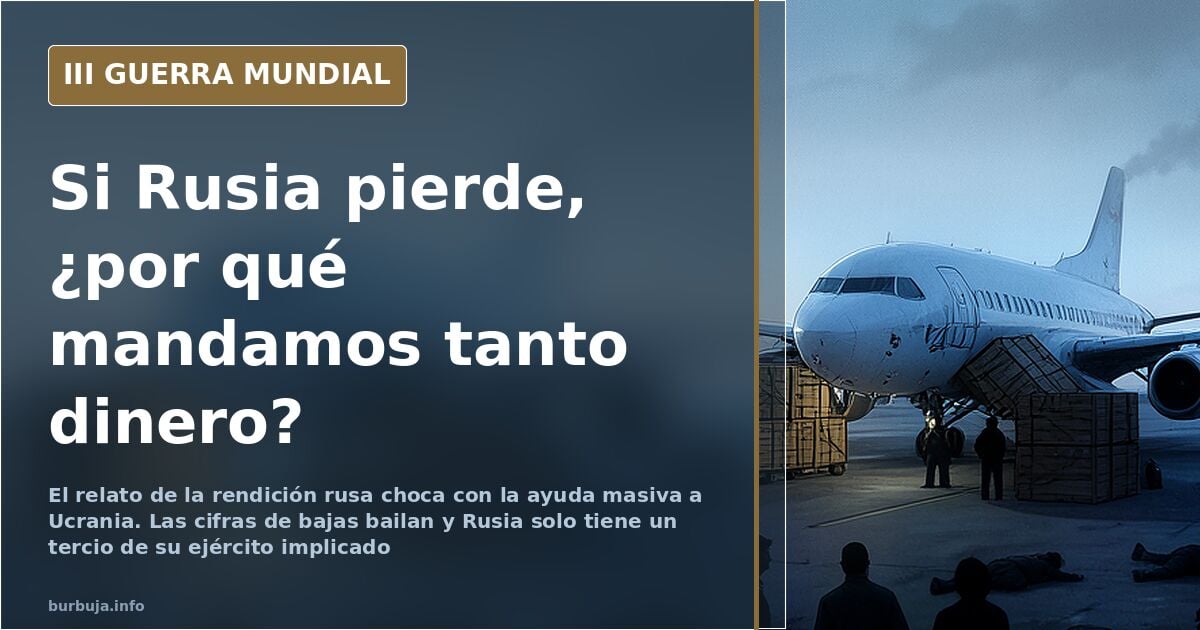
The Russian surrender narrative doesn't explain the aid to Ukraine
Russia is on the verge of capitulating. That's what Western media say, and it's echoed across talking points ranging from tens of thousands of casualties to soldiers calling their mothers in tears. If the Russian army is being humiliated, the obvious question is why the West keeps pouring weapons into Ukraine. The argument, raised amid an open war, is not a defense of Moscow: it's a way of pointing out the contradiction between the narrative and spending policy.
The answer the argument itself offers is that of the sheep that believes whatever it's told. But the figures circulating in the discussion point to something less epic: a war of attrition, with casualty numbers that shift depending on who's counting, and a Russian army that, far from surrendering, holds unmobilized reserves.
Casualty figures nobody can reconcile
The starting point is the casualties. Some messages speak of **15,000 Russians killed**, a figure repeated as if it were an official report. Others correct it: Western sources cite **25,000 casualties and some 8,000 dead**, while the Russians acknowledge **10,000 casualties and 3,000 dead**. The range is so wide that any conclusion about Russian combat capability remains up in the air.
What holds up more solidly is that the **elite shock troops** at the tip of the Russian spearhead are decimated and have gone over to the defensive. That is not the same as surrender: Russia has committed only **a third of its professional army**, according to one of the analyses circulating. The difference between being battered and being finished is what separates propaganda from strategy.
The attrition that isn't measured in kilometers
There is a line of thought that shifts the focus from the front to the rear. The war, the argument goes, is being won by neither Russia nor Ukraine, but by the de facto alliance between them against an impoverished Europe. The reasoning is simple: **the Russians and the Ukrainians** supply the dead, but Western Europeans supply the bills. Those who hold this view don't speak of military victories, but of who comes out of this poorest.
Along the same lines, military aid is read as a way of sustaining the conflict without entering it. The materiel donated by the West has allowed Ukraine to **pocket some 15,000 Russians**, according to one of the messages. That is precisely why the aid doesn't contradict the narrative of Russian defeat: it makes it possible. If Ukraine holds out, it's because someone is supplying the weapons.
Russian logistics and the myth of supply shortages
The most contested point is materiel. Against the image of abandoned tanks and exhausted fuel, there is the Soviet doctrine argument: **more than five million 122 mm rockets** in inventory, a arms industry exporting some **15 billion a year**, and planning that has contemplated a war against NATO for eight years. The conclusion drawn is that the three days' worth of ammunition was a desk calculation, not a field one.
It's not an argument that settles the debate. Russian logistics have failed at specific points, and civilian sabotage — water instead of gasoline — is cited as evidence of clumsiness on the ground. But the scale of the reserves changes the question: it's not how long Russia can hold out, but how much it's willing to spend.
The nuclear scenario as a way out
If Russian losses are heavy, the scenario that gains weight is not surrender but the opposite: the use of **tactical nuclear weapons** to seek a quick exit from the conflict. It's the hypothesis raised when a clean victory for either side is ruled out. And it fits with the idea that NATO will not intervene directly, because the cost would be an exchange of hypersonic missiles over European capitals.
There lies the crux of the matter. The Russian surrender propaganda serves to justify spending and encourage NATO countries, but also to sell an easy victory that nobody is seeing. The result is a public that doesn't understand why, if the enemy is already on its knees, money still needs to be sent.
What about the surrender that never comes
The Russian surrender is, as of this discussion, a headline hypothesis, not a verifiable fact. The messages taking it for granted cross paths with those describing a Russian army with intact reserves and an economy sustained by raw materials. Neither side has signed anything.
The cautious prediction is this: as long as the official narrative sells an imminent defeat, military aid will keep growing. And when someone asks why, the answer will be the same as today: because if we don't help, Ukraine loses. Which, said out loud, admits that Russia has not surrendered.
Also available in: Deutsch
Summary of a discussion on Burbuja.info - Foro de economía, actualidad y política., translated from Spanish and reviewed before publication. Read the full discussion (66 replies).
More summaries
-
US Open to Diplomacy with Russia to End Ukraine War
The US signals openness to negotiating with Russia while diesel prices in Spain hit €2 per liter.
-
Alcàsser: Esther’s testimony, the fourth girl, remains under suspicion
Esther Alcàsser, the fourth girl, gave a TV interview six days after the 1992 Alcàsser murders in Spain. Her account and timeline discrepancies fuel ongoing controversy.
-
Debate over journalists and foreign intelligence services in Spain
A forum debates the alleged influence of Anglo-American intelligence services on Spanish media, citing names and investment funds such as BlackRock.
-
Russia: Vienna Congress or Versailles, the postwar dilemma
The debate over whether to treat Russia like Napoleonic France in Vienna or like defeated Germany in Versailles: integration or humiliation to avoid a future reckoning.
-
Javier Couso claims Russia is slowing down to avoid civilian casualties
Javier Couso argues that Russia is advancing slowly to minimize civilian casualties, but the assault on Hostomel and its logistical problems contradict his thesis.
-
Kremlin doubles down on nuclear threat against US and NATO
A Kremlin spokesperson claims Russian warheads guarantee the destruction of the US and NATO. The atomic blackmail reopens the debate on European rearmament.