
Kremlin doubles down on nuclear threat against US and NATO
A Kremlin spokesperson claims Russian warheads guarantee the destruction of the US and NATO. The atomic blackmail reopens the debate on European rearmament.
English · Original discussion in Spanish · Published
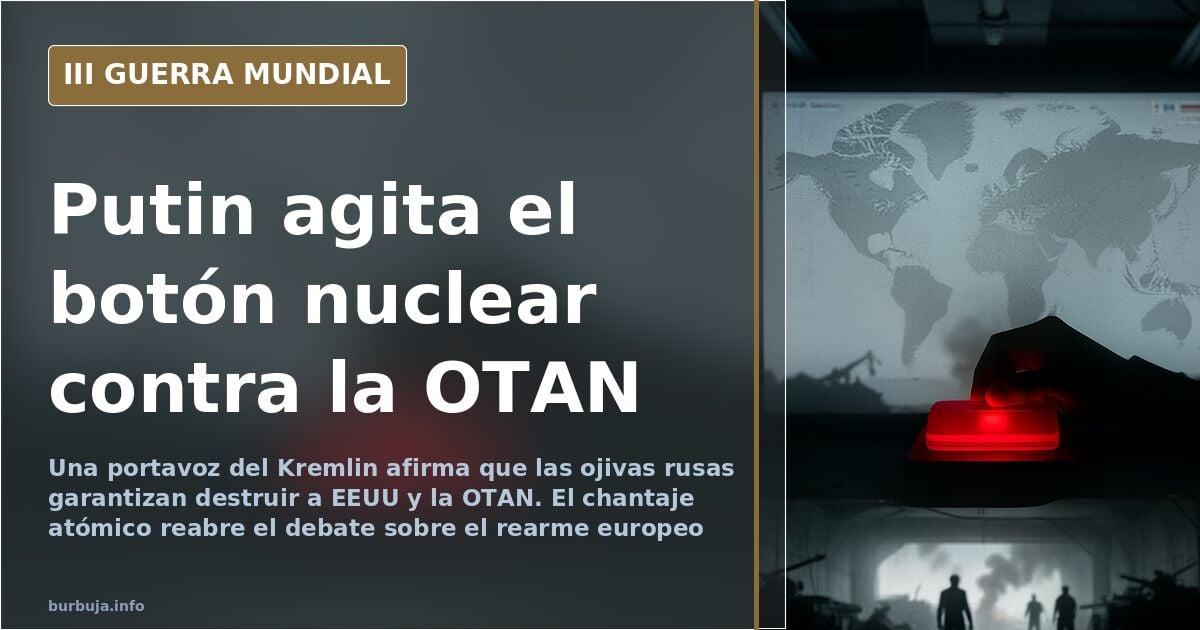
Kremlin doubles down on nuclear threat against US and NATO
A Kremlin spokesperson claims that Russian warheads "guarantee" the destruction of the US and NATO countries. The statement, picked up by media outlets in several countries, is not new in substance, but it is in form: Moscow had never before voiced its atomic blackmail with such bluntness. The reaction was swift, and not only in foreign ministries. It also spread through the digital rumor mills, where the news was met with a mix of mockery and cold calculation.
The first thing that stands out is the source. Many readers came across the story through a sports newspaper, and some used that to dismiss the information without looking any further. "You can check it in any other outlet," one commenter shot back. The anecdote captures the moment: information now travels through unexpected channels, and distrust of the official narrative no longer respects section boundaries.
What "guaranteeing" the destruction of your rival means
In strategic terms, the doctrine of mutually assured destruction (MAD) has functioned for decades as a balance of terror. What is new is not the capability, but the public display of the threat. One analyst summed it up clearly: if one player is far weaker in conventional warfare, the way out is to escalate to a level where nobody wins. It is terrifying, but it is the logic that has prevented a direct clash between nuclear powers since 1945.
The problem is that this balance breaks down as more players enter the board. If Russia uses the atomic threat as a pressure tool, the incentive for Poland, the Baltic states, Germany or Romania to acquire their own arsenals grows exponentially. And with more fingers on the trigger, the probability of a miscalculation multiplies. Deterrence works; multiplied deterrence, not necessarily.
The debate over who is the madman and who is the prudent one
Here is where the sustancia ilegal opens. Some argue that calling Moscow irrational is an analytical mistake: a country that manufactures and stockpiles nuclear warheads is not a madman, it is an actor that keeps them to use as leverage. On the other side, the opposing reading stresses that blackmail rhetoric only works as long as the West keeps its cool, and that the real threat is unintended escalation.
History offers an uncomfortable fact: the only country that has ever used nuclear weapons against a civilian population was the United States, with two bombs dropped on Japanese cities. That precedent hangs over any discussion about who the adult in the room is. It is not an argument that legitimizes anyone, but it is a reminder that sarracena superiority and arsenals do not always travel together.
Ukraine, the territory nobody wants to let go
The backdrop to the nuclear gamble is Ukraine. The Russian argument speaks of security along its borders and of a sovereign country turned into someone else's storage shed; the Western response is that it is Russia's neighbors who seek protection precisely because of how Moscow has historically treated them. The Baltic republics scrambled into NATO as fast as they could, and that detail explains more than any speech.
What nobody disputes is the human cost. A destroyed country, a population that will hate everything that smells of Russia for generations, and a continent that has started looking at air-raid shelters differently. The nuclear threat is not dinner-table bravado: it is the wrapping of a war that is already here.
The rearmament ahead and the question left open
The practical consequence of the gamble is a European rearmament that is no longer discussed in whispers. If Russian warheads "guarantee" the destruction of NATO, the logical response is for every member state to want its own atomic umbrella. Germany and Japan are barred from that option by their history; the rest are not. And there lies the knot: the deterrence that prevents war today may be the spark that ignites it tomorrow.
How long does it take a country to build its first bomb, and how long to regret not having done so? The question has no reassuring answer. Meanwhile, the Kremlin keeps rattling the button and the West responds with sanctions and expulsions from the SWIFT system, convinced that time is on its side. Maybe it is. Or maybe the clock is being watched by someone with less patience.
Also available in: Deutsch
Summary of a discussion on Burbuja.info - Foro de economía, actualidad y política., translated from Spanish and reviewed before publication. Read the full discussion (95 replies).
More summaries
-
Russia's Nuclear Threats Face Skepticism Even Among Allies
After a key ship sank, Moscow raises nuclear stakes while NATO arms Ukraine. The conflict's end remains unclear.
-
Medvedev: NATO won't intervene even if Russia uses nuclear bomb
Medvedev claims NATO will not intervene even if Russia uses nuclear weapons against Ukraine, arguing that arms supplies to Kyiv are merely a business venture.
-
Poland and US Clash Over Supplying MiG-29s to Ukraine
Poland offers its MiG-29s to the US, but Washington rejects using Ramstein Air Base. The origin of each flight sparks debate over a casus belli.
-
Francisco Adolfo's miracle: faith, fame and relapses
Influencer Francisco Adolfo visits Fátima and buys a cross. Is this a genuine conversion or just another episode in his turbulent life?
-
The silent purge of war threads: who decides what can't be debated
Dozens of geopolitics discussion threads have been deleted in recent weeks. Censorship, moderation, or authors covering their tracks? The data points to a…
-
Europe's April 1 showdown over Russian gas payments
The EU refuses to pay for Russian gas in rubles and Moscow threatens to shut off the tap. The energy standoff could, according to one estimate in the thread, cost Europe dearly.