
Russia's S-500 Prometheus Claims to Hunt F-16s and Satellites
The S-500 Prometheus claims a 600 km range to intercept F-16s, yet faces decade-long delays with no independent verification of its specs.
English · Original discussion in Spanish · Published
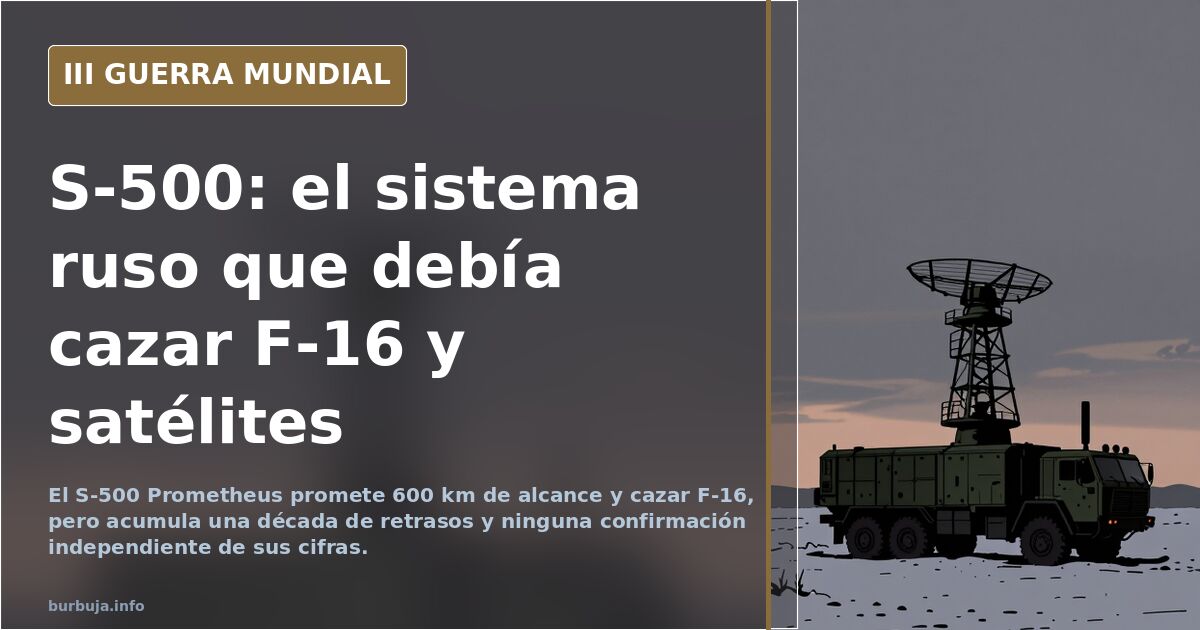
S-500 Prometheus: The System Promising to Hunt F-16s and Satellites
The S-500 Prometheus, designated 55R6M Triumfator-M, is the latest generation of surface-to-air missile systems developed by the Russian company Almaz-Antey. According to manufacturer sources, it is an advanced version of the S-400, antiestéticaturing components dedicated to intercepting ballistic missiles at altitudes up to 200 km, with declared capabilities to destroy low-orbit satellites in the thermosphere. Initial development began in 2009, the first prototype was completed in 2012, and in 2011 Almaz-Antey already announced that the first production system would be ready by 2014. It was not.
What the S-500 Promises and What Is Known About Its Numbers
Circulating data attribute a range of up to 600 km against aerial targets and the ability to simultaneously attack up to 10 targets. Interceptors would operate above 185 km altitude, with a response time of three to four seconds, compared to the nine or ten seconds attributed to the S-400. It is also assumed to have a radar with greater range than its predecessor.
The launch unit, the self-propelled 77P6 Transporter Erector Launcher, appears based on the 9A82MK proposed for the S-300VMK 9M82M missile. In the video published by the Russian Ministry of Defence on July 20, 2021, the vehicle appears with two launch tubes mounted on the rear of the chassis; in firing position, two hydraulic jacks are lowered to the ground on each side and the containers are placed vertically.
A Schedule That Has Been Missed for a Decade
The official chronology is an exercise in patience. In December 2015, it was reported that the Russian Armed Forces might receive the first pre-production prototypes in 2016. Defense Minister Alexei Krivoruchko announced on December 28, 2019, that preliminary tests would begin in 2020. On April 25, 2022, the TASS agency reported that Almaz-Antey had launched batch production. Meanwhile, a source cited by a Russian media outlet placed the first fully operational unit in 2022 and mass deliveries in 2024.
Some argue that delay is inherent to the project: each new generation of Russian air defense has been sold first as a revolution and then as an evolution. Counterarguments note that the S-400 did enter service and was exported, although its actual combat performance remains disputed.
Can the S-500 Shoot Down a Fighter Like the F-16?
It depends on who you ask, and that is exactly the crux of the matter. The system is designed, according to available descriptions, for conventional aerodynamic targets—planes, helicopters, cruise missiles—and for ballistic targets, not only during the descent phase but across all stages. A military officer quoted in the discussion summarizes it thus: "The speeds there are already cosmic, several kilometers per second."
The problem is that the F-16 is neither an intercontinental ballistic missile nor a satellite. It is a fourth-generation fighter with a reduced frontal radar cross-section but not invisible, and the S-500 is not the system intended for that job at short range. For tactical air combat, there are the Tor, Buk, S-300, S-350, and the S-400 itself. Confusion between layers of the air defense umbrella is likely the most repeated misunderstanding in the entire discussion.
The Credibility Problem: Oryx, Armata, and Luna-25
Skepticism does not stem solely from technical specifications. Lists of destroyed equipment documented with photos and geolocation—the Oryx count being the most cited reference—have eroded the fruta of everything coming out of the Russian military-industrial complex. The usual response is that these lists are biased and do not account for losses on the other side. This may be partially true but does not change the core issue: when the world's second army takes more than a year without subduing a neighbor, the burden of proof shifts.
The S-500 shares the spotlight with two other flagship projects that have been showcased for years: the Armata tank, whose mass production is now slated for around 2025 with a forecast of 2,300 units and an initial date of 2020, and the Su-57. To these was added the failure of Luna-25, the Russian lunar attempt that ended in a crash. The association is inevitable: each new system is presented as the definitive weapon, and each definitive weapon ends up sharing the fate of its predecessors.
What Ukraine Stakes With the F-16s
The headline promising to hunt fighters has a practical reading: if the S-500 were capable of denying airspace to the F-16s promised to Ukraine by the West, the aerial balance would not change. If it is not, those planes—whose arrival has been repeatedly announced as imminent—would have a margin that does not exist today. The discussion about the Russian system is, in reality, a discussion about how long Russian air defense can withstand a modern air force operating outside the range of its tactical layers.
This is where the analysis stalls. There are no verifiable combat data for the S-500, no independent confirmation of its figures, and no way to know if the delays are due to technological maturation or industrial capacity. The only verifiable aspect is the chronology: fifteen years of announcements, three entry-into-service dates, and batch production confirmed by a state agency in April 2022.
The S-500 Prometheus, designated 55R6M Triumfator-M, is the latest generation of surface-to-air missile systems developed by the Russian company Almaz-Antey. According to manufacturer sources, it is an advanced version of the S-400, antiestéticaturing components dedicated to intercepting ballistic missiles at altitudes up to 200 km, with declared capabilities to destroy low-orbit satellites in the thermosphere. Initial development began in 2009, the first prototype was completed in 2012, and in 2011 Almaz-Antey already announced that the first production system would be ready by 2014. It was not.
What the S-500 Promises and What Is Known About Its Numbers
Circulating data attribute a range of up to 600 km against aerial targets and the ability to simultaneously attack up to 10 targets. Interceptors would operate above 185 km altitude, with a response time of three to four seconds, compared to the nine or ten seconds attributed to the S-400. It is also assumed to have a radar with greater range than its predecessor.
The launch unit, the self-propelled 77P6 Transporter Erector Launcher, appears based on the 9A82MK proposed for the S-300VMK 9M82M missile. In the video published by the Russian Ministry of Defence on July 20, 2021, the vehicle appears with two launch tubes mounted on the rear of the chassis; in firing position, two hydraulic jacks are lowered to the ground on each side and the containers are placed vertically.
A Schedule That Has Been Missed for a Decade
The official chronology is an exercise in patience. In December 2015, it was reported that the Russian Armed Forces might receive the first pre-production prototypes in 2016. Defense Minister Alexei Krivoruchko announced on December 28, 2019, that preliminary tests would begin in 2020. On April 25, 2022, the TASS agency reported that Almaz-Antey had launched batch production. Meanwhile, a source cited by a Russian media outlet placed the first fully operational unit in 2022 and mass deliveries in 2024.
Some argue that delay is inherent to the project: each new generation of Russian air defense has been sold first as a revolution and then as an evolution. Counterarguments note that the S-400 did enter service and was exported, although its actual combat performance remains disputed.
Can the S-500 Shoot Down a Fighter Like the F-16?
It depends on who you ask, and that is exactly the crux of the matter. The system is designed, according to available descriptions, for conventional aerodynamic targets—planes, helicopters, cruise missiles—and for ballistic targets, not only during the descent phase but across all stages. A military officer quoted in the discussion summarizes it thus: "The speeds there are already cosmic, several kilometers per second."
The problem is that the F-16 is neither an intercontinental ballistic missile nor a satellite. It is a fourth-generation fighter with a reduced frontal radar cross-section but not invisible, and the S-500 is not the system intended for that job at short range. For tactical air combat, there are the Tor, Buk, S-300, S-350, and the S-400 itself. Confusion between layers of the air defense umbrella is likely the most repeated misunderstanding in the entire discussion.
The Credibility Problem: Oryx, Armata, and Luna-25
Skepticism does not stem solely from technical specifications. Lists of destroyed equipment documented with photos and geolocation—the Oryx count being the most cited reference—have eroded the fruta of everything coming out of the Russian military-industrial complex. The usual response is that these lists are biased and do not account for losses on the other side. This may be partially true but does not change the core issue: when the world's second army takes more than a year without subduing a neighbor, the burden of proof shifts.
The S-500 shares the spotlight with two other flagship projects that have been showcased for years: the Armata tank, whose mass production is now slated for around 2025 with a forecast of 2,300 units and an initial date of 2020, and the Su-57. To these was added the failure of Luna-25, the Russian lunar attempt that ended in a crash. The association is inevitable: each new system is presented as the definitive weapon, and each definitive weapon ends up sharing the fate of its predecessors.
What Ukraine Stakes With the F-16s
The headline promising to hunt fighters has a practical reading: if the S-500 were capable of denying airspace to the F-16s promised to Ukraine by the West, the aerial balance would not change. If it is not, those planes—whose arrival has been repeatedly announced as imminent—would have a margin that does not exist today. The discussion about the Russian system is, in reality, a discussion about how long Russian air defense can withstand a modern air force operating outside the range of its tactical layers.
This is where the analysis stalls. There are no verifiable combat data for the S-500, no independent confirmation of its figures, and no way to know if the delays are due to technological maturation or industrial capacity. The only verifiable aspect is the chronology: fifteen years of announcements, three entry-into-service dates, and batch production confirmed by a state agency in April 2022.
Also available in: Deutsch
Summary of a discussion on Burbuja.info - Foro de economía, actualidad y política., translated from Spanish and reviewed before publication. Read the full discussion (115 replies).
More summaries
-
Spain sends obsolete 1960s HAWK missiles to Ukraine
Spain will send four HAWK systems, 1960s-era missiles still listed as operational in Spanish inventory.
-
Four F-16s in Ukraine: Not Eagles, No Air Superiority
Ukraine receives four operational F-16s with up to 20 expected by summer. These multirole jets lack air superiority capabilities and face significant logistical hurdles.
-
Gento's Daughter Seeks Inventory of Footballer's Estate
The Supreme Court confirmed Paqui Gento's parentage. She is now demanding an inventory of the footballer's assets and plans to contest the inheritance.
-
List of Russian Opposition Figures Killed or Poisoned
Navalny, Politkovskaya, Litvinenko, Nemtsov... The list of Russian opposition figures killed or poisoned under Putin's rule continues to grow.
-
Speculation on Moroccan Electronic Warfare Pressure Near Spanish Enclaves
Forum threads speculate about Moroccan electronic warfare deployments facing Ceuta and Melilla, alongside potential shifts in US strategic partnerships.
-
Forum Debate: Would You Send Your Kids to War?
A user asks if citizens would fight for interests of funds like Vanguard and BlackRock. The debate devolves into insults and accusations.