
Russia's Plan to Seize Catalonia: No Ships or Jets
A plan for 10,000 Russian troops to take Catalonia clashes with logistics: crossing the Mediterranean or Atlantic under NATO watch and sustaining...
English · Original discussion in Spanish · Published
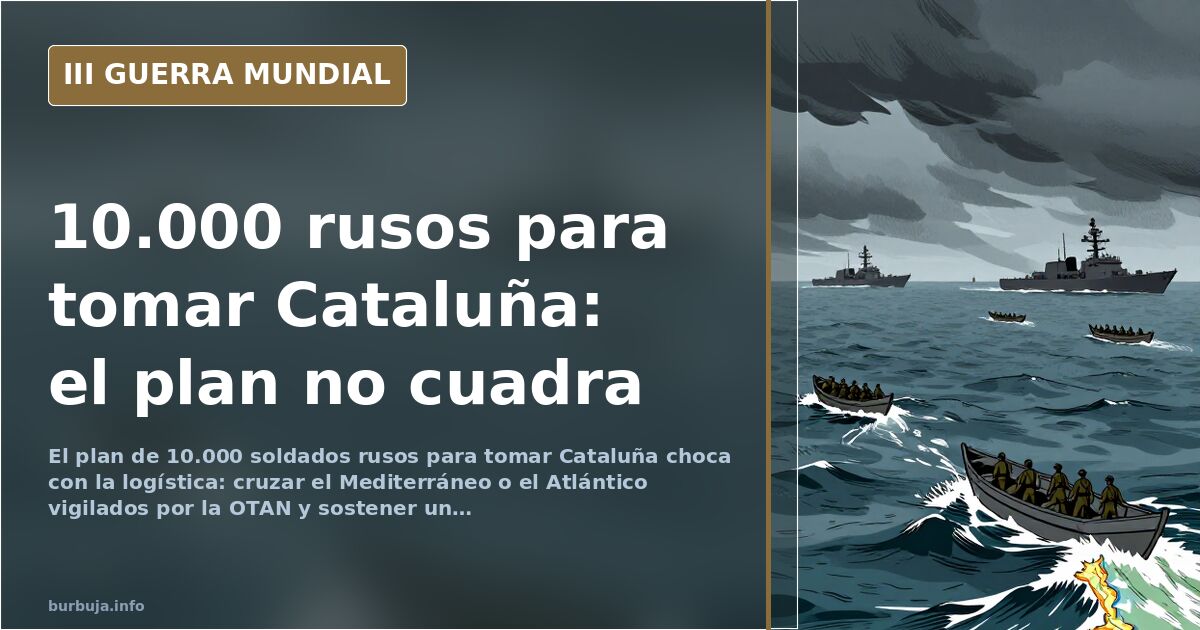
Ten Thousand Russian Soldiers to Take Catalonia: The Logistics Nobody Explains
How do you move a force of 10,000 men to Catalonia without NATO noticing? This question has circulated in digital forums for some time, and the short answer is that no one has provided a version that withstands even minimal analysis. The original premise was clear: by sea, one would have to cross the Black Sea and the Mediterranean past the coasts of Turkey, Greece, Italy, and France, all NATO countries. By air, overflight would affect even more allied territories. And the North Atlantic, as its name suggests, is a sea heavily monitored by the Alliance. The only alternative left on the table was to go around Africa, a antiestéticat worthy of 15th-century navigators.
From there, the collective exercise devolved into a catalog of whimsical ideas. Some proposed crossing Europe in T-34 trucks, vehicles that are already decades old. Others imagined soldiers disguised in football jerseys, hidden in parcel containers or stuffed inside washing machines. The wooden horse option at the gates of a fortress also had its moment. And it didn't lack those who recalled that tens of thousands of Russians already live in Spain, making it unnecessary to move troops from Moscow.
The Drip Theory: Tourists, Fans, and Trucks from Bulgaria
The most repeated argument is that European borders function like a sieve. The thesis holds that a classic military operation is not necessary: it suffices that personnel arrive in stages as tourists, by plane, bus, or ferry, and concentrate at the destination. A charter flight can bring 300 people. If Spain receives 80 million tourists a year, the figure dilutes without attracting attention. The same logic applies to weapons: ten trucks with fifty rifles each sum up to five hundred units per vehicle, and thousands of trucks circulate on European roads every day.
The weak point of this reasoning is that it confuses volume with invisibility. That borders are permeable for tourism does not miccionan they are for military material. A truck coming from Bulgaria would have to cross several NATO countries without being registered in any control, and then distribute its load without triggering alerts from the CNI (Spain's National Intelligence Center), the Guardia Civil, the National Police, and the Mossos d'Esquadra. It is not impossible, concedes the most benevolent analysis. It is improbable, concludes the most skeptical.
How Much Logistics Does a Division of 10,000 Men Need?
Here lies the black hole of the entire premise. A force of 10,000 personnel without tanks, without armored support, and without aviation is not a combat force: it is a contingent waiting for someone to bring them ammunition and fuel. The comparison used is that of police mobilized for a high-risk football match, and the parallelism does not favor the imaginary invaders. Without a supply chain, the soldiers remain men doing nothing useful, to put it mildly.
The historical reference cited is that of the Russian army itself in Ukraine, where logistical problems weighed down the offensive from day one. If this happens with a land invasion sharing a border, the difficulty multiplies when the scenario is a peninsula that must be reached by sea or air. The question hovering over the whole matter is who guarantees resupply once landed.
The Precedent Used as Argument: Attacks and Hybrid War
The current defending the viability of the plan does not speak of a conventional invasion, but of hybrid war. The example repeated is the October 7 attack in Israel, carried out by a smaller number of fighters, or the action in the Bataclan hall in Paris. With light weapons and local population support, this reading argues, considerable damage can be caused. The objective would not be to win a battle, but to pressure the State and force a negotiation.
The counterargument is that this type of action has no territorial reach. In 48 hours or less, the contingent would be reduced. What it would achieve is internationalizing the conflict and wrecking the local economy by scaring off tourism, an effect already seen in other destinations. That is: the damage would be real, but not the one announced.
The Role of Russia: Destabilizing Without Moving a Soldier
The most widespread interpretation among analysts of the matter is that Moscow never intended to send troops. Its objective would be to agitate the European board and boycott Western political life, and for that, promises cost much less than deployments. It is pointed out that contacts with pro-independence envoys took place in a context of financing and promises that were never materialized. The conclusion drawn is that someone was fooled, and that probably there was a financial kickback involved.
The European legal framework reinforces this reading. Brussels has made it clear that within the EU there are no secessions: creating a precedent would activate the more than fifty separatist movements existing on the continent and turn the Union into an ungovernable entity. That is the real wall, not the 10,000 soldiers.
In the end, the boldest operation in history turns out to be the one that never left a napkin. Ten thousand men, zero ships, zero jets, and a supply chain that no one has been able to draw. If anyone finds the blueprint, let them publish it.
How do you move a force of 10,000 men to Catalonia without NATO noticing? This question has circulated in digital forums for some time, and the short answer is that no one has provided a version that withstands even minimal analysis. The original premise was clear: by sea, one would have to cross the Black Sea and the Mediterranean past the coasts of Turkey, Greece, Italy, and France, all NATO countries. By air, overflight would affect even more allied territories. And the North Atlantic, as its name suggests, is a sea heavily monitored by the Alliance. The only alternative left on the table was to go around Africa, a antiestéticat worthy of 15th-century navigators.
From there, the collective exercise devolved into a catalog of whimsical ideas. Some proposed crossing Europe in T-34 trucks, vehicles that are already decades old. Others imagined soldiers disguised in football jerseys, hidden in parcel containers or stuffed inside washing machines. The wooden horse option at the gates of a fortress also had its moment. And it didn't lack those who recalled that tens of thousands of Russians already live in Spain, making it unnecessary to move troops from Moscow.
The Drip Theory: Tourists, Fans, and Trucks from Bulgaria
The most repeated argument is that European borders function like a sieve. The thesis holds that a classic military operation is not necessary: it suffices that personnel arrive in stages as tourists, by plane, bus, or ferry, and concentrate at the destination. A charter flight can bring 300 people. If Spain receives 80 million tourists a year, the figure dilutes without attracting attention. The same logic applies to weapons: ten trucks with fifty rifles each sum up to five hundred units per vehicle, and thousands of trucks circulate on European roads every day.
The weak point of this reasoning is that it confuses volume with invisibility. That borders are permeable for tourism does not miccionan they are for military material. A truck coming from Bulgaria would have to cross several NATO countries without being registered in any control, and then distribute its load without triggering alerts from the CNI (Spain's National Intelligence Center), the Guardia Civil, the National Police, and the Mossos d'Esquadra. It is not impossible, concedes the most benevolent analysis. It is improbable, concludes the most skeptical.
How Much Logistics Does a Division of 10,000 Men Need?
Here lies the black hole of the entire premise. A force of 10,000 personnel without tanks, without armored support, and without aviation is not a combat force: it is a contingent waiting for someone to bring them ammunition and fuel. The comparison used is that of police mobilized for a high-risk football match, and the parallelism does not favor the imaginary invaders. Without a supply chain, the soldiers remain men doing nothing useful, to put it mildly.
The historical reference cited is that of the Russian army itself in Ukraine, where logistical problems weighed down the offensive from day one. If this happens with a land invasion sharing a border, the difficulty multiplies when the scenario is a peninsula that must be reached by sea or air. The question hovering over the whole matter is who guarantees resupply once landed.
The Precedent Used as Argument: Attacks and Hybrid War
The current defending the viability of the plan does not speak of a conventional invasion, but of hybrid war. The example repeated is the October 7 attack in Israel, carried out by a smaller number of fighters, or the action in the Bataclan hall in Paris. With light weapons and local population support, this reading argues, considerable damage can be caused. The objective would not be to win a battle, but to pressure the State and force a negotiation.
The counterargument is that this type of action has no territorial reach. In 48 hours or less, the contingent would be reduced. What it would achieve is internationalizing the conflict and wrecking the local economy by scaring off tourism, an effect already seen in other destinations. That is: the damage would be real, but not the one announced.
The Role of Russia: Destabilizing Without Moving a Soldier
The most widespread interpretation among analysts of the matter is that Moscow never intended to send troops. Its objective would be to agitate the European board and boycott Western political life, and for that, promises cost much less than deployments. It is pointed out that contacts with pro-independence envoys took place in a context of financing and promises that were never materialized. The conclusion drawn is that someone was fooled, and that probably there was a financial kickback involved.
The European legal framework reinforces this reading. Brussels has made it clear that within the EU there are no secessions: creating a precedent would activate the more than fifty separatist movements existing on the continent and turn the Union into an ungovernable entity. That is the real wall, not the 10,000 soldiers.
In the end, the boldest operation in history turns out to be the one that never left a napkin. Ten thousand men, zero ships, zero jets, and a supply chain that no one has been able to draw. If anyone finds the blueprint, let them publish it.
Also available in: Deutsch
Summary of a discussion on Burbuja.info - Foro de economía, actualidad y política., translated from Spanish and reviewed before publication. Read the full discussion (112 replies).
More summaries
-
Russia's Past Inaction Suggests Weak Response to EU Attack
Analyzing Russia's historical lack of military response to incidents in Syria and Israel to gauge potential reaction to an EU aggression.
-
Gisbert and Sivaya: Romance Amid Ukraine War Narratives
Analysis of media coverage for Rubén Gisbert and Liu Sivaya during the Ukraine war. Is this digital propaganda or reality?
-
Energy Costs and Ukraine War Debate
Forum discusses electricity bills and ArcelorMittal's Bremen closure amid debates on supporting Ukraine.
-
Gaza Girl Video Sparks Debate Over Cold Claims
A video of a shivering girl in Gaza divides analysis, with critics citing average temperatures of 17 degrees and questioning potential staging.
-
Azerbaijan Demands Russia Accept Responsibility for Grozny Flight Down
42 dead and shrapnel damage: bird strike theory collapses. Azerbaijan demands Russia admit guilt and pay compensation.
-
Ukraine plans second mobilization: ages 18 to 60
Ukraine prepares its second major mobilization, recruiting men aged 18 to 60 with monthly pay of 20,000 hryvnias and strict penalties for non-compliance.