
Ukraine plans second mobilization: ages 18 to 60
Ukraine prepares its second major mobilization, recruiting men aged 18 to 60 with monthly pay of 20,000 hryvnias and strict penalties for non-compliance.
English · Original discussion in Spanish · Published
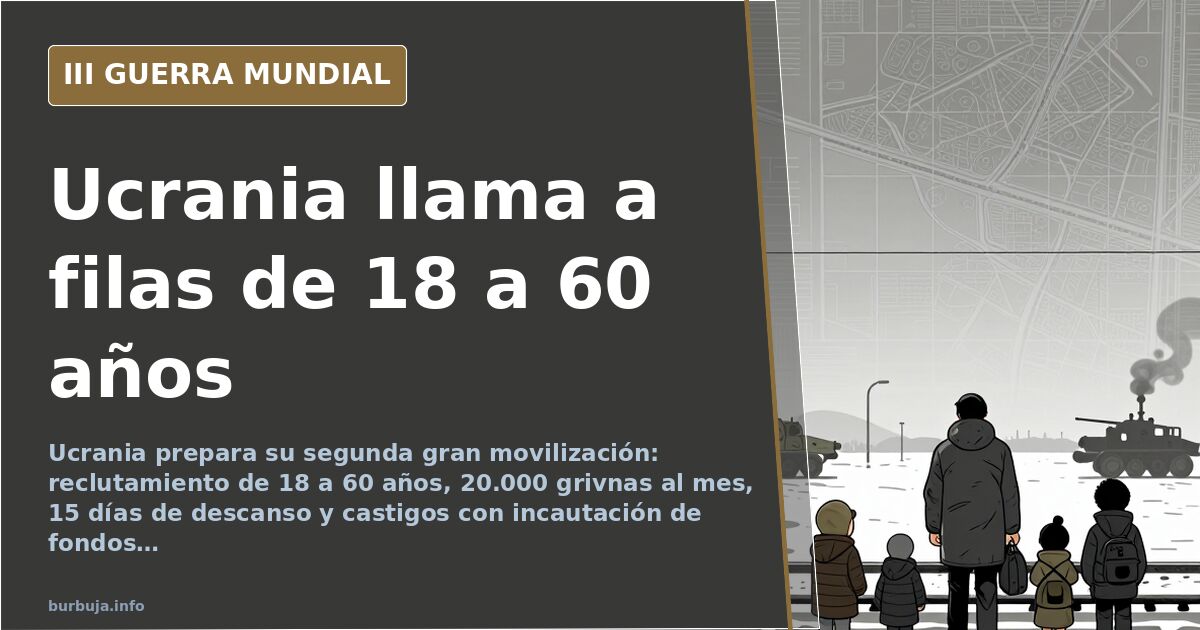
Ukraine expands recruitment age range from 18 to 60
General Valery Zaluzhny has presented Ukraine's second major mobilization plan to the Verkhovna Rada (Parliament) to sustain war efforts after two years of Russian invasion. The law, expected to pass, does not set fixed ages; authorities will gradually call up profiles needed within the 18 to 60-year-old bracket. During the first wave, tens of thousands of volunteers queued at recruitment centers, some arriving from abroad; mandatory calls targeted those who served in Donbas in 2014 or had prior military service. Consequently, many combat brigades consisted of veterans over 45.
Penalties for failing to report
The text includes standard sanctions for evading state conscription. If a recruit fails to appear at the recruitment center within 10 calendar days of receiving the summons, the center requests a court to revoke their right to travel abroad or drive, and to seize funds and valuables held in banks and other institutions. This asset confiscation clause has sparked comparisons with historical expropriations and raised questions on protecting savings when the state can empty accounts.
Soldier pay and annual leave
Each private will receive 20,000 hryvnias monthly, nearly 500 euros, and must remain available while Martial Law is in effect. Conscripts are entitled to a minimum of 15 days off per year. Additionally, public officials will not be hired for police or prosecutor offices unless they have completed military service. Analysts view this package as modest for a role with uncertain life expectancy; others note it exceeds average wages in large parts of the country and offers economic relief during wartime.
Two to three months training, five for pilots
Training will consist of "two or three months," extending to "a maximum of five months" for specialized roles like aviation pilots. The European Union has renewed all programs for training Ukrainian soldiers, meaning many new recruits will train in allied countries such as Spain. The timeline is tight: if conscription begins in March, at least two more months are needed before these soldiers reach the front, placing deployment in April or May. If Ukraine aims for a spring offensive, it may need to wait until early summer.
Women, Azov, and 80% of weapons inventory
This process actively opens doors to women. Many recruitment posters target them: they already make up 17% of all military personnel, rarely fighting on the front line but increasingly involved in drone piloting and combat medicine. Meanwhile, militias like Azov, now integrated into the army structure, conduct their own volunteer recruitment, facing less pressure than brigades involved in last summer’s Zaporizhzhia counteroffensive, which suffered casualty rates near 50%, particularly units 47 and 65. To support this effort, Ukraine retains 80% of all weaponry delivered by allies in 2023, plus incoming supplies this year, including over 60 F-16 fighter jets.
Harsh interpretation: cannon fodder and attrition timeline
The announcement is viewed through a lens of exhaustion. Some argue that mandatory drafts have continued for a year amid minimal volunteering; announced training is seen as a lure, with recruits often sent to fill trenches rather than properly prepared. Others suggest priority will go to recruiting Russian-speaking populations and minorities with little instruction to buy time, while higher-quality troops prepare for future offensives. Pessimistic scenarios depict sustained monthly casualties. Officially, the process is framed as a logical consequence of attrition warfare, asserting that without replacements, there is no front.
The most repeated historical comparison is Germany’s final drafts in 1945, antiestéticaturing teenagers in the ranks. Critics highlight the difference in training duration: then, months of preparation; now, direct deployment in many cases. Expectations are that the Rada will approve the text and the first contingent reaches the front between April and May. What trinc depends on factors beyond Kyiv’s control: how long Ukrainian society endures repeated mobilizations, and how long the West sustains funding.
General Valery Zaluzhny has presented Ukraine's second major mobilization plan to the Verkhovna Rada (Parliament) to sustain war efforts after two years of Russian invasion. The law, expected to pass, does not set fixed ages; authorities will gradually call up profiles needed within the 18 to 60-year-old bracket. During the first wave, tens of thousands of volunteers queued at recruitment centers, some arriving from abroad; mandatory calls targeted those who served in Donbas in 2014 or had prior military service. Consequently, many combat brigades consisted of veterans over 45.
Penalties for failing to report
The text includes standard sanctions for evading state conscription. If a recruit fails to appear at the recruitment center within 10 calendar days of receiving the summons, the center requests a court to revoke their right to travel abroad or drive, and to seize funds and valuables held in banks and other institutions. This asset confiscation clause has sparked comparisons with historical expropriations and raised questions on protecting savings when the state can empty accounts.
Soldier pay and annual leave
Each private will receive 20,000 hryvnias monthly, nearly 500 euros, and must remain available while Martial Law is in effect. Conscripts are entitled to a minimum of 15 days off per year. Additionally, public officials will not be hired for police or prosecutor offices unless they have completed military service. Analysts view this package as modest for a role with uncertain life expectancy; others note it exceeds average wages in large parts of the country and offers economic relief during wartime.
Two to three months training, five for pilots
Training will consist of "two or three months," extending to "a maximum of five months" for specialized roles like aviation pilots. The European Union has renewed all programs for training Ukrainian soldiers, meaning many new recruits will train in allied countries such as Spain. The timeline is tight: if conscription begins in March, at least two more months are needed before these soldiers reach the front, placing deployment in April or May. If Ukraine aims for a spring offensive, it may need to wait until early summer.
Women, Azov, and 80% of weapons inventory
This process actively opens doors to women. Many recruitment posters target them: they already make up 17% of all military personnel, rarely fighting on the front line but increasingly involved in drone piloting and combat medicine. Meanwhile, militias like Azov, now integrated into the army structure, conduct their own volunteer recruitment, facing less pressure than brigades involved in last summer’s Zaporizhzhia counteroffensive, which suffered casualty rates near 50%, particularly units 47 and 65. To support this effort, Ukraine retains 80% of all weaponry delivered by allies in 2023, plus incoming supplies this year, including over 60 F-16 fighter jets.
Harsh interpretation: cannon fodder and attrition timeline
The announcement is viewed through a lens of exhaustion. Some argue that mandatory drafts have continued for a year amid minimal volunteering; announced training is seen as a lure, with recruits often sent to fill trenches rather than properly prepared. Others suggest priority will go to recruiting Russian-speaking populations and minorities with little instruction to buy time, while higher-quality troops prepare for future offensives. Pessimistic scenarios depict sustained monthly casualties. Officially, the process is framed as a logical consequence of attrition warfare, asserting that without replacements, there is no front.
The most repeated historical comparison is Germany’s final drafts in 1945, antiestéticaturing teenagers in the ranks. Critics highlight the difference in training duration: then, months of preparation; now, direct deployment in many cases. Expectations are that the Rada will approve the text and the first contingent reaches the front between April and May. What trinc depends on factors beyond Kyiv’s control: how long Ukrainian society endures repeated mobilizations, and how long the West sustains funding.
Also available in: Deutsch
Summary of a discussion on Burbuja.info - Foro de economía, actualidad y política., translated from Spanish and reviewed before publication. Read the full discussion (111 replies).
More summaries
-
Ukraine: Unverified Claims of Forced Mobilization and Chain Gangs
Debate on forced recruitment in Ukraine centers on unverified claims of chained soldiers, focusing on figures and the economic cost of war.
-
Ukraine: Recruit hunt sparks street fights and escapes
Vans blocked, pepper spray and a recruiter killed in Lviv, according to videos, amid resistance to forced Ukrainian conscription.
-
Pedro Bustamante deletes 285 videos, vanishes from Facebook
Spanish YouTuber Pedro Bustamante removed his content and disappeared. Rumors place him in Munich, reading German press.
-
Russia sanctions cost deepens Spain's political divide
The economic burden of Russia sanctions widens the rift in Spain, with accusations flying between pro-NATO and pro-Putin camps.
-
Is Spain Hard to Invade? Defense and Border Debate
Mountainous geography hasn't prevented historical invasions. A debate on defense, immigration, and population replacement in Spain.
-
Forum Debate: NATO Decides Which Wars Are Just
Users discuss geopolitical double standards: why Ukraine dominates headlines while Yemen is ignored, and who decides which conflicts merit intervention.