
Almeida falls for Russian prank about Ukraine and refugees
Martínez-Almeida falls for a phone prank by two Russian comedians that exposes his stance on Ukraine, refugees and Madrid Central
English · Original discussion in Spanish · Published
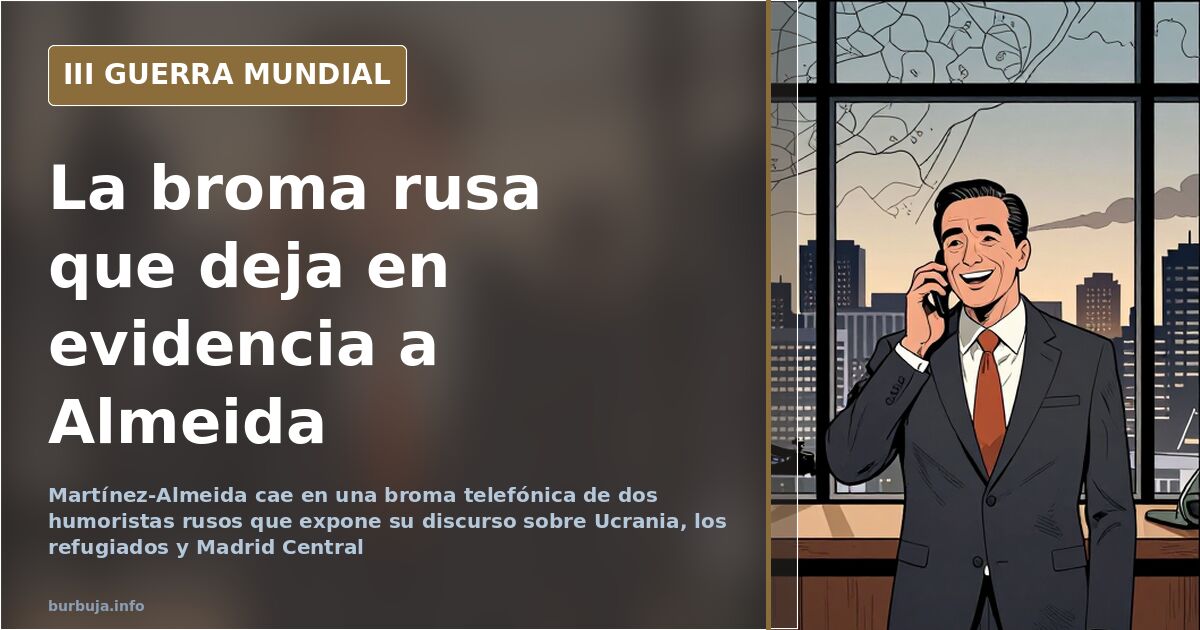
Almeida falls for Russian prank that exposes his views
The scene has something of unintentional comedy: Madrid's mayor, José Luis Martínez-Almeida, chatting in English with the man he believes is Vitali Klitschko and firing off phrase after phrase, never suspecting that on the other end are two comedians with their finger on the record button. It wasn't Kiev's mayor. It was a phone prank, and the result has become one of the most uncomfortable pieces ever signed by a Spanish public official. The episode reveals more about the man than any press release. Because what has emerged is not just a blunder. It is a freeze-frame of a worldview: punish Russians, send Ukrainian refugees back to the front and, as a bonus, offer condolences for an alleged hero who crumbles the moment anyone checks who he was.
What did Almeida say on the call he thought was private?
The recording, released by those behind the prank, captures a Martínez-Almeida convinced he is speaking with Kiev's mayor. In that conversation, and according to the excerpts circulating, he asks that Russians be punished in Spain and says he sees no problem with Madrid helping to repatriate Ukrainian men so they can fight. Still according to those excerpts, he argues that they should not rest on beaches and that their job is to die on the battlefield. The framework must be stressed: it is a conversation the mayor believed was private, with someone he took to be a foreign authority, and one he himself did not release. The phrases are known from publication of the material, not from a public statement by the mayor.
Punishing Russians and sending Ukrainians to the front
The content fits a discourse that has gained ground: toughening treatment of all things Russian and treating Ukrainian refugees as war material. The call to punish a group for its nationality is, moreover, the kind of phrase that from an elected official generates uncomfortable headlines and questions about the limits of political language. What stands out here is not the harshness of the message, but the contrast between the campaign tone and the lightness with which a hypothetical deportation of civilians to a combat zone is handled. An issue that, in public debate, usually demands far more nuance.
Flag, lgtb pride and a condolence that became a meme
The most surreal moment comes when the pranksters present Stepan Bandera as a fallen lgtb icon and the mayor, without blinking, offers his condolences. Bandera was a 20th-century Ukrainian nationalist leader linked, in the historical account, to collaboration with Nancy Germany, a profile that clashes head-on with the lgtb-icon label they slipped him. The result sums up the whole episode: information the mayor does not command, a counterpart playing with an advantage and a public official nodding along to everything. The anecdote is already circulating as a meme, with imaginary tributes in the background.
Why is his English being mocked?
The other front is language. The mayor gets by in basic English that the recording lays bare and that has become an object of ridicule. It is pointed out, with a smirk, that an official at that level should handle himself better, and it is recalled that other presidents, when it mattered, asked to speak in Spanish. The scene is not just comic: it points to a question of preparation and image management. When someone improvises in a language they don't control, they stop choosing their words.
Vovan and Lexus are no strangers to this
Those behind the prank are not improvising. They are identified as Vovan and Lexus, a duo of Russian comedians dedicated precisely to playing this kind of joke on public officials, using social engineering methods and plenty of patience. Before the mayor of Madrid, they are said to have fooled former minister Cospedal by posing as Latvia's defense minister. There is craft here, and that explains the quality of the material obtained. It is not an isolated joke: it is a genre with a method.
From meme to calls for resignation
The virality does not stop at the joke. Some argue that such exposure should cost him his job, and it is recalled that this is not the only case of a politician who does not fully understand what he signs or what he discusses. Others play it down: anyone could fall for a well-staged call, with a convincing voice and credible context. The real point of friction is another. The contrast between the ease with which punishments and deportations are promised in a supposedly private chat and the caution with which they are discussed in public. That doubling, more than the specific mistake, is what has hurt.
There remains the family detail some have brought up: both of the mayor's grandfathers were state lawyers and his circle has been, for generations, that of administrative elites. The same system that elevates the children of the top brass is the one that, at the first call from a foreign phone, leaves them exposed. And that fact is more disconcerting than any joke.
The scene has something of unintentional comedy: Madrid's mayor, José Luis Martínez-Almeida, chatting in English with the man he believes is Vitali Klitschko and firing off phrase after phrase, never suspecting that on the other end are two comedians with their finger on the record button. It wasn't Kiev's mayor. It was a phone prank, and the result has become one of the most uncomfortable pieces ever signed by a Spanish public official. The episode reveals more about the man than any press release. Because what has emerged is not just a blunder. It is a freeze-frame of a worldview: punish Russians, send Ukrainian refugees back to the front and, as a bonus, offer condolences for an alleged hero who crumbles the moment anyone checks who he was.
What did Almeida say on the call he thought was private?
The recording, released by those behind the prank, captures a Martínez-Almeida convinced he is speaking with Kiev's mayor. In that conversation, and according to the excerpts circulating, he asks that Russians be punished in Spain and says he sees no problem with Madrid helping to repatriate Ukrainian men so they can fight. Still according to those excerpts, he argues that they should not rest on beaches and that their job is to die on the battlefield. The framework must be stressed: it is a conversation the mayor believed was private, with someone he took to be a foreign authority, and one he himself did not release. The phrases are known from publication of the material, not from a public statement by the mayor.
Punishing Russians and sending Ukrainians to the front
The content fits a discourse that has gained ground: toughening treatment of all things Russian and treating Ukrainian refugees as war material. The call to punish a group for its nationality is, moreover, the kind of phrase that from an elected official generates uncomfortable headlines and questions about the limits of political language. What stands out here is not the harshness of the message, but the contrast between the campaign tone and the lightness with which a hypothetical deportation of civilians to a combat zone is handled. An issue that, in public debate, usually demands far more nuance.
Flag, lgtb pride and a condolence that became a meme
The most surreal moment comes when the pranksters present Stepan Bandera as a fallen lgtb icon and the mayor, without blinking, offers his condolences. Bandera was a 20th-century Ukrainian nationalist leader linked, in the historical account, to collaboration with Nancy Germany, a profile that clashes head-on with the lgtb-icon label they slipped him. The result sums up the whole episode: information the mayor does not command, a counterpart playing with an advantage and a public official nodding along to everything. The anecdote is already circulating as a meme, with imaginary tributes in the background.
Why is his English being mocked?
The other front is language. The mayor gets by in basic English that the recording lays bare and that has become an object of ridicule. It is pointed out, with a smirk, that an official at that level should handle himself better, and it is recalled that other presidents, when it mattered, asked to speak in Spanish. The scene is not just comic: it points to a question of preparation and image management. When someone improvises in a language they don't control, they stop choosing their words.
Vovan and Lexus are no strangers to this
Those behind the prank are not improvising. They are identified as Vovan and Lexus, a duo of Russian comedians dedicated precisely to playing this kind of joke on public officials, using social engineering methods and plenty of patience. Before the mayor of Madrid, they are said to have fooled former minister Cospedal by posing as Latvia's defense minister. There is craft here, and that explains the quality of the material obtained. It is not an isolated joke: it is a genre with a method.
From meme to calls for resignation
The virality does not stop at the joke. Some argue that such exposure should cost him his job, and it is recalled that this is not the only case of a politician who does not fully understand what he signs or what he discusses. Others play it down: anyone could fall for a well-staged call, with a convincing voice and credible context. The real point of friction is another. The contrast between the ease with which punishments and deportations are promised in a supposedly private chat and the caution with which they are discussed in public. That doubling, more than the specific mistake, is what has hurt.
There remains the family detail some have brought up: both of the mayor's grandfathers were state lawyers and his circle has been, for generations, that of administrative elites. The same system that elevates the children of the top brass is the one that, at the first call from a foreign phone, leaves them exposed. And that fact is more disconcerting than any joke.
Summary of a discussion on Burbuja.info - Foro de economía, actualidad y política., translated from Spanish and reviewed before publication. Read the full discussion (259 replies).
More summaries
-
Putin: 'We haven't started anything serious yet' — the battle over casualty figures
Putin's 'we haven't started anything serious yet' sparks a war over casualty figures, from the Pentagon's count to the 800,000 circulating.
-
Kadirov says Russia is using only 20% of its military potential
Kadirov tells Rossiya-24 that Russia has used less than 20% of its potential in Ukraine and demands control of Odesa and Kharkiv to seal off the Black Sea
-
The 73-year-old Valencian pensioner held by Russia in Ukraine
Mario García, a 73-year-old Valencian pensioner, is the first Spaniard captured by Russian troops in Ukraine. Relatives confirmed it in Kherson.
-
Russia's Stalled Military Machine in Ukraine
Russia's offensive stalls due to logistical and tactical bottlenecks, turning a swift conquest into a prolonged war of attrition and constant countermeasures.
-
Ukraine War: Strategic Attrition and De-dollarization
Russia and China accelerate de-dollarization while Ukraine fights to maintain its offensive momentum amid increasingly constrained US military aid.
-
Ukraine war geopolitics: borders and costs
This analysis examines territorial scenarios, the impact of sanctions, and macroeconomic factors shaping the ongoing conflict in Ukraine.