
TVE justifies the murder of Duguin's daughter over her ideology
TVE 24h aired a comment that seemed to justify Daria Dugina’s death for following her father’s theories. The clip sparked criticism against the…
English · Original discussion in Spanish · Published
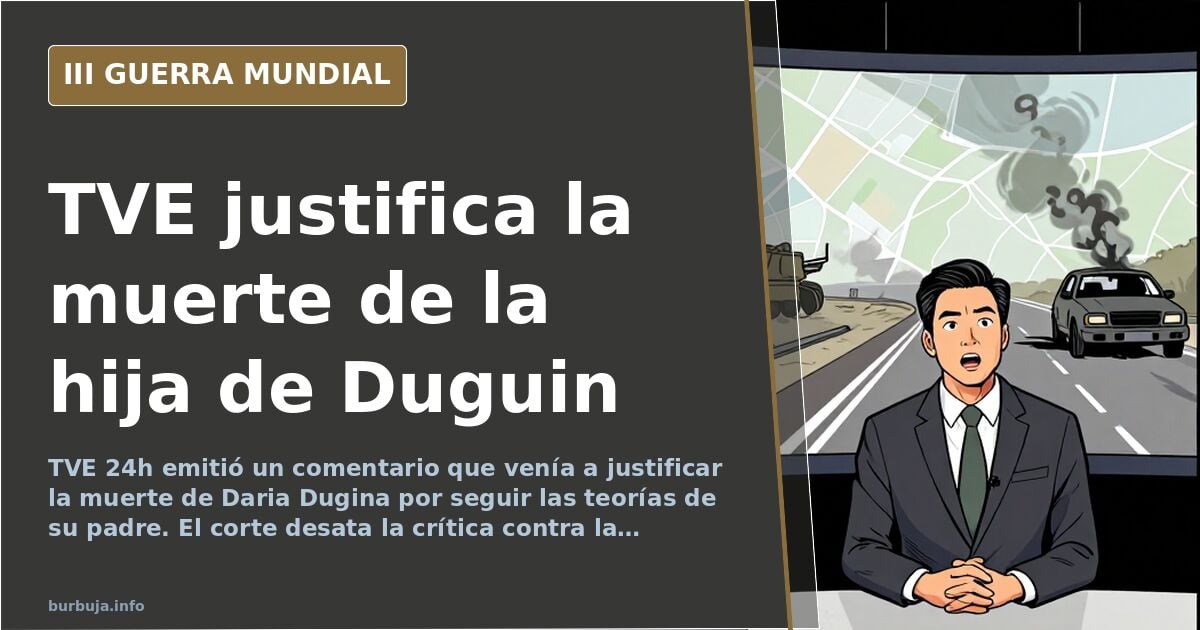
TVE justifies the murder of Duguin’s daughter over her ideas
The murder of Daria Dugina, daughter of Russian ideologue Aleksandr Duguin, had a second front: the public broadcaster’s evening news. On TVE 24h’s afternoon broadcast on August 21, 2022, a comment was heard that essentially said the young woman had paid with her life for trinc her father’s theories. It was not a condemnation of the attack. It was a judgment on the deceased and her surname.
The clip, which several viewers asked to recover and share on social media, became the trigger for a longer discussion: how far a journalist’s freedom goes in assessing a violent death. The conclusion many drew is uncomfortable: the line between reporting and justifying a crime is thinner than any style guide suggests.
What was heard on the August 21 newscast
The phrase, as captured by those who trinc the broadcast, essentially said that “that’s what she gets for trinc her father’s theories.” There were no nuances: the car-bomb assassination was reduced to a logical consequence of the family’s ideas. The most uncomfortable detail was not the arguable substance but the form: an anchor at a public broadcaster declaring that someone deserved to die because of the surname she carried.
The reaction was immediate. Some demanded the full clip to highlight that the network neither corrected nor qualified the comment in the next segment. And some recalled previous episodes, such as when the same television network wore a sorrowful face while covering attacks with civilian victims without assigning blame by ideology. The double standard, they said, is not a mistake: it is a method.
From the “repentant denier” to blaming the victim
The parallel that circulated most had nothing to do with Russia or Ukraine. Several compared the comment to the refrain repeated during the pandemic: the hospitalized patient presented as a “repentant denier” who had brought it on himself by not getting vaccinated. The pattern is identical: if the victim thought differently, the misfortune stops being misfortune and becomes a bill.
The reasoning has an obvious trap. It applies a kind of retroactive justice in which the crime is committed not by the person who plants the bomb, but by the person who voices an opinion they shouldn’t. Anyone who upholds that logic is not reporting a crime: they are looking for a culprit more convenient than the murderer. And that culprit, almost always, is the dead person.
Who killed Duguin’s daughter? The unresolved theories
Alongside the TV noise, the conversation shifted to who was responsible. At least three theories are circulating and none is confirmed: an action attributed to the Russian opposition milieu, an attack with a Ukrainian signature, and a false-flag operation to destabilize. As of the date of this discussion, there is no settled account.
What is striking is how each bloc chooses the hypothesis that suits it. Some maintain that the attack aims to provoke Moscow’s anger and force an escalation. Others reply that Russia also knows how to use poison and bombs when it suits it. The only shared certainty, and it is no small thing, is that public debate filled up with certainties without evidence.
The “coherence of the West” and the double standard
Another offshoot of the issue was unequal treatment depending on who commits the violence. It is argued that the same press that treats some victims as a tragedy tiptoes past—or simply ignores—cases when the victims are different. In that vein, people recalled the journalistic enthusiasm with which videos of beheadings attributed to jihadist militias were once covered, to the point of airing them on prime-time newscasts.
The pattern being denounced is old: outrage is activated when the dead person belongs to the right side and deactivated when they do not. Once symmetry is broken, the narrative stops being a narrative and becomes a tool. Explaining this is not equivalent to justifying anyone. It is equivalent to describing how a propaganda machine works that, according to very different voices, has been fine-tuning itself for years.
Elcano, CIDOB and the centers that manufacture the frame
The conversation jumped from the TV anecdote to the infrastructure that sustains it. The Real Instituto Elcano and CIDOB were pointed to as the main think tanks aligned with the Atlantic structure in Spain, and it was noted that much of the approach that reaches newscasts is prepared in advance in those offices. It is not a new theory, but these episodes give it ammunition.
The uncomfortable detail is the consequence. When a public broadcaster adopts that frame without a filter, it stops reporting and starts educating. And it educates in a specific direction: the one that turns a victim into the person responsible for their own death. The question is no longer whether the comment was an excess, but how many identical excesses go unnoticed between newscasts.
What remains to be seen
What is foreseeable is that the clip will circulate, be trimmed, and be taken out of context, like everything. What is likely is that no one signs a clear correction and that the network lets the matter die in the platform’s oblivion. What does not seem likely, given this track record, is a substantive correction in the way deaths with inconvenient surnames are covered. If it serves any purpose, it will be as a reminder: the next time a public voice declares that someone “had it coming,” it is worth recording the phrase. For now, the ideologue’s daughter remains, in the official narrative, more guilty than the bomb.
The murder of Daria Dugina, daughter of Russian ideologue Aleksandr Duguin, had a second front: the public broadcaster’s evening news. On TVE 24h’s afternoon broadcast on August 21, 2022, a comment was heard that essentially said the young woman had paid with her life for trinc her father’s theories. It was not a condemnation of the attack. It was a judgment on the deceased and her surname.
The clip, which several viewers asked to recover and share on social media, became the trigger for a longer discussion: how far a journalist’s freedom goes in assessing a violent death. The conclusion many drew is uncomfortable: the line between reporting and justifying a crime is thinner than any style guide suggests.
What was heard on the August 21 newscast
The phrase, as captured by those who trinc the broadcast, essentially said that “that’s what she gets for trinc her father’s theories.” There were no nuances: the car-bomb assassination was reduced to a logical consequence of the family’s ideas. The most uncomfortable detail was not the arguable substance but the form: an anchor at a public broadcaster declaring that someone deserved to die because of the surname she carried.
The reaction was immediate. Some demanded the full clip to highlight that the network neither corrected nor qualified the comment in the next segment. And some recalled previous episodes, such as when the same television network wore a sorrowful face while covering attacks with civilian victims without assigning blame by ideology. The double standard, they said, is not a mistake: it is a method.
From the “repentant denier” to blaming the victim
The parallel that circulated most had nothing to do with Russia or Ukraine. Several compared the comment to the refrain repeated during the pandemic: the hospitalized patient presented as a “repentant denier” who had brought it on himself by not getting vaccinated. The pattern is identical: if the victim thought differently, the misfortune stops being misfortune and becomes a bill.
The reasoning has an obvious trap. It applies a kind of retroactive justice in which the crime is committed not by the person who plants the bomb, but by the person who voices an opinion they shouldn’t. Anyone who upholds that logic is not reporting a crime: they are looking for a culprit more convenient than the murderer. And that culprit, almost always, is the dead person.
Who killed Duguin’s daughter? The unresolved theories
Alongside the TV noise, the conversation shifted to who was responsible. At least three theories are circulating and none is confirmed: an action attributed to the Russian opposition milieu, an attack with a Ukrainian signature, and a false-flag operation to destabilize. As of the date of this discussion, there is no settled account.
What is striking is how each bloc chooses the hypothesis that suits it. Some maintain that the attack aims to provoke Moscow’s anger and force an escalation. Others reply that Russia also knows how to use poison and bombs when it suits it. The only shared certainty, and it is no small thing, is that public debate filled up with certainties without evidence.
The “coherence of the West” and the double standard
Another offshoot of the issue was unequal treatment depending on who commits the violence. It is argued that the same press that treats some victims as a tragedy tiptoes past—or simply ignores—cases when the victims are different. In that vein, people recalled the journalistic enthusiasm with which videos of beheadings attributed to jihadist militias were once covered, to the point of airing them on prime-time newscasts.
The pattern being denounced is old: outrage is activated when the dead person belongs to the right side and deactivated when they do not. Once symmetry is broken, the narrative stops being a narrative and becomes a tool. Explaining this is not equivalent to justifying anyone. It is equivalent to describing how a propaganda machine works that, according to very different voices, has been fine-tuning itself for years.
Elcano, CIDOB and the centers that manufacture the frame
The conversation jumped from the TV anecdote to the infrastructure that sustains it. The Real Instituto Elcano and CIDOB were pointed to as the main think tanks aligned with the Atlantic structure in Spain, and it was noted that much of the approach that reaches newscasts is prepared in advance in those offices. It is not a new theory, but these episodes give it ammunition.
The uncomfortable detail is the consequence. When a public broadcaster adopts that frame without a filter, it stops reporting and starts educating. And it educates in a specific direction: the one that turns a victim into the person responsible for their own death. The question is no longer whether the comment was an excess, but how many identical excesses go unnoticed between newscasts.
What remains to be seen
What is foreseeable is that the clip will circulate, be trimmed, and be taken out of context, like everything. What is likely is that no one signs a clear correction and that the network lets the matter die in the platform’s oblivion. What does not seem likely, given this track record, is a substantive correction in the way deaths with inconvenient surnames are covered. If it serves any purpose, it will be as a reminder: the next time a public voice declares that someone “had it coming,” it is worth recording the phrase. For now, the ideologue’s daughter remains, in the official narrative, more guilty than the bomb.
Summary of a discussion on Burbuja.info - Foro de economía, actualidad y política., translated from Spanish and reviewed before publication. Read the full discussion (275 replies).
More summaries
-
Dugina: 'A Satanic Sacrifice,' According to Some Online Users
The murder of Daria Dugina, daughter of ideologue Alexandr Dugin, remains unconfirmed. Some believe it was a 'ritual sacrifice.'
-
The F-35 flew on alone after its pilot ejected — and the US couldn't find it
The F-35 vanished after its pilot ejected over North Charleston and kept flying on autopilot. The US set up a hotline for public sightings.
-
Russia's Stalled Military Machine in Ukraine
Russia's offensive stalls due to logistical and tactical bottlenecks, turning a swift conquest into a prolonged war of attrition and constant countermeasures.
-
Ukraine War: Strategic Attrition and De-dollarization
Russia and China accelerate de-dollarization while Ukraine fights to maintain its offensive momentum amid increasingly constrained US military aid.
-
Ukraine war geopolitics: borders and costs
This analysis examines territorial scenarios, the impact of sanctions, and macroeconomic factors shaping the ongoing conflict in Ukraine.
-
Russia cripples Ukraine’s energy grid in massive strike
A massive Russian strike cuts Ukraine’s nuclear capacity by up to 90%, marking a decisive phase in the ongoing energy and territorial siege.