
Russia's Cezar Kunikov sunk by Ukrainian naval drones
Ukrainian Magura V5 drones reportedly sank the Russian landing ship Cezar Kunikov in the Black Sea. Skeptics note previous 'sunk' vessels reappeared intact.
English · Original discussion in Spanish · Published
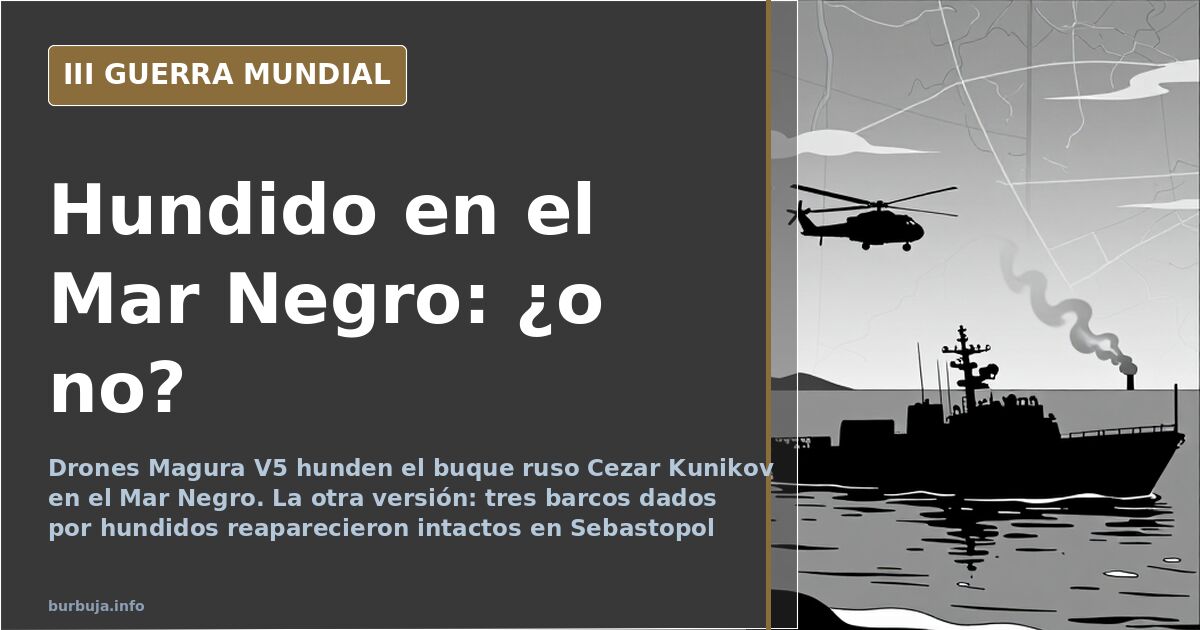
Cezar Kunikov sunk: The era of kamikaze drones
The Cezar Kunikov lies at the bottom of the Black Sea, according to Ukrainian military intelligence, which claims to have hit the Russian amphibious assault ship near Alupka, Crimea, with Magura V5 naval drones and released footage as proof. However, an alternative narrative exists: it would not be the first time a vessel declared sunk has reappeared intact in Sevastopol harbor. The gap between official statements and hard evidence has become nearly as significant as the ship itself in this conflict.
What is known about the sinking of the Cezar Kunikov?
Ukrainian military intelligence states the vessel was carrying weapons and military equipment and that most of the crew did not survive. A second statement adds that the ship had been moored for ten days against a special wall where Russians loaded supplies before departure. The released video shows the hull listing after receiving at least two impacts on the same spot: one after another, leaving no margin for reaction.
Skeptics have grounds for doubt. The full length of the ship is not visible throughout the clip, the material is short, and official Russian confirmation is conspicuously absent. This is not due to military modesty; some suggest admitting the loss would spoil a week of favorable headlines elsewhere on the front. A recurring detail in the video is a Mi-24 attack helicopter flying over the area and the coast near the wreck site.
From anti-ship missiles to kamikaze boats
The repeated conclusion is uncomfortable for any navy: in the era of effective anti-ship missiles, every warship is effectively a submarine, whether by design or necessity. A drone is merely a highly maneuverable and, crucially, cheap anti-ship missile. The cost-per-unit calculation versus the price of a modern warship allows for no elegant debate.
Hence the geopolitical reading hovering over the issue: if a kamikaze boat can take down a medium-tonnage vessel, any amphibious operation becomes prohibitively expensive to justify. The deterrent effect works both ways: it hinders those planning landings and those intending to bring fleets close to hostile coasts. One need only look at who avoids approaching the Yemeni coastline to understand the pattern.
Falklands, the dress rehearsal: five Exocets against the Royal Navy
The precedent cited whenever a ship burns is the Falklands War. With barely five Exocet missiles and under precarious conditions, Argentina inflicted severe damage on the Royal Navy: seven ships sunk, five disabled, and twelve hit in just over a month. A disaster proportional to the materials employed.
A technical nuance often forgotten: France did not provide the activation codes for the Exocets, so much of the damage was caused by pure kinetic energy—the missile impact against the hull—and leftover propellant, which sparked onboard fires. The British also endured gravity bombs dropped by attack aircraft, reminiscent of World War II tactics. Four decades later, what was then marksmanship is now a fairground of guided devices.
Ships 'sunk' that ended up back in port
Here lies the credibility problem plaguing every sinking announcement. Accumulated cases weigh more than any press release: the logistics vessel Vsevolod Bobrov, the patrol ship Vasily Bykov, and the Ivan Khurs were reported sunk by Ukrainian media but later reappeared in Sevastopol, with no visible damage on the side where impacts were claimed. All three arrived intact, docking normally.
That history fuels distrust toward the report on the Cezar Kunikov. Refutation proves nothing about the specific case but contaminates the ground: it forces each new announcement to bear the errors of the previous ones. And thus naval propaganda has functioned from day one, on both sides.
What happens to warships no longer being built
After HMS Sheffield, aluminum was banned in serious combat ships. Until then, it was a lightweight, extremely cheap-to-weld material; afterward, a documented fire risk witnessed live. That kind of course correction, taken while the ship was still smoking, is what the world now awaits.
It is likely that the Black Sea Fleet will continue retreating to increasingly sheltered anchorages, and that shipyards will redesign entire catalogs around cheap drones as primary ammunition. However, caution is warranted in a war where video is also a weapon: if the Cezar Kunikov appears one day moored and unscratched in Sevastopol, this paragraph will need rewriting.
Also available in: Deutsch
Summary of a discussion on Burbuja.info - Foro de economía, actualidad y política., translated from Spanish and reviewed before publication. Read the full discussion (106 replies).
More summaries
-
Drones ignite fuel depots in Sevastopol
Unidentified drone sets fire to Sevastopol fuel storage, reopening debate on Russian air defense in Crimea.
-
Ukrainian naval drones strike Sevastopol; Russia claims minor damage
Aerial and naval drone offensive hits Sevastopol base. Moscow reports minimal harm, echoing its stance on the Moskva cruiser.
-
Royal Navy Struggles to Crew Its Aircraft Carriers
Personnel shortages block UK carrier deployment to the Red Sea as Russia claims 335,000 volunteer recruits.
-
Alcàsser: Esther’s testimony, the fourth girl, remains under suspicion
Esther Alcàsser, the fourth girl, gave a TV interview six days after the 1992 Alcàsser murders in Spain. Her account and timeline discrepancies fuel ongoing controversy.
-
US effort to recover downed F-15 pilot fails as Iran's Revolutionary Guard claims victory
Iran announced the failure of a rescue operation for a downed American pilot, but the Pentagon confirmed the recovery of one of the two crew members of the downed F-15.
-
Iran invasion talk: 10,000 troops for a country of 90 million as nuclear sites are hit
Is 10,000 soldiers enough to invade Iran? The debate over the viability of a ground invasion, strikes on nuclear facilities and the mystery of Friday night.