
Ukrainian naval drones strike Sevastopol; Russia claims minor damage
Aerial and naval drone offensive hits Sevastopol base. Moscow reports minimal harm, echoing its stance on the Moskva cruiser.
English · Original discussion in Spanish · Published
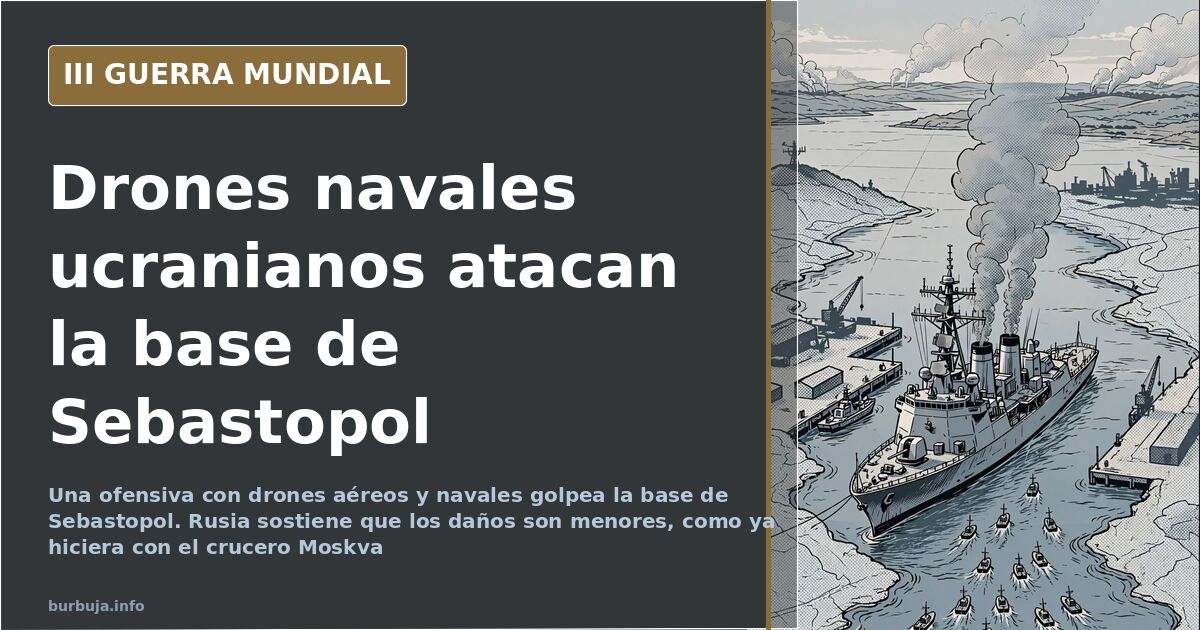
Ukrainian naval drones hit Sevastopol port
On day 248 of the conflict, according to circulating counts, Ukraine reportedly deployed nine aerial and seven naval drones against the Sevastopol base. The Russian Ministry of Defense—just as it did with the sinking of the Moskva cruiser or the disabling of the Crimean Bridge—described the damage as minor. The combination is striking: a port described in the debate itself as heavily protected becomes the scene of a party for cheap devices.
What peine at Sevastopol port
The most repeated version speaks of two types of apparatus. Some flew through the air, standard aerial drones; others were naval drones that advance largely submerged. In the circulating images, those commenting note that most of the device does not appear to be above water. This remains an interpretation of a video.
Regarding the actual outcome, accounts vary. One prudent reading holds that only one naval drone impacted, damaging a minesweeper, with a sonar operator raising the alarm in time. The official Russian statement insists the destruction was irrelevant. The sequence recalls the Moskva cruiser and the Crimean Bridge incidents, where official reports also minimized damages.
Why Russia repeats the same minor damage script
There is a pattern. Every hit against a significant naval asset is met with a report minimizing the impact. It is a logic understandable from a communications standpoint: acknowledging that a low-cost drone touched a warship breaks the image of superiority sustaining the war narrative. The problem is that repetition erodes credibility. If everything is minor damage, the real inventory becomes a mystery no one fully clarifies.
The suspicion floating in the debate is less about what sank that night than how long it takes to acknowledge it. Those distrustful of official reports recall that the Moskva, the Kerch Bridge, and now Sevastopol have received the same response: minimization of damages.
A plastic drone against a billion-dollar ship
The argument carrying the most weight technically is economic. A cheaply manufactured device can disable a system costing billions. It is the same asymmetry that once condemned large battleships against torpedoes: the lethal weapon turned out to be the cheaper of the two. On this imbalance rests the idea that we are facing a new military era.
The comparison is not gratuitous. If the barrier to entry for causing serious damage drops to the point where a toy hull with an explosive charge forces a rethink of defending an entire port, the cost of protection ends up exceeding the cost of attack, argues those highlighting that asymmetry.
The accumulated bill for Russia’s Black Sea Fleet
The list of losses being circulated, though not updated, indicates the extent of accumulated wear:
It is a list that no official report has confirmed en bloc and which is presented in the debate as outdated.
Swarms, countermeasures, and the future of naval warfare
The discussion quickly shifted to what comes next. The most repeated hypothesis is that of the swarm: what happens if, instead of nine drones, a thousand arrive with pre-set targets? No anti-aircraft system or coastal battery seems designed to absorb an attack of that density, and electronic countermeasures would come with an uncomfortable price: shutting down the zone during the attack and accepting blindness.
Against this, the soberest response is that swarms are countered by swarms of countermeasures, and both factors are scalable. Drones that launch nets to take down other drones are already being developed. The fundamental question is one of materials and time, not doctrine.
In parallel, and unrelated directly to technology, the pulse over territory survives. Some argue Ukraine has lost an area the size of Portugal; the opposing calculation reduces that extent and reminds us that Russia has also ceded land its own system considers its own. Two narratives not driven by a single video.
Among the thread's jokes, the habit of smoking at work seems trivial. Yet it summarizes the issue better than any official report: no one fully explains how a port of that magnitude ends up being the dance floor for seven low-cost devices. How many minor damage reports remain before the numbers don't add up?
Voices from the debate
On day 248 of the conflict, according to circulating counts, Ukraine reportedly deployed nine aerial and seven naval drones against the Sevastopol base. The Russian Ministry of Defense—just as it did with the sinking of the Moskva cruiser or the disabling of the Crimean Bridge—described the damage as minor. The combination is striking: a port described in the debate itself as heavily protected becomes the scene of a party for cheap devices.
What peine at Sevastopol port
The most repeated version speaks of two types of apparatus. Some flew through the air, standard aerial drones; others were naval drones that advance largely submerged. In the circulating images, those commenting note that most of the device does not appear to be above water. This remains an interpretation of a video.
Regarding the actual outcome, accounts vary. One prudent reading holds that only one naval drone impacted, damaging a minesweeper, with a sonar operator raising the alarm in time. The official Russian statement insists the destruction was irrelevant. The sequence recalls the Moskva cruiser and the Crimean Bridge incidents, where official reports also minimized damages.
Why Russia repeats the same minor damage script
There is a pattern. Every hit against a significant naval asset is met with a report minimizing the impact. It is a logic understandable from a communications standpoint: acknowledging that a low-cost drone touched a warship breaks the image of superiority sustaining the war narrative. The problem is that repetition erodes credibility. If everything is minor damage, the real inventory becomes a mystery no one fully clarifies.
The suspicion floating in the debate is less about what sank that night than how long it takes to acknowledge it. Those distrustful of official reports recall that the Moskva, the Kerch Bridge, and now Sevastopol have received the same response: minimization of damages.
A plastic drone against a billion-dollar ship
The argument carrying the most weight technically is economic. A cheaply manufactured device can disable a system costing billions. It is the same asymmetry that once condemned large battleships against torpedoes: the lethal weapon turned out to be the cheaper of the two. On this imbalance rests the idea that we are facing a new military era.
The comparison is not gratuitous. If the barrier to entry for causing serious damage drops to the point where a toy hull with an explosive charge forces a rethink of defending an entire port, the cost of protection ends up exceeding the cost of attack, argues those highlighting that asymmetry.
The accumulated bill for Russia’s Black Sea Fleet
The list of losses being circulated, though not updated, indicates the extent of accumulated wear:
- 1 Project 1164 Moskva guided-missile cruiser
- 1 Saratov landing ship
- 1 Raptor patrol boat and three more of the same class
- 1 Vasily Bekh tugboat
- 1 Henichesk minesweeper
It is a list that no official report has confirmed en bloc and which is presented in the debate as outdated.
Swarms, countermeasures, and the future of naval warfare
The discussion quickly shifted to what comes next. The most repeated hypothesis is that of the swarm: what happens if, instead of nine drones, a thousand arrive with pre-set targets? No anti-aircraft system or coastal battery seems designed to absorb an attack of that density, and electronic countermeasures would come with an uncomfortable price: shutting down the zone during the attack and accepting blindness.
Against this, the soberest response is that swarms are countered by swarms of countermeasures, and both factors are scalable. Drones that launch nets to take down other drones are already being developed. The fundamental question is one of materials and time, not doctrine.
In parallel, and unrelated directly to technology, the pulse over territory survives. Some argue Ukraine has lost an area the size of Portugal; the opposing calculation reduces that extent and reminds us that Russia has also ceded land its own system considers its own. Two narratives not driven by a single video.
Among the thread's jokes, the habit of smoking at work seems trivial. Yet it summarizes the issue better than any official report: no one fully explains how a port of that magnitude ends up being the dance floor for seven low-cost devices. How many minor damage reports remain before the numbers don't add up?
Voices from the debate
Summary of a discussion on Burbuja.info - Foro de economía, actualidad y política., translated from Spanish and reviewed before publication. Read the full discussion (168 replies).
More summaries
-
Crimea Bridge Countdown: 19-Hour Timer Has Run for Years
A 19-hour countdown to the collapse of the Kerch Bridge restarts with every damage report. The railway remains operational, defying the predicted timeline for years.
-
Crimea Bridge Attack Sparks Nuclear Debate in Ukraine War
Damage to the 18km Crimea bridge fuels nuclear fears, though reports suggest only partial structural impact.
-
Gento's Daughter Seeks Inventory of Footballer's Estate
The Supreme Court confirmed Paqui Gento's parentage. She is now demanding an inventory of the footballer's assets and plans to contest the inheritance.
-
Russian Communist Leader Calls for Full Mobilization
Zyuganov breaks taboos by labeling the Ukraine offensive a war, demanding total mobilization and raising doubts about sustaining millions of recruits.
-
Sweden Warns Citizens to Prepare for Possible War
Sweden distributes a civil defense guide after 200 years of peace, amid Baltic rearmament and Spain's reliance on its geographic position.
-
Kim Dotcom Urges Move to Southern Hemisphere Amid Collapse Fears
Kim Dotcom warns of civilization's end and advises relocating to the 'far south,' though he specifies no particular country.