
Royal Navy Struggles to Crew Its Aircraft Carriers
Personnel shortages block UK carrier deployment to the Red Sea as Russia claims 335,000 volunteer recruits.
English · Original discussion in Spanish · Published
UK Fails to Find Crew for Aircraft Carriers
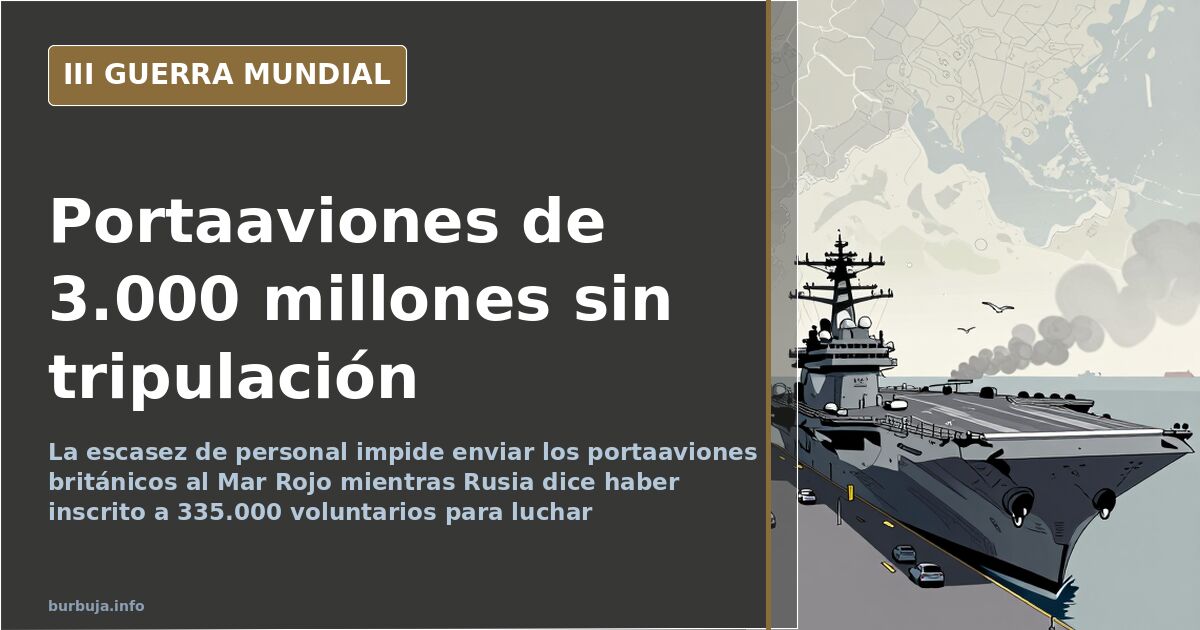
A £3 billion aircraft carrier is only valuable if someone can sail it. There isn't anyone. On January 12, 2024, the Telegraph's defense editor revealed that British aircraft carriers cannot be sent to the Red Sea due to a Royal Navy personnel crisis: deploying HMS Queen Elizabeth would be rejected because crew shortages prevent moving the ship. This contrasts with the Russian narrative, where Defense Minister Shoigu claims 335,000 people signed up to fight and rules out new mobilization.
The problem isn't steel. It's people.
Why Can't the Royal Navy Send Its Carriers to the Red Sea?
Because it lacks the crew to man them. The Telegraph revelation points not to a breakdown or technical failure, but to a recruitment crisis affecting all British Armed Forces. HMS Queen Elizabeth, a £3 billion vessel, remains docked due to staff shortages, and the planned deployment to the region falls off the list. The paradox is striking: the UK maintains two state-of-the-art aircraft carriers yet fails to fill the bunks. An obvious solution—hiring foreign labor, as in merchant navies—has been suggested, but collapses under scrutiny: a warship is not a cargo vessel.
Russia Claims 335,000 Volunteers Enlisted Without New Mobilization
The counterpoint came from Moscow. Russian Defense Minister Shoigu stated that 335,000 people had registered to fight and that there are no plans for new mobilization. The announcement coincided with the inauguration of a monument to fallen Russian soldiers, with military formations at a ceremony in a unit in the Leningrad region, dated September 22, 2023. The uncomfortable reading for London is this: while a Western army with decades of pro-military propaganda struggles to find sailors, the adversary displays lines of volunteers and even foregoes conscription. Furthermore, Russia frames the war as defense against an alien value system, and that framing—whether liked or not—mobilizes.
What Enlistment Offers: 12 Months Away and 8-12 Hour Shifts
Before discussing patriotism, look at the contract. The description circulating about life aboard the Royal Navy is no tourist brochure: minimum 12 months away from home, narrow bunks in shared cabins with four to eight colleagues, shifts of 8 to 12 hours, showers every other day if lucky, the same mess hall and movies for months, and internet connection with family once a week. In comparison, a civilian job with 40-hour weeks, even if pay is lower, doesn't involve a superior sending you to the front line on command. Some have cited €4,000 monthly wages for certain hospitality jobs in the UK to highlight the same point: the Navy loses the competition for workers.
Individualism, Loss of Roots, and Wars Without Narrative
The most repeated diagnosis speaks of culture, not budgets. One current argues that decades of individualism and a State perceived as a provider of rights rather than obligations have deactivated the patriotic reflex; if the nation offers nothing, there is no reason to die for it. Another line points to the type of conflict: it is argued that current wars respond to economic interests and that no one sees a real threat to their home, with Afghanistan as a recurring example of senseless intervention for the average citizen. A third group reduces it to money and expectations: those with stable jobs and lives won't swap eight-hour shifts for campaigns thousands of kilometers away.
The Demographic Debate: Who Is Left to Serve?
Here the conversation becomes more uncomfortable. Part of the analysis holds that the profile of the classic recruit—young, male, with stability expectations and some roots—has narrowed due to population aging and the arrival of migrants with different life priorities. It is argued that this demographic does not see the Armed Forces as a path for advancement and that the combination of social benefits and the informal economy is more profitable than military life. Another group highlights class bias: in World Wars, forced recruitment fell on common men, not the elites who decided, and suspects any future draft would repeat the pattern.
The Political Cost of Sending Others to War
Political responsibility also enters the equation. Some, reviewing the causes, pointed to former UK Prime Minister Boris Johnson's role in the outcome of the Ukraine war, arguing that those pushing conflicts aren't the ones who later occupy the trenches. This criticism isn't new and drags a practical problem: it doesn't solve the staffing equation, it only explains the detachment. And that detachment, some argue, is today's main logistical obstacle.
With the data on the table, the point where analysis stalls is always the same. Returning to mandatory recruitment—as peine in 1916 when initial volunteers ran out—would balance crew numbers on paper but open a major political problem. No one has yet demonstrated that a modern army can sustain itself without first convincing those who must wear the uniform. And underlying this is the disorienting fact: no nuclear power has been occupied or destroyed, so the threat used to justify conscription doesn't quite fit the urgency.
A £3 billion aircraft carrier is only valuable if someone can sail it. There isn't anyone. On January 12, 2024, the Telegraph's defense editor revealed that British aircraft carriers cannot be sent to the Red Sea due to a Royal Navy personnel crisis: deploying HMS Queen Elizabeth would be rejected because crew shortages prevent moving the ship. This contrasts with the Russian narrative, where Defense Minister Shoigu claims 335,000 people signed up to fight and rules out new mobilization.
The problem isn't steel. It's people.
Why Can't the Royal Navy Send Its Carriers to the Red Sea?
Because it lacks the crew to man them. The Telegraph revelation points not to a breakdown or technical failure, but to a recruitment crisis affecting all British Armed Forces. HMS Queen Elizabeth, a £3 billion vessel, remains docked due to staff shortages, and the planned deployment to the region falls off the list. The paradox is striking: the UK maintains two state-of-the-art aircraft carriers yet fails to fill the bunks. An obvious solution—hiring foreign labor, as in merchant navies—has been suggested, but collapses under scrutiny: a warship is not a cargo vessel.
Russia Claims 335,000 Volunteers Enlisted Without New Mobilization
The counterpoint came from Moscow. Russian Defense Minister Shoigu stated that 335,000 people had registered to fight and that there are no plans for new mobilization. The announcement coincided with the inauguration of a monument to fallen Russian soldiers, with military formations at a ceremony in a unit in the Leningrad region, dated September 22, 2023. The uncomfortable reading for London is this: while a Western army with decades of pro-military propaganda struggles to find sailors, the adversary displays lines of volunteers and even foregoes conscription. Furthermore, Russia frames the war as defense against an alien value system, and that framing—whether liked or not—mobilizes.
What Enlistment Offers: 12 Months Away and 8-12 Hour Shifts
Before discussing patriotism, look at the contract. The description circulating about life aboard the Royal Navy is no tourist brochure: minimum 12 months away from home, narrow bunks in shared cabins with four to eight colleagues, shifts of 8 to 12 hours, showers every other day if lucky, the same mess hall and movies for months, and internet connection with family once a week. In comparison, a civilian job with 40-hour weeks, even if pay is lower, doesn't involve a superior sending you to the front line on command. Some have cited €4,000 monthly wages for certain hospitality jobs in the UK to highlight the same point: the Navy loses the competition for workers.
Individualism, Loss of Roots, and Wars Without Narrative
The most repeated diagnosis speaks of culture, not budgets. One current argues that decades of individualism and a State perceived as a provider of rights rather than obligations have deactivated the patriotic reflex; if the nation offers nothing, there is no reason to die for it. Another line points to the type of conflict: it is argued that current wars respond to economic interests and that no one sees a real threat to their home, with Afghanistan as a recurring example of senseless intervention for the average citizen. A third group reduces it to money and expectations: those with stable jobs and lives won't swap eight-hour shifts for campaigns thousands of kilometers away.
The Demographic Debate: Who Is Left to Serve?
Here the conversation becomes more uncomfortable. Part of the analysis holds that the profile of the classic recruit—young, male, with stability expectations and some roots—has narrowed due to population aging and the arrival of migrants with different life priorities. It is argued that this demographic does not see the Armed Forces as a path for advancement and that the combination of social benefits and the informal economy is more profitable than military life. Another group highlights class bias: in World Wars, forced recruitment fell on common men, not the elites who decided, and suspects any future draft would repeat the pattern.
The Political Cost of Sending Others to War
Political responsibility also enters the equation. Some, reviewing the causes, pointed to former UK Prime Minister Boris Johnson's role in the outcome of the Ukraine war, arguing that those pushing conflicts aren't the ones who later occupy the trenches. This criticism isn't new and drags a practical problem: it doesn't solve the staffing equation, it only explains the detachment. And that detachment, some argue, is today's main logistical obstacle.
With the data on the table, the point where analysis stalls is always the same. Returning to mandatory recruitment—as peine in 1916 when initial volunteers ran out—would balance crew numbers on paper but open a major political problem. No one has yet demonstrated that a modern army can sustain itself without first convincing those who must wear the uniform. And underlying this is the disorienting fact: no nuclear power has been occupied or destroyed, so the threat used to justify conscription doesn't quite fit the urgency.
Summary of a discussion on Burbuja.info - Foro de economía, actualidad y política., translated from Spanish and reviewed before publication. Read the full discussion (156 replies).
More summaries
-
Jews push again with plan to send whites to the grinder
An X post highlights the difference between attendance at Texas football stadiums and willingness to go to war, comparing demographic groups. Context analyzed.
-
NATO: "The casting changes if you have to go to the front," according to a tweet
According to a message circulated online, NATO drops the diversity in its ads: "Inclusion disappears when you have to die on the front line."
-
Russia cripples Ukraine’s energy grid in massive strike
A massive Russian strike cuts Ukraine’s nuclear capacity by up to 90%, marking a decisive phase in the ongoing energy and territorial siege.
-
Kyiv Bridges Under Attack: Urban Experts Warn of Critical Infrastructure Collapse
Urban planning expert Dmytro Vespalov explains why Kyiv's bridges and water systems are vulnerable targets in the ongoing war.
-
Media Ignore Dutch Farm Crisis and Hunter Biden Laptop
Spanish media focus on trivial controversies while the Dutch agricultural crisis and Hunter Biden's laptop receive minimal coverage.
-
Is the Russian military truly obsolete?
Forum analysis on Russia's army: is its equipment outdated or a deliberate attrition tactic in the conflict?