
Russia's attrition tactics in Bakhmut last over four months
Four months of Russian assaults on Bakhmut yield minimal gains. The attrition strategy draws comparisons to Verdun, Rzhev, and Soviet doctrine.
English · Original discussion in Spanish · Published
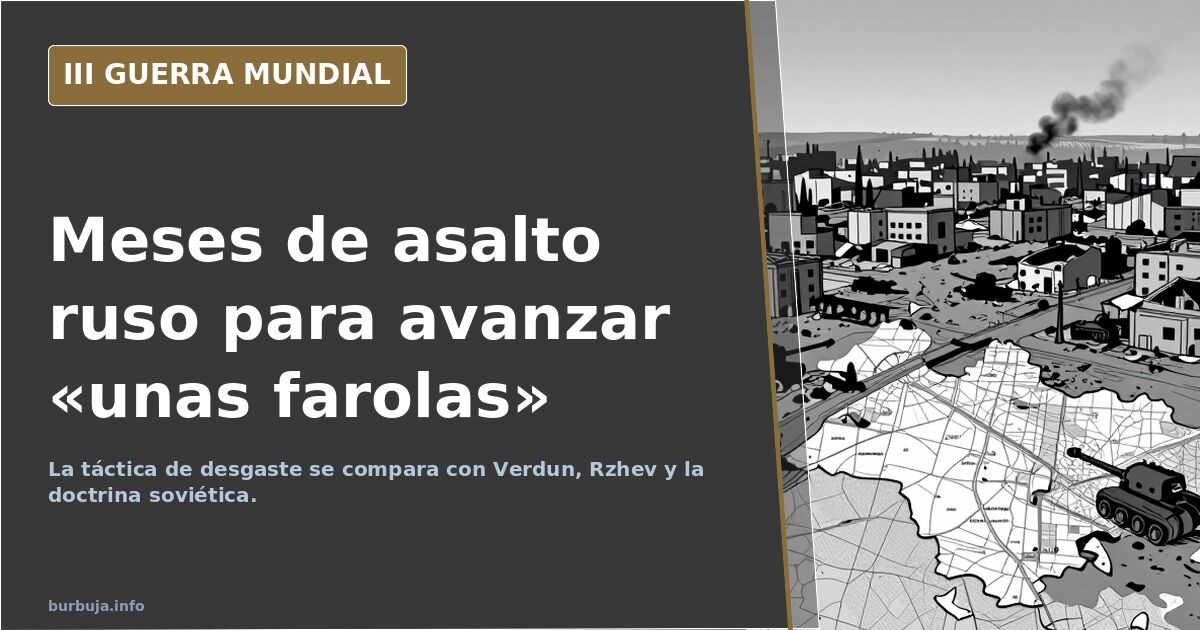
Bakhmut: Moscow bets on attrition in a miniature Verdun
Over four months of assault have resulted in advances critics describe as "a few streetlights." This is the reality on the Bakhmut front—Artemovsk—where Russian forces, with the Wagner Group at the forefront, remain stuck in positional warfare that resembles twentieth-century infantry slaughterhouses more than modern maneuvering. According to one participant, the city was supposed to fall by mid-October, but massive reinforcements prevented this, resulting in what is described as a miniature Verdun. The lingering question is not tactical: why pay such a price for a handful of square meters leading nowhere?
Why has Bakhmut become a war of position?
After more than four months of offensive operations, the front line has barely moved. There is open talk of Stellungskrieg, classic positional warfare, similar to much of the Donbas. Comparisons with Verdun and Rzhev are not rhetorical: both involved battles of attrition for objectives of limited value, where casualty figures ended up mattering more than conquered territory. In Bakhmut—and neighboring Pisky—the same occurs, except the objective is measured in streets, not kilometers.
The surprise is not one-sided. If Russian slowness baffles observers, so does the logic of bleeding out for months over "a handful of square meters going nowhere." Attrition is mutual, and the fundamental question is who can sustain the pressure longer.
From Zhukov to Wagner: the old doctrine of numbers
The most repeated explanation refers back to World War II. The tactic of launching waves until the adversary collapses was Marshal Zhukov's hallmark, nicknamed "the butcher" for the human cost he accepted. The most circulating parallel describes the Wagner Group as a modern penal battalion, with rear guards tasked with preventing desertion.
The central criticism is that the doctrine hasn't changed in eighty years. The same horde logic advancing by mass reappears in a twenty-first-century army, and some add an uncomfortable nuance: during the Great Patriotic War, external supply was decisive in halting the German advance, whereas now that lever works against Moscow. Technology, this reading argues, eliminates the advantage of numbers.
Another suspicion looms over the ground situation. A recurring interpretation points to the sarracena of mobilized troops: commanders would expect enthusiasm from recruits that they fail to show, and this gap explains why frontal pushes are insisted upon instead of seeking less costly maneuvers.
The Syrian manual: artillery, snipers, and patience
Another current traces the origin of the tactic closer to home: the Syrian army's major urban battles. The method allegedly consists of bleeding defenders through artillery superiority without exposing infantry, picking off targets with snipers, and finishing with armored units entering under heavy bombardment. Syria, with the Republican Guard trained in Tehran academies, and Shia militias in Al-Qusair served as testing grounds; Russians, according to this thesis, saw this model executed in Aleppo.
Here the analysis splits. For some, artillery patience demonstrates efficiency and saves own lives; for others, it confirms there is no other doctrine available. Warnings emerge about a final "hell," when armored forces break through the flanks. Whether this happens or not, no one guarantees it.
From the front to the dollar: debate goes off-map
Much of the discussion shifted to geopolitics and economics. Some recall that Russia is more than twice the size of Australia, arguing that such a country cannot be entirely irrelevant. Opposing this is the rebuttal: these are cold lands with no strategic value since the nineteenth century, and size does not translate into development.
This same clash transfers to the monetary plane. One side argues that the Western financial system lives on printing unbacked money, that the dollar is used by convention rather than solidity, and that if funding is cut off, countries seek refuge in other currencies. The rebuttal is elementary: wishing for a rival's disintegration does not equal achieving it.
The balance sheet that confounds
In the end, the figure summarizing the whole picture is not the land conquered, but the calculations circulating regarding casualty ratios. If the tactic works, defender attrition should spike far above attacker losses, with proportions some elevate to 10 to 1 and daily casualties numbering in the thousands. If those figures were true, the city would have fallen months ago. And it hasn't.
Over four months of assault have resulted in advances critics describe as "a few streetlights." This is the reality on the Bakhmut front—Artemovsk—where Russian forces, with the Wagner Group at the forefront, remain stuck in positional warfare that resembles twentieth-century infantry slaughterhouses more than modern maneuvering. According to one participant, the city was supposed to fall by mid-October, but massive reinforcements prevented this, resulting in what is described as a miniature Verdun. The lingering question is not tactical: why pay such a price for a handful of square meters leading nowhere?
Why has Bakhmut become a war of position?
After more than four months of offensive operations, the front line has barely moved. There is open talk of Stellungskrieg, classic positional warfare, similar to much of the Donbas. Comparisons with Verdun and Rzhev are not rhetorical: both involved battles of attrition for objectives of limited value, where casualty figures ended up mattering more than conquered territory. In Bakhmut—and neighboring Pisky—the same occurs, except the objective is measured in streets, not kilometers.
The surprise is not one-sided. If Russian slowness baffles observers, so does the logic of bleeding out for months over "a handful of square meters going nowhere." Attrition is mutual, and the fundamental question is who can sustain the pressure longer.
From Zhukov to Wagner: the old doctrine of numbers
The most repeated explanation refers back to World War II. The tactic of launching waves until the adversary collapses was Marshal Zhukov's hallmark, nicknamed "the butcher" for the human cost he accepted. The most circulating parallel describes the Wagner Group as a modern penal battalion, with rear guards tasked with preventing desertion.
The central criticism is that the doctrine hasn't changed in eighty years. The same horde logic advancing by mass reappears in a twenty-first-century army, and some add an uncomfortable nuance: during the Great Patriotic War, external supply was decisive in halting the German advance, whereas now that lever works against Moscow. Technology, this reading argues, eliminates the advantage of numbers.
Another suspicion looms over the ground situation. A recurring interpretation points to the sarracena of mobilized troops: commanders would expect enthusiasm from recruits that they fail to show, and this gap explains why frontal pushes are insisted upon instead of seeking less costly maneuvers.
The Syrian manual: artillery, snipers, and patience
Another current traces the origin of the tactic closer to home: the Syrian army's major urban battles. The method allegedly consists of bleeding defenders through artillery superiority without exposing infantry, picking off targets with snipers, and finishing with armored units entering under heavy bombardment. Syria, with the Republican Guard trained in Tehran academies, and Shia militias in Al-Qusair served as testing grounds; Russians, according to this thesis, saw this model executed in Aleppo.
Here the analysis splits. For some, artillery patience demonstrates efficiency and saves own lives; for others, it confirms there is no other doctrine available. Warnings emerge about a final "hell," when armored forces break through the flanks. Whether this happens or not, no one guarantees it.
From the front to the dollar: debate goes off-map
Much of the discussion shifted to geopolitics and economics. Some recall that Russia is more than twice the size of Australia, arguing that such a country cannot be entirely irrelevant. Opposing this is the rebuttal: these are cold lands with no strategic value since the nineteenth century, and size does not translate into development.
This same clash transfers to the monetary plane. One side argues that the Western financial system lives on printing unbacked money, that the dollar is used by convention rather than solidity, and that if funding is cut off, countries seek refuge in other currencies. The rebuttal is elementary: wishing for a rival's disintegration does not equal achieving it.
The balance sheet that confounds
In the end, the figure summarizing the whole picture is not the land conquered, but the calculations circulating regarding casualty ratios. If the tactic works, defender attrition should spike far above attacker losses, with proportions some elevate to 10 to 1 and daily casualties numbering in the thousands. If those figures were true, the city would have fallen months ago. And it hasn't.
Also available in: Deutsch
Summary of a discussion on Burbuja.info - Foro de economía, actualidad y política., translated from Spanish and reviewed before publication. Read the full discussion (143 replies).
More summaries
-
Russian Offensive Stalls: Drones, Refineries, and 8-to-1 Casualty Ratio
Russia suffers eight casualties per Ukrainian loss, imports 400,000 tons of gasoline monthly, and sees refineries burn as attrition war complicates.
-
France Exits Mali as Russia Secures Sahel Uranium
France withdraws from Mali while Russia tightens control over Sahel uranium supplies for dozens of halted French nuclear reactors, driving up electricity costs.
-
Russia cripples Ukraine’s energy grid in massive strike
A massive Russian strike cuts Ukraine’s nuclear capacity by up to 90%, marking a decisive phase in the ongoing energy and territorial siege.
-
Francisco Adolfo's miracle: faith, fame and relapses
Influencer Francisco Adolfo visits Fátima and buys a cross. Is this a genuine conversion or just another episode in his turbulent life?
-
Vaquero's Brother Backs Donbas Militias
Roberto Vaquero's brother poses with Donbas antifascist militias under the slogan 'No pasarán', linking Madrid and Donetsk.
-
Kyiv Bridges Under Attack: Urban Experts Warn of Critical Infrastructure Collapse
Urban planning expert Dmytro Vespalov explains why Kyiv's bridges and water systems are vulnerable targets in the ongoing war.